Living folio · Guilds
Saint Guild
The Saint Guild is not merely a religion. It is not merely a guild either. It is the oldest continuous institution in Versa that has never needed to reinvent itself, because the thing it offers has never stopped being necessary. It controls the only healing magic in the world, maintains the only institution...
Overview
The Saint Guild is not merely a religion.
It is not merely a guild either.
It is the oldest continuous institution in Versa that has never needed to reinvent itself, because the thing it offers has never stopped being necessary. It controls the only healing magic in the world, maintains the only institution capable of training those who wield it, and wraps all of that inside a faith so genuinely held by so many people that separating the spiritual from the political has become, over centuries, essentially impossible.
The Saint Guild is a church, a hospital, a production facility, a political power, and a business. It presents all of these faces simultaneously and sees no contradiction in doing so. The First Saint healed the world. The Guild exists to continue that work. That the work also requires property, revenue, influence, and strategic relationships with the other three powers of the Grand Council is simply the reality of operating in a city built around a dungeon rather than a paradise.
They are comfortable with that reality. They have been for a very long time.
Origins and founding belief
In the beginning, according to the faith, there was suffering.
The Tower opened, or had always been open, and the world discovered what lived inside it. People died in numbers that the earliest records describe with a bluntness that feels almost modern: too many, too fast, and with no answer. The healers of the time used herbs, pressure, rest, and prayer. The herbs helped sometimes. The rest of it helped less.
Then the Hand God intervened.
Not in fire and thunder. Not with armies or miracles that reshaped the landscape. In the quiet of a single encounter, the Hand God appeared to the First Saint—a figure whose name is preserved in the liturgical record but whose life before that moment is almost entirely undocumented—and passed to them the knowledge of holy healing. Not the knowledge of how it worked. Not the mechanism or the theory. Just the capacity: the ability to channel something larger than personal mana through a vessel, the Holy Grimoire, in ways that closed wounds, removed poison, and kept people alive who should have died.
The First Saint did not keep this.
They taught it. They built the first binding ceremony, produced the first Grimoires, trained the first Priests, and established the creed that has governed the Guild ever since: healing is a gift, not a transaction; but maintaining the capacity to heal requires resources, and resources require organisation.
That tension between gift and transaction has defined the Saint Guild from its first generation to its current one.
The First Saint's creed (what they actually believe)
The creed is not a long document. It has been expanded, annotated, and argued over for centuries, but the original text is short enough to be memorised by any child raised in a devout household.
Its core commitments are: - Healing belongs to the living. The Hand God's gift was given to protect life. No Priest may refuse to stabilise a dying person regardless of their ability to donate. - Knowledge is sacred. The methods of the Grimoire, the binding, and the Holy Items are not to be shared outside the Guild's sanctioned channels. This is framed as protection rather than secrecy: knowledge misused is knowledge corrupted. - Service precedes comfort. A Priest's personal welfare is secondary to the needs of those they serve. This is taken seriously inside the Guild and occasionally to extremes by its most devoted members. - The Guild endures. The Saint Guild's continuation is itself a moral obligation. A world without the Guild is a world without holy healing. Protecting the institution is therefore protecting everyone it serves.
That last point is where most of the Guild's political behavior finds its justification.
The symbol
The Saint Guild's symbol is a shield: not a warrior's shield but a protector's, broad and stable, with four pointed corners arranged at equal distances like the points of a circular star.
At the center of the shield sits an open book—the First Saint's Holy Grimoire, rendered plain and undecorated to emphasise that it is the object itself that matters, not any particular copy. From the spine of the open book, a single line extends outward in each direction toward the four corners of the shield, representing the light and healing that the First Saint spread to every corner of the city and the world beyond.
The book at the center is surrounded by a golden circle: a deliberate visual reference to the rim of the Inverted Tower, that great wound in the earth around which Versa was built. The interpretation taught in Saint Guild schools is explicit about this: the First Saint's Grimoire stands at the center of the Tower's darkness, blocking it, transforming it, sending light outward rather than letting the dark spread inward.
The symbol appears on every Chapel door, every Healing Hall curtain, every Priest's formal vestment, and every official document the Guild produces. It is one of the most recognizable marks in Versa, immediately readable to anyone who has grown up in the city, and deliberately designed to communicate its meaning without requiring literacy or explanation.
Structure and leadership
At the top of the Saint Guild sits the Saint: a single individual who holds the title for life and administers the Guild's affairs from the Cathedral's private chambers. The Saint is not elected by popular vote or appointed by external authority. They are chosen by the Council of Seniors: the twelve most experienced non-Priest administrators and highest-ranking Priests within the Guild, who convene in private following the death or formal retirement of the previous Saint and reach consensus through a process the Guild describes as discernment and everyone outside the Guild describes as politics.
The title carries complete institutional authority. The Saint sets doctrine, approves Grimoire modifications, determines the donation scales for the Healing Halls, controls the production of Holy Items, and represents the Guild at the Grand Council. No decision of significant weight within the Guild moves without the Saint's awareness and most require explicit approval.
Below the Saint, the Guild divides into two parallel structures that have coexisted uneasily since the institution's early history.
The Priest hierarchy runs from newly bound junior Priests through mid-rank field practitioners to senior Priests whose Grimoires carry verse families that most of their colleagues will never see performed. Advancement through this hierarchy is governed by demonstrated competence, Tower experience, and the accumulation of rank that unlocks access to more complex Scribe work. Senior Priests hold significant institutional authority within their specific domains—the senior Healing Hall Priest, for example, effectively controls who receives what level of care on any given day.
The Administrative hierarchy runs parallel and is staffed entirely by non-Priests: individuals who took vows of service to the Guild without undergoing Priest training. They manage the Guild's finances, property holdings, supply chains, legal affairs, diplomatic correspondence, and the logistical infrastructure that keeps every Chapel and Healing Hall operational. Many of the Guild's most powerful internal figures are administrators rather than Priests, a fact that the Priest hierarchy acknowledges with varying degrees of comfort.
The tension between these two structures is one of the Guild's oldest internal conflicts and one of its most productively managed ones. Neither side can function without the other. Both know it. Neither is entirely comfortable admitting it.
The Chapel network
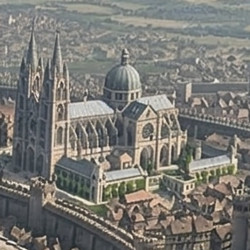
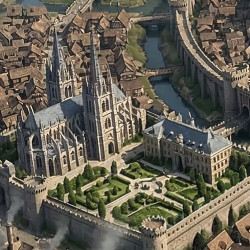
The Cathedral is the Saint Guild's headquarters and its most visible presence in Versa, but it is not the only place the Guild operates.
Across the city, in districts ranging from the wealthy inner wards to the crowded outer residential areas near the docks, the Guild maintains a network of Chapels: smaller buildings that serve simultaneously as neighbourhood places of worship and local healing centers.
A Chapel is never large. The architecture is consistent and immediately recognizable—white-painted stone where full marble is not affordable, the Guild symbol above the door, a small worship space with benches and a representation of the First Saint, and behind it a compact healing area staffed by one or two junior Priests on rotating assignment.
The healing available at a Chapel is limited compared to the Cathedral's Healing Hall. Junior Priests working with less extensive Grimoires can close fresh wounds, treat standard infections, neutralise common poisons, and provide basic Tower-sickness management. For anything more serious, patients are directed to the Cathedral.
The donation system operates at Chapels exactly as it does at the Cathedral, scaled to the more modest capabilities on offer. The Guild has deliberately kept Chapel donations lower than Cathedral rates, framing this as accessibility and managing it as market segmentation.
Chapels also serve a social function that the Cathedral, by virtue of its size and formality, cannot replicate. A neighbourhood Chapel is a place where people know the Priests by name, where local concerns are heard and sometimes acted on, where the Guild's presence feels personal rather than institutional. The Guild understands the value of this and staffs Chapels with people who have the specific temperament to make it work.
The pilgrimage books
One of the Saint Guild's most quietly successful initiatives is something that began, by most accounts, as a minor administrative decision and became a significant cultural institution.
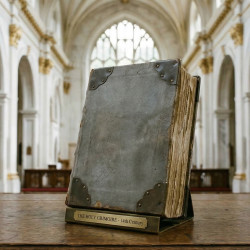
Any visitor to any Chapel or to the Cathedral itself can purchase a pilgrimage book: a simple bound journal of good paper, blank inside, sold at a modest price that covers the material cost with a small margin for the Guild. The book comes with the Guild symbol embossed on the cover and nothing else.
At any Chapel or Cathedral Healing Hall, for a modest additional donation, a junior clergy member will write a prayer or blessing in the book in formal liturgical script using standard ink—not mana ink, not Sacred Grade material, just careful calligraphy in the hand of someone trained to do it well. The prayer is generic or personalised depending on what the visitor requests.
Devout citizens collect entries across multiple Chapels over years of regular attendance. Travelers passing through Versa pick up a book and a single entry as a keepsake. Pilgrims who have traveled specifically to visit the Cathedral treat the accumulation of entries as the purpose of the journey.
The books are not holy objects. The prayers in them carry no mana, no circuit, no connection to the Grimoire system. The Guild is explicit about this when asked. They are tokens of devotion and tourism, and the Guild treats them as such without embarrassment.
They are also a reliable revenue stream, a branding exercise, and a way of making the Saint Guild's presence feel warm and accessible to people who will never need emergency healing but who form the broad base of public goodwill that the institution depends on. The Guild is also explicit about this when asked, which most people find either refreshingly honest or faintly troubling depending on their prior relationship with religious institutions.
Public perception
The Saint Guild occupies a position in Versa's social landscape that no other institution quite matches: it is simultaneously the most loved and most quietly resented power in the city, and both reactions are entirely justified.
The faithful are genuinely faithful. Versa is a religious city in the way that cities built around visible, daily danger tend to become religious. The Tower takes people. The Guild brings some of them back. For families who have watched a Priest close a wound that should have been fatal, the faith is not abstract. It is personal, specific, and not easily argued with.
The pragmatic majority respect the Guild the way they respect any institution that provides something essential and does so reliably. They may not attend Chapel regularly. They may mutter about donation scales when they have to pay them. They will still go to the Healing Hall when they need to and they will be grateful when it works.
The resentful minority exist and are not entirely wrong. The donation system is tiered access to survival, and people who cannot afford substantial donations receive junior Priests for serious injuries. The Guild's monopoly on holy healing means there is no alternative, no competitive pressure, and no external check on how the scale is set. People who have lost someone because the family could not afford a senior Priest tend not to become devoted followers. The Guild acknowledges this reality in careful internal documents and addresses it in public by emphasising the baseline guarantee: no one is turned away from stabilisation regardless of donation.
The outright cynical point to the Guild's political power, its property holdings, its influence at the Grand Council, and its carefully maintained information monopoly, and suggest that the Hand God's gift has been very good for the people administering it. The Guild does not engage with this characterisation publicly. Privately, its administrators consider it an oversimplification that misses the genuine difficulty of maintaining a global healing infrastructure across centuries without revenue, property, and influence.
Both positions contain truth. The Saint Guild has learned to live with that.
Quick phrasing you can reuse in prose
- "They healed you and they charged you for it and you were grateful anyway, because the alternative was dying, and they were the only ones who could prevent that." - "The Chapel on the corner had been there longer than anyone on the street could remember. The Priest inside changed every few years. The symbol above the door never did." - "She believed. She also understood that belief and the donation scale were two separate things, and that the Guild needed both to function." - "The pilgrimage book cost less than a good meal. The prayer inside it cost slightly more. Neither was the point. The point was having something to hold." - "They were not corrupt. They were powerful, and they had learned, over a very long time, that power and corruption were adjacent enough to require constant attention to the distance between them." - "The Hand God healed the living. The Saint Guild handled everything else."
Connected records