Finding sheet · Mana
Mana Ink
Mana Ink — Full Reference What it is Mana Ink is not paint. It is not dye. It is not a cosmetic substance that happens to carry a magical property as a secondary characteristic. It is a precision delivery medium : a carrier fluid engineered to hold powdered mana stone material in stable suspension, applied...
Overview
Mana Ink — Full Reference
What it is
Mana Ink is not paint. It is not dye. It is not a cosmetic substance that happens to carry a magical property as a secondary characteristic.
It is a precision delivery medium: a carrier fluid engineered to hold powdered mana stone material in stable suspension, applied to a surface with enough control to form functional mana circuits, and then charged to make those circuits active. The ink is the vehicle. The powdered stone is the conductor. The charge is what makes it real.
Without all three elements working together correctly, Mana Ink is an expensive stain. With them, it becomes the foundation of two of the most significant technologies in Versa: Ritualist body circuits and Holy Grimoire inscription.
How it is made
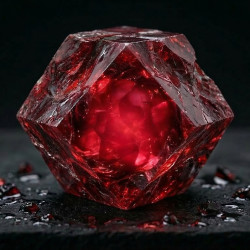
The production of Mana Ink begins in the same place Refined Stone production does: with rough mana stones pulled from the Tower.
Stage One — Powder Extraction (The Grind Chamber)
Where Refined Stone production crushes rough stones under pressure to release and capture the mana before melting the remains, Mana Ink production takes a different path from the start.
The rough stones selected for ink production are typically mid-rank material: high enough to produce a powder with meaningful mana saturation, low enough that the process remains controllable. Very high-rank stones are rarely used for standard ink because the mana density in the resulting powder becomes difficult to stabilise in suspension.
The stones are placed into a Grind Chamber: a sealed, dust-controlled room lined with the same copper-threaded conduit mesh used in Crush Chambers, but configured differently. Instead of a press, the chamber contains precision grinding mechanisms—layered stone wheels and ceramic grinding plates that reduce the rough mana stones to an extraordinarily fine powder through a slow, graduated process.
The grinding is not fast. It cannot be.
Rough mana stones ground too quickly produce friction heat that destabilises the mana inside and causes micro-releases—small uncontrolled discharges that contaminate the powder with irregular mana bursts and make the resulting material inconsistent and dangerous to work with. The wheels turn slowly. The plates apply measured pressure. The stone is reduced over hours rather than minutes.
The result is a powder so fine it behaves almost like a liquid when disturbed—a pale, faintly luminous dust that catches light at certain angles in the same soft pink that characterises all processed mana stone material. Under magnification the individual particles are irregular but extremely small, small enough to remain suspended in a carrier fluid without settling immediately.
Critically, the mana is not extracted from the stone during grinding. Unlike the Crush Chamber process, the Grind Chamber does not attempt to separate the mana from the material. The mana remains bound inside each particle of powder, distributed throughout the dust in the same way it was distributed throughout the original stone. This is what makes the powder useful for ink rather than for Refined Stones: the mana is carried with the material, not removed from it.
The powder is collected, sealed in airtight containers, and moved immediately to the next stage. Mana stone powder exposed to open air for extended periods begins to slowly discharge its bound mana as ambient bleed, which reduces potency and wastes material.
Stage Two — Suspension (The Ink Kitchen)
The carrier fluid used in Mana Ink is not standard ink base. Standard ink bases—water, oil, gum solutions—interact poorly with mana stone powder. The mana in the particles reacts to certain organic compounds in ways that cause clumping, premature discharge, or separation that no amount of agitation corrects.
The carrier fluid used by licensed Mana Ink producers is a refined neutral suspension medium: a clear, slightly viscous liquid produced from a combination of distilled mineral solvents and stabilising compounds that the Mana Guild has developed and refined over generations. The exact formulation is guild-proprietary. The general principles are understood well enough that unlicensed approximations exist, but the quality difference between properly produced carrier fluid and amateur substitutes is significant and immediately apparent to anyone who works with circuits professionally.
The powder is introduced into the carrier fluid in measured ratios inside a sealed mixing vessel. The ratio matters considerably: - Too little powder: the circuit lines lack mana density and produce weak or unstable effects when activated. - Too much powder: the suspension becomes unstable, the particles begin to interact with each other before the ink is even applied, and the resulting circuits are unreliable and potentially dangerous.
The correct ratio is determined by the intended application. Ink mixed for Ritualist skin circuits is formulated differently from ink mixed for Grimoire inscription, because skin and treated paper respond differently to the same particle density. Experienced ink producers mix different grades for different purposes and label them accordingly.
Once mixed, the ink is tested for consistency, checked for particle distribution under magnification, and sealed. At this stage it is still inert. The powder carries its bound mana, but the ink as a whole does not yet function as a circuit medium. The charge has not been applied.
Stage Three — Charging (The Ink Charge)
Charging Mana Ink is a more delicate process than charging Refined Stones, because the medium is liquid and the mana must be driven into suspended particles rather than into a solid glass structure.
The sealed ink containers are placed into a charging bath: a shallow vessel of conductive fluid connected to a controlled mana conduit feed. The containers are not opened. The charge is applied through the walls of the sealed vessel, using a slow, low-pressure feed that allows the mana from the conduit to interact with the mana already present in the suspended powder particles.
What this process does is not add raw mana to the ink. It aligns the mana already present in the particles, orienting the charge within each grain so that when the ink is applied to a surface and a circuit is drawn, the particles will respond to an incoming mana signal in a consistent and predictable direction rather than firing randomly.
Unaligned powder produces ink that works unpredictably. The circuits drawn with it activate in irregular ways, produce inconsistent effects, and in the worst cases create feedback loops that discharge violently at the point of application. This is one of the primary risks associated with unlicensed ink production: the powder can be ground adequately by someone without guild training, but the alignment charge requires equipment and expertise that is considerably harder to replicate.
Once charged, the ink is sealed, stamped with the producer's mark and a grade designation, and moved to distribution.
It has a limited shelf life. The alignment of the charge in the suspended particles is not permanent. Over time—months for lower grades, somewhat longer for premium formulations—the orientation drifts and the ink loses its reliability. Old ink does not become inert. It becomes unpredictable, which is considerably worse.
How it is used
Ritualist skin circuits
When a Ritualist applies Mana Ink to their skin, they are drawing a circuit that will later conduct their own mana in a specific direction when activated.
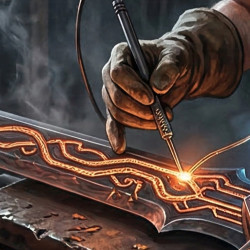
The application requires precision instruments: fine brushes or engraving tools designed to maintain consistent line width across the full circuit without interruption. A circuit with a break in it does not simply underperform. It fails to close, and an open circuit under mana pressure can discharge back along the line toward the point where the Ritualist is feeding mana into it. Early Ritualists learn what that feels like. They generally learn it once.
The ink bonds to the upper layers of skin through the mana saturation in the particles interacting with the low-level ambient mana present in all living tissue. It does not penetrate deeply. It sits close to the surface, which is why damaged skin disrupts circuits and why a Ritualist who takes serious cuts across a circuit-covered area loses those enhancements until the skin is healed and the ink reapplied.
The circuit, once drawn, is passive. It does not activate itself. It waits. When the Ritualist directs mana into the starting point of the pattern, the aligned particles conduct it along the circuit path and the effect produces itself at the terminus.
Holy Grimoire inscription
The application of Mana Ink to Holy Grimoire pages operates on different principles than skin inscription, because the medium is treated paper rather than living tissue.
The pages of a Holy Grimoire are pre-treated with a base mana saturation during production, which means the ink does not need to bond to living tissue. Instead it bonds to the existing mana saturation in the page material, integrating with it rather than sitting on top of it. This produces a more stable inscription than skin circuits—the lines do not degrade with movement, sweat, or physical impact in the way skin circuits can.
The trade-off is precision requirements. On skin, minor imperfections in a circuit line can sometimes be compensated for by the living tissue's own mana micro-flow. On paper there is no such compensation. A line that is fractionally too thin at one point will produce a gap in the circuit that the page cannot bridge. This is why Sacred Scribes spend years developing their technique before being permitted to work on active Grimoires, and why the five back pages—produced by a process and at a scale of precision that no known human Scribe has replicated—represent something that the current state of craft simply cannot explain.
Other uses
Mana Ink's properties make it useful beyond Ritualist circuits and Grimoire inscription, though most secondary applications are less technically demanding versions of the same principles.
Runic marking and ward inscription - Simple protective wards, alarm circuits, and mana-reactive markers can be drawn with lower-grade Mana Ink onto stone, wood, metal, or treated fabric surfaces. - These are not as powerful or as stable as Ritualist circuits or Grimoire inscription, but they are accessible to people without specialist training and are widely used in Tower rest nodes, guild halls, and private residences for basic security and signalling purposes.
Enchantment stabilisation (Alchemist adjacent) - Alchemists working on field enchantment repairs sometimes use low-grade Mana Ink to reinforce damaged runic contacts on gear—drawing a temporary bridge across a broken circuit to restore function until proper repair is possible. - This is not considered true inscription work. It is closer to electrical tape: functional, temporary, and not something a Sacred Scribe would acknowledge as being in the same category as their work.
Cartography and Tower mapping - Specialist cartographers who produce Tower maps sometimes use diluted Mana Ink to mark mana-active zones, distortion areas, and Warden territories on their charts. - Maps produced this way are mana-reactive: a person with even basic mana sensitivity can feel the marked zones respond faintly when the map is held near active mana, providing a secondary confirmation layer beyond the visual markings.
Identification and authentication seals - Guild contracts, high-value documents, and authenticity certificates sometimes carry a Mana Ink seal that cannot be replicated by standard forgery methods. - The seal responds to mana in a specific way that trained appraisers can verify. It does not prevent all forgery, but it raises the technical bar considerably.
Grades and quality
Mana Ink is produced in several grades, each suited to different applications: - Standard Grade: used for runic marking, ward inscription, and temporary circuit work. Widely available, relatively affordable, shelf life of several months. - Craft Grade: used by working Ritualists for regular circuit maintenance and new inscription. More consistent particle distribution, longer shelf life, tighter charge alignment. Sold through licensed suppliers to registered Ritualists. - Precision Grade: used for complex integrated circuits and multi-layer Ritualist work. Expensive, limited availability, short shelf life requiring careful storage. Most veteran Ritualists use nothing else. - Sacred Grade: used exclusively by Saint Guild Sacred Scribes for Grimoire inscription. Not commercially available. Production method not publicly disclosed. Whether it is fundamentally different from Precision Grade or simply Precision Grade produced under better conditions is a question the Saint Guild does not answer.
Quick descriptive lines for prose
- "The ink cost more than the knife. That was always the calculation." - "She mixed it herself. She always mixed it herself. She had seen what happened when you trusted someone else's ratios." - "Old ink doesn't stop working. It stops being predictable. That's worse." - "The line had to be unbroken. One gap, anywhere, and the circuit became something else entirely." - "Standard grade for the walls. Craft grade for the skin. Sacred grade for things she wasn't allowed to look at directly."
Connected records