Living folio · City
Grand Council
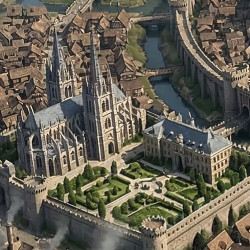
The Grand Council is not the most beautiful building in Versa. That distinction belongs to the Cathedral, whose white marble and gold catch the light in ways that stop people mid step. The Grand Council does not try to compete with that. It does not try to compete with anything. It simply stands where it...
Overview
The Grand Council is not the most beautiful building in Versa.
That distinction belongs to the Cathedral, whose white marble and gold catch the light in ways that stop people mid-step. The Grand Council does not try to compete with that. It does not try to compete with anything. It simply stands where it stands, in the middle of the city, equally distant from every institution that matters, and waits for the people who need it to come to it.
It is the seat of the city's governing coalition: the physical location where the four most powerful guilds in Versa—the Saint Guild, the Mana Guild, the Guardians Guild, and the Merchant Guild—conduct the slow, difficult, and frequently frustrating business of running a city built around a hole in the earth that produces monsters and wealth in roughly equal measure.
No single guild owns it. No single guild dominates it. That is the entire point.
Where it sits
The Grand Council occupies a plot near the geographic center of Versa, chosen with a deliberateness that every guild involved was very public about at the time of its establishment and has been quietly satisfied with ever since.
It is not close to the Cathedral. It is not adjacent to the Mana Refinery's supply roads. It does not sit in the shadow of any Guardian Checkpoint or within sight of the Harbour Halls. The distance between the Grand Council and each guild's primary base of operations is not identical—the city's geometry does not allow for perfect symmetry—but it is close enough to equal that no guild has ever successfully argued the placement favored another.
The streets around it are wide and well maintained, kept clear by a combination of Grand Council staff and rotating Guardian patrols that treat the surrounding district as neutral ground. There are no guild banners on the approach roads. No guild colors mark the lamp posts or the paving stones. The district around the Grand Council is the most deliberately unguilded space in Versa, and that absence of affiliation is itself a kind of statement.
The building is visible from several of Versa's main avenues, not because it is the tallest structure in the city but because the plaza in front of it is wider than anything in the surrounding districts, cleared and maintained as a public space that gives the facade room to be seen properly.
The exterior
The Grand Council building is large without being aggressive about it.
It is built from dark, polished stone—not the white marble of the Cathedral or the rough working stone of the Refinery, but a deep charcoal grey that has been dressed and finished to a smooth face that reflects light without glowing. The color belongs to no guild. It reads as formal, permanent, and deliberately neutral in the way that only something designed by committee across four competing institutions can achieve.
The facade is symmetrical in a way that feels almost mathematical. Four equal sections divide the front face, each carrying the carved symbol of one of the four founding guilds set into the stone at the same height, the same size, and with the same depth of cut. The Saint Guild's open hand. The Mana Guild's conduit circle. The Guardians Guild's gate arch. The Merchant Guild's scaled balance. None elevated above the others. None larger. None more ornate.
Above the four symbols, running the full width of the facade, a carved frieze depicts the founding moment of the Union: four figures standing at equal distances around a central point, their hands extended toward it but not touching. The carving is formal rather than naturalistic—more symbol than scene—and it has been interpreted differently by every scholar who has written about it. The four guilds have never officially endorsed any single interpretation, which most historians consider deliberate.
The entrance is a single wide archway at the center of the facade, framed in the same dark stone as the walls, fitted with doors of iron-banded dark timber that are tall enough to make anyone passing through them feel the weight of where they are going. The doors stand open during operating hours. When they are closed, they are locked from inside, and the Grand Council is not in session.
To the left of the main entrance, at the far end of the facade, a second entrance sits flush with the wall, smaller, marked only by a plain iron door with no symbol above it. This entrance leads down. Most people in Versa know what lies beneath. Most people in Versa do not look at that door longer than necessary.
The entrance hall
Through the main doors and into the building, the Grand Council makes its most direct statement about what it is and what it represents.
The entrance hall is tall, wide, and deliberately impressive in a way that the exterior carefully avoids. The ceiling rises two full floors above the polished stone floor, supported by four rows of columns—one row for each guild, each row carved from a slightly different stone that carries the guild's associated color without being garish about it. The Saint Guild's columns are pale cream. The Mana Guild's are a warm rose-tinted grey. The Guardians Guild's are the same dark charcoal as the exterior. The Merchant Guild's are a deep brown timber rather than stone, the only wooden columns in the hall, and somehow the most visually arresting because of it.
The floor between the columns is inlaid stone in a pattern that radiates outward from a central point—four quadrants, each quadrant carrying a subtle geometric pattern associated with one of the four guilds, meeting at the center in a design that belongs to none of them and all of them simultaneously. The inlay work is old and has been repaired many times. The repairs are visible if you look closely. No one has ever replaced the floor entirely, and the accumulated history of its maintenance is considered by the Grand Council's staff to be part of what the floor means.
Red is the dominant color of the interior in the way that white marble dominates the Cathedral. Deep crimson carpets run the length of the entrance hall from the main doors to the chamber corridor beyond, wide enough that four people could walk abreast without stepping off the edge. They are replaced on a fixed schedule and maintained between replacements with a care that reflects how seriously the Grand Council takes the impression the building makes on everyone who enters it.
The walls of the entrance hall carry the history of the Union in a continuous display that runs from the main doors to the far end: carved panels, framed documents behind glass, mounted artifacts, and formal portraits of past guild representatives who served in the Council. The display is organised chronologically, oldest near the entrance and newest near the chamber corridor, and it tells the story of every significant decision the Grand Council has made since its founding.
There are long gaps in the timeline where nothing significant was decided.
The staff do not draw attention to these gaps. Visitors who notice them and ask are told that stability is also a form of governance.
The staff quarters and bureaucratic offices
To either side of the entrance hall, accessible through corridors that branch left and right from the main space, lie the working offices of the Grand Council: the rooms where the actual daily administration of the city's governing coalition happens.
The offices are organised by function rather than by guild, which was one of the more contentious decisions made during the Grand Council's early history and remains one of its more successful ones. A taxation office does not belong to the Mana Guild or the Merchant Guild. It belongs to the Grand Council, and it is staffed by personnel seconded from all four guilds in equal numbers, working under Grand Council authority rather than their home institution's direction.
In practice this works better than most observers predicted and worse than the Grand Council's official literature suggests.
The staff from different guilds bring different institutional cultures into the same rooms. Guardians-seconded clerks tend toward procedural precision and thorough documentation. Mana Guild personnel tend toward technical efficiency and occasionally forget that not everyone shares their assumption that optimal resource allocation is self-evidently the correct priority. Saint Guild staff bring an institutional gravity to their work that other guild members sometimes find reassuring and sometimes find oppressive. Merchant Guild representatives move faster than everyone else and are frequently frustrated that the Grand Council does not.
The result is an administrative culture that is slower than any single guild would produce on its own and more balanced than any of them would prefer.
The offices themselves are functional and well-maintained without being luxurious. Dark timber furniture. Stone floors covered by smaller versions of the red carpets from the entrance hall. Mana lamp housings on the walls rather than windows, which makes the office corridors feel slightly airless to visitors from the outside but suits the staff who spend their days in them. Conduit tube terminals connect the offices to each other and to the main chamber, carrying internal communications through the same capsule system used in the Harbour Halls, though the Grand Council's network is older, slower, and considerably more prone to the specific kind of malfunction that only aging mana infrastructure produces.
Each of the four guilds maintains a dedicated representative suite in the office wing: a set of rooms reserved for the use of that guild's appointed Grand Council members, furnished and maintained at the guild's own expense, decorated according to that guild's preferences, and therefore the one part of the Grand Council building where guild identity is openly expressed.
The Saint Guild suite is calm and pale, with devotional objects and the smell of the specific incense the Cathedral burns. The Mana Guild suite has equipment cases and instrument housings that suggest its occupants are never entirely off duty. The Guardians Guild suite is sparse and functional in the way that suggests its occupants would be uncomfortable if it were anything else. The Merchant Guild suite has the best furniture of the four and the most comprehensive tube terminal network, because the Merchant Guild's representatives considered connectivity a non-negotiable requirement and paid for the installation themselves.
The discussion chamber
At the far end of the entrance hall's carpet, through a final set of doors that are heavier than any others in the building, lies the discussion chamber: the room where the Grand Council actually governs.
It is a round room.
This was not an accident and was not a compromise. It was the one design decision that all four guilds agreed on without significant negotiation, because a round room has no head, no elevated position, no wall that is more important than any other wall. A round room is the only shape that makes four equal parties genuinely equal in the physical space they share.
The ceiling of the chamber rises higher than the entrance hall, a dome of dressed stone with a single circular opening at the apex that admits natural light in a column that moves across the floor as the day progresses. The walls are plain dark stone interrupted only by four alcoves, one for each guild, each alcove holding a standing lamp in that guild's associated color and a carved panel depicting that guild's founding. The panels are the same size. The lamps are the same height. The alcoves are the same depth.
At the center of the room sits a round table of dark timber, large enough to seat the representatives of all four guilds with their advisors and still leave room for the clerks who record every word spoken in the chamber. The chairs around the table are identical. There is no chair that is larger, higher, or positioned more centrally than any other. Visiting dignitaries who expect to find a throne or a speaker's podium consistently find the chamber disorienting, which the Grand Council's longer-serving members have learned to take a quiet satisfaction in.
The floor of the chamber is the same inlaid stone as the entrance hall, but here the pattern is simpler: four equal quadrants meeting at the center point directly beneath the table's midpoint and the dome's apex. On clear days, when the light column from the dome falls directly on that center point, it illuminates nothing in particular. The table covers it. The symbolism has been noted by every writer who has described the chamber and interpreted in every possible direction.
Voting in the chamber requires three of the four guilds to consent for any measure to pass. This threshold was set at the founding and has never been changed, because changing it would itself require three of the four guilds to consent and no coalition of three has ever agreed that the threshold should be different. The Grand Council moves slowly as a result. New laws are rare. Significant city-wide actions require months of negotiation before a vote is called. The four guilds spend considerable energy simply maintaining the agreements that already exist rather than producing new ones.
This is considered, by the Grand Council's staff, to be working as intended.
What it feels like to be inside
The entrance hall feels like history with good maintenance. The red carpets and the column rows and the long display of past decisions give the space a weight that has nothing to do with the stone it is built from. People tend to walk more carefully in it than the floor requires. They speak more quietly than the acoustics demand.
The offices feel like any serious institution's working interior: purposeful, slightly pressured, full of people who know exactly what they are doing and are mildly impatient with anyone who does not.
The representative suites feel like embassies. Each one is a small piece of a different institution transplanted into neutral ground, and the tension between the suite and the building around it is palpable in the way that only genuinely competing powers occupying shared space can produce.
The discussion chamber feels like a room where things have been decided that could not be undone.
Not oppressive. Not threatening. Just weighted, in the specific way of a space that has absorbed decades of consequential conversations and holds the residue of all of them in the stone and the air and the particular quality of silence that falls when the doors close and the session begins.
Quick descriptive lines for prose
- "Four guilds, one table, one rule: three of them had to agree. In practice this meant that the city changed slowly, which most of its residents considered a feature." - "The carpet was red because all four guilds had rejected each other's suggested colors and red was the only one none of them objected to. The Grand Council considered this a reasonable metaphor for most of what happened inside it." - "The round table had no head. Every representative who sat down at it for the first time spent a moment looking for one before understanding that was the point." - "The entrance hall told the story of every decision the Grand Council had made. The gaps in the timeline were longer than the entries. No one on staff mentioned this to visitors." - "It was the most powerful room in Versa. It was also the room where the least happened per hour of any room in the city. The Grand Council considered both statements accurate." - "You entered through the main doors if you were there to govern. You entered through the side door if you were not coming back."
Connected records