Finding sheet · Mana
Holy Grimore
The Holy Grimoire — Object Description Physical appearance A Holy Grimoire does not look like a weapon. It does not look like a tool. It looks like a book that has been loved for a very long time by someone who understood exactly what it was worth. The cover is thick, bound in leather that has been treated...
Overview
The Holy Grimoire — Object Description
Physical appearance
A Holy Grimoire does not look like a weapon. It does not look like a tool. It looks like a book that has been loved for a very long time by someone who understood exactly what it was worth.
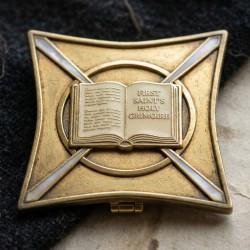
The cover is thick, bound in leather that has been treated and re-treated until it feels closer to stone than skin. The color varies by Grimoire—deep burgundy, dark brown, black so old it has gone greenish at the edges—but the finish is always the same: smooth, warm, and slightly resistant to the touch, as if the material itself were subtly pushing back. The corners are reinforced with small metal brackets, plain and functional. The spine is stitched in heavy thread that has never frayed. There are no decorative titles on the cover. No name. No symbol of the Hand God pressed into the leather. Just the book, plain and deliberate, as if it had decided that anything added would be beneath it.
The pages inside are thick, cream-colored, and faintly warm to the touch. Not hot. Just warm, the way a stone holds heat after the sun has moved. The text is written in a formal liturgical script that is legible but not casual—the kind of writing that asks you to slow down. The verses are separated by thin ruled lines. Some pages carry small geometric diagrams in the margins: not decorative illustrations, but technical annotations that neither the current Priest nor most scholars could fully interpret.
The mana infusion (why the book doesn't die)
Every page of a Holy Grimoire, from cover to the last sheet, has been treated during production with a base layer of diluted mana ink. Not enough to carry circuits. Not enough to activate anything on its own. Just enough to saturate the material at a fundamental level, making the entire object subtly resistant to the world's attempts to ruin it.
The practical results are immediately obvious to anyone who has worked with books in field conditions: - Tears don't propagate. A page that catches on a nail or a rough edge may nick at the point of contact, but the damage stops there. The fiber holds. - Water beads and runs off. Rain, river crossings, spilled potions, blood—none of it soaks in. The pages dry clean. - Heat doesn't char. Held near open flame the cover will warm uncomfortably but will not ignite under normal exposure. The pages yellow slightly under sustained heat but do not burn through. - Stains don't set. Ink, mud, food, ichor—anything applied to the surface sits on top of the mana-treated material and can be wiped away with cloth. The pages remain cream-colored after years of field use. - The spine doesn't weaken. Most books opened thousands of times develop a broken spine, loose signatures, pages that drift free. A Holy Grimoire opened every single day for a decade looks structurally identical to the day it was bound.
This is not magic in any dramatic sense. It is material science applied through mana saturation. The Saint Guild's binders have been doing it the same way for generations. They know the steps. They do not particularly understand why the steps work, which is a theme that runs through the entire object.
The five back pages (what makes it holy)
This is where the book stops being a well-made mana-treated journal and becomes something that no one outside the Saint Guild's senior scribes has ever successfully replicated or fully explained.
The final five pages of every Holy Grimoire are different from the rest.
To a casual observer they look almost blank. The cream color is the same. The weight is the same. But held at an angle to the light, or examined in a space where active mana is present, the surface reveals itself to be covered—entirely covered, margin to margin, top to bottom—in print so fine it approaches the limit of what the human eye can resolve without aid.
It is not writing. It is not verse. It is not the liturgical script found in the rest of the book.
It is mana ink circuitry.
The same specialised ink that Ritualists use to draw enhancement circuits into their skin has been applied here by a process that the Saint Guild calls Sacred Impression—a misnomer, since the result looks nothing like a stamp or seal. It looks like someone with the patience of something inhuman and the precision of a machine sat down and drew an unbroken circuit across five full pages without lifting the instrument once. The lines are thinner than a human hair in places. The geometry shifts scale repeatedly, from patterns visible to the naked eye at the edges down to structures that require a magnifying lens to confirm are actually there. It folds back on itself, references earlier sections, loops and branches and reconverges in ways that suggest a logic operating at a level no one examining it has ever managed to decode.
Mage Guild scholars who have been permitted to study these pages—under strict Saint Guild supervision, never alone, never with the ability to copy—have produced a consistent set of conclusions over the centuries: - The circuitry is functional. It is not decorative. It is doing something. - The complexity exceeds anything currently producible by known Ritualist technique by an order of magnitude that makes direct comparison feel absurd. - The patterns on every Grimoire are different. Not variations on a template. Genuinely, fundamentally different from each other in ways that suggest they are not copies of a single design but individually produced works. - No one knows how they are made. The Saint Guild's senior scribes, called the Sacred Scribes, produce them. The process is conducted in private. The tools used are not publicly known. The time required per page is not disclosed. The result arrives and it works, and that is all the world is permitted to know.
What these five pages do, in practical terms, is transform the book.
A Holy Grimoire without these pages is a mana-treated journal with verses in it. Functional as a reference. Useful as a study text. Worth money as a crafted object.
With these pages it becomes something the mana infused into the rest of the book can anchor to—a structured foundation complex enough to support the blood-binding, hold the spell patterns written by Scribes, and channel a Priest's mana through the Grimoire's framework instead of requiring the Priest to construct that framework themselves.
The five pages are, in essence, the engine. Everything else in the book is the body built around it.
The blood binding (first use)
When a new Holy Grimoire is issued to a Priest by the Saint Guild, the book is complete in every way except one.
The five pages at the back are active. The mana saturation throughout is stable. The cover is sealed. But the book has no owner. It is a loaded mechanism with no trigger assigned.
The binding ceremony is not elaborate. There is no altar, no candles, no lengthy prayer. A senior Priest or Saint Guild official opens the book to the inside front cover. The new Priest presses their thumb to a small marked point on the page and applies enough pressure to break the skin.
The blood touches the paper.
What happens next takes less than three seconds and produces no visible effect beyond a mark appearing on the page.
The mark is a sigil, geometric and precise, generated somewhere in the interaction between the Priest's blood, their personal mana signature, and the five pages of circuitry at the back of the book. It settles into the paper as if it had always been there. It is unique. No two binding marks produced across the entire documented history of the Saint Guild have ever been identical. The variables that produce each specific pattern—whether they come from the Priest's mana, their bloodline, something the circuitry reads from their soul, or some combination of all three—remain unknown.
From this point the book responds to its Priest and to no one else.
Another person can open it. They can read the verses. The pages are not hidden or locked. But when they attempt to use the book as a channel, nothing answers. The mana they put in does not find the framework. The circuit has a specific key now, and they are not it.
Adding spells (the Scribe system)
A newly bound Grimoire does not arrive full.
The Saint Guild issues each book with a base set of verses covering fundamental healing, basic status cleansing, and emergency stabilisation. Enough to make a new Priest functional. Not enough to make them complete.
As a Priest advances—gaining rank, accumulating experience, proving competence in the Tower—they become eligible to have new spells added to their Grimoire. This is done exclusively by Sacred Scribes: the Saint Guild's specialist writers, each of whom has spent years learning to work with mana ink at the precision required to inscribe functional patterns onto already-active pages without destabilising the existing circuitry.
The process works as follows: - The Priest brings their Grimoire to the Saint Guild and presents their current adventurer rank documentation. - A Scribe assesses which spell families are available at that rank. - The Priest selects from the available options and pays the Scribe's Donation—a contribution to the Saint Guild framed as religious giving rather than a commercial transaction, though the distinction is largely semantic. The amounts are not small. - The Scribe takes the book into a private scriptorium. The time required varies by spell complexity: simpler additions may take a day. More advanced verse families can take a week or longer. - The book is returned with new pages added or existing pages extended, the fresh mana ink inscription integrated into the existing framework of the five back pages without breaking anything already there.
The Priest then must attune to the new verse. This is not automatic. A freshly added spell sits in the book as potential—the Priest must read it, work with it, use it in the field until the Grimoire's channelling of that specific pattern becomes reliable. A verse that has not been attuned can produce incomplete effects or fail to fire at a critical moment. Experienced Priests treat new additions with caution until the attunement has settled.
There is no upper limit specified by the Saint Guild on how many spells a Grimoire can hold. In practice the limit is imposed by the Priest's rank, the cost of Scribe work, and the physical space remaining in the book. A Grimoire carried by a high-rank Priest of twenty years is a dense, heavy object whose pages are covered front and back with precisely inscribed verse and whose margins have long since disappeared under annotation.
What happens when it is damaged or lost
The mana saturation protects the book from most daily hazards. But the Tower is not daily hazard territory.
Sustained magical attack, deliberate destruction, fire sustained long enough and hot enough, deep Tower mana distortion events—these can damage a Holy Grimoire in ways normal wear cannot.
A damaged page means a damaged spell. The verse is still there but the mana ink inscription beneath it or surrounding it may be compromised, and a compromised circuit does not produce a clean channel. The effect misfires, fires weakly, or does not fire at all. A Priest who loses access to wound closure in the middle of a Tower run has a very specific and very immediate problem.
A destroyed Grimoire is catastrophic.
The blood binding is gone. The five pages are gone. The Priest retains their mana, their faith, their years of practice, and the memory of every verse they ever learned. What they no longer have is the framework that made any of it usable as holy magic. They are a person standing in front of a door they can see perfectly clearly and cannot open.
The Saint Guild can issue a new Grimoire and perform a new binding. The cost is significant. The process of re-adding every spell through the Scribe system must begin again from whatever the Priest's rank permits. The new book is a stranger that shares all of the Priest's history and none of their familiarity. It takes time. It takes money. It takes the particular kind of patience required to rebuild something you already built once.
Most Priests who have lost a Grimoire describe the period before the new binding as the worst of their career.
Not because they were helpless.
Because they could remember exactly what they used to be able to do.
Quick descriptive lines for prose
- "The last five pages looked almost blank until the light caught them right. Then they looked like something that shouldn't exist." - "She had carried it for eleven years. The cover still looked new." - "He pressed his thumb to the page and the book decided to know him." - "The Scribe took it away for four days and brought it back with three new verses and a donation receipt that made him wince." - "No one had ever successfully copied those back pages. Several people had tried. The Saint Guild had opinions about that." - "It survived the flood, the fire, and a goblin's best effort with a rusted knife. It was a better survivor than most of the people who had carried it."
Connected records