Living folio · Class
Priest
Priest is the Tower's primary healing force and the only true buff caster : the party member who keeps people alive, removes what shouldn't be there, and amplifies what should. Their power does not come from personal mana mastery like a Mage, nor from prepared substances like an Alchemist. It comes from the...
Overview
Priest is the Tower's primary healing force and the only true buff-caster: the party member who keeps people alive, removes what shouldn't be there, and amplifies what should. Their power does not come from personal mana mastery like a Mage, nor from prepared substances like an Alchemist. It comes from the Holy Grimoire—a blood-bound book that channels the Shepherd of Tides' blessing through them in a way that even they cannot fully explain.
Tag fit: Mana / Long Range / Support.
In a five-person party, the Priest's slot is usually: - Primary healing (wounds, blood loss, organ trauma, Tower-sickness) - Status removal (poison, curse, mana contamination, debilitating conditions) - Buff application (the only class that can directly enhance living companions) - Emergency stabilisation (keeping someone alive long enough to extract)
What makes Priest different from other classes
- They are the only class that can heal through mana directly. Alchemists use potions. Craftsmen use herbs and bandages. Priests reach into a wound with channelled holy mana and close it. - They are the only class that can apply buffs to living beings. This is the hard line that separates them from Alchemists and Ritualists. No other class can directly enhance a living person's capabilities through mana in real time. - Their power is not fully theirs. A Priest doesn't understand the mechanics of what they cast. The Grimoire does the heavy lifting—translating prayer and intent into structured mana patterns that the Priest's body could never construct alone. - They carry a religious identity that is inseparable from the class. A Priest who loses faith does not simply lose motivation. They lose access. The Shepherd, the Saint, the Grimoire, and the healing magic are all part of the same unbroken chain.
The Shepherd of Tides (the divine foundation)
The Priest's power is not their own. It is borrowed, channelled, granted by the Shepherd of Tides—the god who stands at the boundary between life and death and guides the living back from the edge.
The Shepherd does not resurrect. He does not reach beyond the threshold once a soul has crossed into death. What He offers is preservation: the anchoring of souls to flesh long enough for healing to take root, the guidance of the wounded back from the dark waters before they drown.
The First Saint received this knowledge directly from the Shepherd in the earliest days of Versa, when the Tower's dangers killed faster than any healer could answer. The Shepherd appeared, taught the First Saint how to channel His blessing through a structured vessel—the Holy Grimoire—and set a clear boundary: "Guide the living back from the dark waters. Do not follow the dead into the Deep."
Every Priest since has worked within that same boundary.
A Priest can keep a person alive through wounds that should kill them. They can cleanse poisons, remove corruption, stabilize failing organs, and hold a dying body together long enough for recovery to begin. What they cannot do is bring back someone who has already died. The Grimoire does not carry those verses. The Shepherd's blessing does not extend past that threshold. A Priest who arrives too late can only confirm what the family already knows.
This theological limit is not a failure of skill or faith. It is the nature of the blessing itself, and every Priest learns to live with it or leaves the calling.
The Holy Grimoire (the heart of the class)
The Grimoire is not a spellbook in the conventional sense. It does not list instructions that a trained person could follow step by step. It is closer to a living mana interface bound to a single person by blood.
When a Priest reads a verse aloud or in focused silence, the Grimoire does not teach them how to cast. It casts through them—pulling the correct mana pattern from the five impossibly complex circuit pages at the back of the book and running it through their body like a current finding the path of least resistance.
The closest comparison is a system that has already solved the equation and simply hands the Priest the answer. The Priest does not know the working. They know the verse, the intent, and the result.
Key rules:
- Blood-bound: each Grimoire is linked to one specific Priest at the moment of binding. Another person holding it gains nothing. It is inert in any other hands. - Cannot be copied in any meaningful sense. The mana infused into it—especially the five back pages of Sacred Grade circuitry—is not a formula that can be extracted and reproduced by reading. - Can be lost or damaged, which is one of the most catastrophic things that can happen to a Priest in the field. A Priest without their Grimoire loses access to most of their casting immediately. - Grows with the Priest over time—not in the sense that it physically changes, but in the sense that the depth and speed of what it can channel through a given Priest improves as their mana capacity and Resonance increase.
What it looks like:
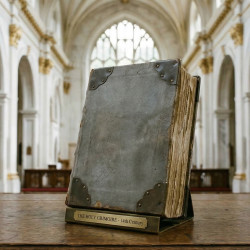
A Holy Grimoire does not look like a weapon. It looks like a book that has been loved for a very long time by someone who understood exactly what it was worth.
The cover is thick, bound in leather that has been treated until it feels closer to stone than skin. The color varies—deep burgundy, dark brown, black gone greenish at the edges—but the finish is always smooth, warm, and slightly resistant to the touch. The corners are reinforced with plain metal brackets. The spine is stitched in heavy thread that has never frayed. There are no decorative titles. No name. No symbol. Just the book.
The pages inside are thick, cream-colored, and faintly warm to the touch. The verses are written in formal liturgical script, separated by thin ruled lines. Some pages carry small geometric diagrams in the margins—technical annotations that neither the Priest nor most scholars could fully interpret.
The final five pages are different from the rest. To a casual observer they look almost blank. Held at an angle to the light, they reveal themselves to be covered—entirely covered, margin to margin—in mana ink circuitry so fine it approaches the limit of what the human eye can resolve. It is not writing. It is not verse. It is an unbroken circuit of impossible complexity and precision, drawn by a process the Saint Guild calls Sacred Impression and has never fully explained.
These five pages are the engine. Everything else in the book is the body built around it.
The blood binding (first use):
When a new Holy Grimoire is issued to a Priest by the Saint Guild, the book is complete in every way except one: it has no owner.
The binding ceremony is not elaborate. A senior Priest opens the book to the inside front cover. The new Priest presses their thumb to a marked point on the page and applies enough pressure to break the skin.
The blood touches the paper.
What happens next takes less than three seconds and produces no visible effect beyond a mark appearing on the page—a sigil, geometric and precise, generated somewhere in the interaction between the Priest's blood, their personal mana signature, and the five pages of circuitry at the back. It settles into the paper as if it had always been there. It is unique. No two binding marks have ever been identical.
From this point the book responds to its Priest and to no one else.
Adding spells (the Scribe system):
A newly bound Grimoire does not arrive full. The Saint Guild issues each book with a base set of verses covering fundamental healing, basic status cleansing, and emergency stabilisation. Enough to make a new Priest functional. Not enough to make them complete.
As a Priest advances—gaining rank, accumulating experience, proving competence in the Tower—they become eligible to have new spells added to their Grimoire. This is done exclusively by Sacred Scribes: the Saint Guild's specialist writers, each of whom has spent years learning to work with mana ink at the precision required to inscribe functional patterns onto already-active pages without destabilising the existing circuitry.
The process works as follows: - The Priest brings their Grimoire to the Saint Guild and presents their current adventurer rank documentation. - A Scribe assesses which spell families are available at that rank. - The Priest selects from the available options and pays the Scribe's Donation—a contribution to the Saint Guild framed as religious giving rather than a commercial transaction, though the distinction is largely semantic. The amounts are not small. - The Scribe takes the book into a private scriptorium. The time required varies by spell complexity: simpler additions may take a day. More advanced verse families can take a week or longer. - The book is returned with new pages added or existing pages extended, the fresh mana ink inscription integrated into the existing framework of the five back pages without breaking anything already there.
The Priest then must attune to the new verse. This is not automatic. A freshly added spell sits in the book as potential—the Priest must read it, work with it, use it in the field until the Grimoire's channelling of that specific pattern becomes reliable. A verse that has not been attuned can produce incomplete effects or fail to fire at a critical moment.
What happens when it is damaged or lost:
The mana saturation protects the book from most daily hazards. But the Tower is not daily hazard territory.
Sustained magical attack, deliberate destruction, fire sustained long enough and hot enough, deep Tower mana distortion events—these can damage a Holy Grimoire in ways normal wear cannot.
A damaged page means a damaged spell. The verse is still there but the mana ink inscription beneath it or surrounding it may be compromised, and a compromised circuit does not produce a clean channel. The effect misfires, fires weakly, or does not fire at all.
A destroyed Grimoire is catastrophic.
The blood binding is gone. The five pages are gone. The Priest retains their mana, their faith, their years of practice, and the memory of every verse they ever learned. What they no longer have is the framework that made any of it usable as holy magic. They are a person standing in front of a door they can see perfectly clearly and cannot open.
The Saint Guild can issue a new Grimoire and perform a new binding. The cost is significant. The process of re-adding every spell through the Scribe system must begin again from whatever the Priest's rank permits. The new book is a stranger that shares all of the Priest's history and none of their familiarity. It takes time. It takes money. It takes the particular kind of patience required to rebuild something you already built once.
Most Priests who have lost a Grimoire describe the period before the new binding as the worst of their career. Not because they were helpless. Because they could remember exactly what they used to be able to do.
Stat tendencies (Adventurer Card attributes)
(Typical leanings, not hard locks.)
Best / most emphasized - MNA (Mana): the Grimoire channels through the Priest's mana pool; a larger pool means more casts, longer sustained healing, bigger buffs. - RSN (Resonance): critical—the Grimoire's patterns run cleaner and faster through a high-RSN Priest; low RSN causes delays, incomplete heals, and buff instability. - INS (Insight): reading what a wound actually needs, identifying status effects quickly, knowing when to burn a big cast vs. when to hold it.
Usually weaker - STR (Strength): Priests are rarely physical fighters; their value is too high to risk at the front. - AGI (Agility): they don't need to be fast; they need to be reachable and protected. - END (Endurance): variable; field Priests need enough to keep casting under duress, but they are not built for sustained physical exertion.
Where they shine
- Sustained healing over a long run: no other class can keep a party functional across multiple floors the way a Priest can. - Status removal: Tower conditions create poison, mana contamination, curse-adjacent debuffs, and worse. A Priest is the clean answer to all of them. - Buff stacking before a Warden fight: a prepared Priest can raise the effective capability of every party member before the hardest fights. - Range flexibility: unlike Alchemists who work at arm's reach, a Priest can cast heals and buffs across a room—keeping people alive without needing to reach them.
Where they don't shine
- Damage output: Priests have essentially no offensive identity. They are not built to hurt things and should not be expected to. - Self-sufficiency without the Grimoire: lose the book, lose most of the class. A Priest without their Grimoire is a person with decent mana and no reliable way to use it. - Operating alone: a Priest without a party to protect is one of the most vulnerable people in the Tower. - Explaining themselves: they cannot answer the question of how their magic works. In a world that values knowledge as currency, that blind spot has political consequences.
How Priest "works" in-world (skill access logic)
Priest progression unlocks verse families and Grimoire depth rather than personal techniques:
Core casting families (accessed through the Grimoire) - Wound Closure: sealing cuts, burns, punctures, fractures—direct physical repair through holy mana - Status Cleansing: removing poison, infection, mana contamination, fear-states, and Tower-sickness variants - Buff Channelling: strength enhancement, pain suppression, reflex sharpening, mana flow stabilisation—applied to living targets only - Emergency Stabilisation: keeping a dying person alive long enough to extract; not a full heal, but a hard stop on deterioration
Holy Item creation (unique to Priests) - Priests are the only class that can create Holy Items: objects infused with stabilised holy mana that produce effects for non-Priests (minor healing, ward effects, cleansing properties). - The process is taught by the Saint Guild as a series of steps. Like the Grimoire itself, Priests follow the procedure without fully understanding the underlying mechanism. - Holy Items are expensive, time-consuming to make, and heavily regulated by the Saint Guild.
Mana relationship (fits your "Mana" tag)
Priests run entirely on mana but in a different way from Mages: - A Mage shapes mana consciously and directly. - A Priest channels mana through the Grimoire's pre-existing patterns—they are the power source, not the architect. - This means high MNA and RSN matter enormously, but raw mana control skill matters far less than it does for a Mage. - A Priest with great stats but poor faith/focus produces inconsistent results. The Grimoire responds to intent as much as capacity.
Social/economic role (fits your Tower economy)
Priests are among the most socially protected adventurers in Versa: - Every serious guild wants one. A party without a Priest accepts a fundamentally higher casualty risk. - The Saint Guild controls their supply. You cannot train a Priest outside that institution, which means the Guild has enormous leverage over who gets healing and who doesn't. - Holy Items are a secondary economy. Priests who retire from the Tower often transition into Holy Item production—a slower, safer, and still highly profitable career. - They are never truly neutral. Every Priest carries the Saint Guild's brand. In political conflicts, that affiliation matters whether the Priest intends it to or not.
The Shepherd's boundary (the theological weight they carry)
Every Priest learns, early in their training, the same lesson the First Saint learned from the Shepherd of Tides:
"Guide the living back from the dark waters. Do not follow the dead into the Deep."
This is not philosophy. It is the operating limit of everything they do.
A Priest can stabilize a person at the edge of death, pull them back from wounds that should be fatal, cleanse corruption that would kill them within hours. What they cannot do is cross the threshold after someone who has already died. The Grimoire does not carry those verses. The Shepherd's blessing does not extend that far.
This creates a specific kind of emotional weight that Priests carry differently than other classes.
A Mage who fails to kill a target can try again. An Alchemist whose potion doesn't work can mix another. A Priest who arrives too late cannot retry. The person is gone. The Shepherd does not reach beyond the threshold. The family is standing there, and the Priest has to say it: "They were already lost when you brought them in."
Some Priests leave the calling over this. Not because they lack skill. Because the weight of being the person who says that, over and over, in a city built around a dungeon that produces deaths faster than any institution can fully answer, eventually becomes more than they can carry.
The ones who stay learn to separate what they can control from what they cannot. They do the work. They guide the living. They do not follow the dead. That is the boundary the Shepherd set, and no amount of skill, faith, or desperation changes it.
Quick phrasing you can reuse in prose
- "They don't know how it works. It works anyway." - "A party without a Priest isn't a party. It's a countdown." - "The Grimoire doesn't teach you. It speaks through you." - "You can buy a sword anywhere. You can't buy what they carry." - "The Shepherd guides the living. A Priest is the hand that does it." - "She could close a wound that should have killed him. She could not bring back someone who was already gone. That was the difference, and it mattered."
Connected records