Living folio · Lore
Sacred Scribes
Sacred Scribes are not Priests. They are not healers. They do not channel the Shepherd's blessing through a Grimoire or stand at the Healing Hall treating the wounded. They are the invisible architects of the Saint Guild's power: the craftsmen who produce, modify, and maintain the Holy Grimoires that every...
Overview
Sacred Scribes are not Priests. They are not healers. They do not channel the Shepherd's blessing through a Grimoire or stand at the Healing Hall treating the wounded. They are the invisible architects of the Saint Guild's power: the craftsmen who produce, modify, and maintain the Holy Grimoires that every Priest depends on, working in isolation with tools and knowledge that the Guild has never shared beyond the Scriptorium's walls.
A Sacred Scribe's work is technical, precise, and utterly essential. Without them, no new Grimoires enter circulation. No existing Grimoires gain new verses. No Priest advances beyond the base set of healing patterns they received at binding. The entire system—the Cathedral, the Chapels, the Healing Halls, the Saint Guild's political weight, the Shepherd's blessing as it reaches the world—rests on the shoulders of people most citizens of Versa will never meet and whose names appear on no public record.
They are the Guild's most carefully guarded resource and one of its deepest secrets.
Who becomes a Scribe
Becoming a Sacred Scribe is not a path anyone chooses lightly, and it is not a path the Saint Guild opens to many.
The Guild recruits from two sources:
Priests who cannot continue in the field. Injury, trauma, loss of nerve, mana exhaustion, or the slow accumulation of Tower exposure that makes descent impossible—these are the things that end a Priest's active career. Some leave the Guild entirely. Some transition to administrative work or Chapel service. A very small number, those with exceptional fine motor control, deep patience, and an instinct for precision that goes beyond technical training, are offered a different path: the Scriptorium.
Guild-raised candidates identified early. Children born into devout Saint Guild families, raised within the Cathedral or its affiliated institutions, who show neither the temperament for Priest work nor the inclination for administration but who demonstrate a particular kind of focus—the ability to sit for hours without distraction, the capacity to repeat a motion until it becomes perfect, the willingness to work in isolation without complaint. These candidates are tested young, trained slowly, and watched carefully. Most do not survive the selection process. Those who do spend a decade or more in apprenticeship before they are permitted to work on an active Grimoire.
In both cases, the transition into Scribe work requires vows: oaths of silence regarding the specifics of the craft, oaths of service binding the Scribe to the Guild for life, and oaths of obedience to the Saint and the senior Scribe masters who oversee the Scriptorium. A Scribe who breaks those vows does not leave the Cathedral freely. The holy prison beneath the Cathedral has held more than one former Scribe over the Guild's long history.
What they actually do
A Sacred Scribe's primary function is the inscription of new verses into existing Holy Grimoires and the production of new Grimoires for newly ordained Priests.
Adding verses (modification work):
When a Priest advances in rank and becomes eligible for new spell families, they bring their Grimoire to the Cathedral and request the addition. The request is logged, the donation is paid, and the Grimoire is handed to a Scribe.
What happens next is not fast.
The Scribe takes the book into one of the sealed cells in the Scriptorium wing. They examine the existing pages, assess the available space, and determine where and how the new verse can be integrated without destabilizing the patterns already present. The mana ink circuitry that runs through every page of a Holy Grimoire is not static. It is a living network, and adding new lines to it is closer to surgery than writing.
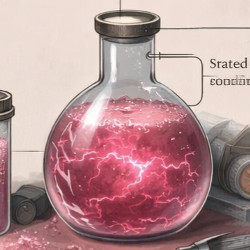
The Scribe works with Sacred Grade Mana Ink: the highest quality ink the Guild produces, stored in the materials vault under controlled conditions and distributed in measured amounts. The ink must be fresh. Old ink—ink that has been sitting for months or whose charge alignment has begun to drift—produces unreliable inscriptions, and an unreliable inscription in a Grimoire does not simply fail. It misfires, and a misfired holy spell channeled through a Priest's body can produce results that range from incomplete healing to internal mana burns that take weeks to recover from.
The Scribe uses specialized tools: brushes so fine they are almost invisible, engraving styluses with tips measured in fractions of a millimeter, magnifying lenses that allow them to see the existing circuitry beneath the verse text. They work slowly. A simple verse addition—something like a basic cleansing pattern or a minor buff—might take a full day. A complex verse family—multi-stage healing sequences, advanced status removal, high-output buff stacking—can take a week or longer.
The process requires absolute focus. A Scribe who makes a mistake mid-inscription cannot simply erase it. Mana ink bonds to the treated paper on contact. A flawed line must be carefully isolated, the surrounding circuitry rerouted to bypass it, and the verse rewritten in a way that compensates for the error without breaking the flow. A Scribe who produces too many flawed inscriptions is removed from active work. The Guild does not tolerate consistent failure in this role. The consequences are too expensive and too dangerous.
Producing new Grimoires (full construction):
Creating a new Holy Grimoire from scratch is the most complex and closely guarded work the Scribes perform, and it is done by the most senior practitioners only.
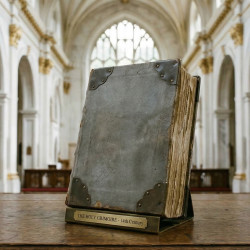
The process begins with the base book: treated paper bound in mana-saturated leather, prepared in advance and stored in the materials vault. The book is blank. No text. No circuits. Just the potential.
The Scribe's first task is the production of the five back pages: the engine that makes everything else possible. These pages are not copied from a template. They are not traced from the First Saint's Grimoire or any other existing book. Each set of five pages is unique, inscribed individually in patterns so complex that no two Scribes produce them identically and no external scholar has ever successfully decoded them.
How the Scribes learned to produce these pages is a question the Saint Guild does not answer. The official position is that the knowledge was passed from the First Saint to the earliest Scribes and has been preserved through unbroken teaching ever since. The unofficial reality, whispered among the most senior Guild members but never confirmed, is that no one fully understands what the five pages do or why the patterns work. The Scribes follow a procedure. The procedure produces functional Grimoires. That is enough.
The inscription of the five back pages takes weeks. The Scribe works in complete isolation, under conditions of mana stability so strict that even minor fluctuations in the building's ambient mana can force a halt to the work. When the pages are complete, they are tested—activated with a measured mana feed to confirm that the circuitry holds and responds correctly. A failed set of five pages is not salvageable. The entire book is discarded, the materials logged as loss, and the Scribe begins again.
Once the five pages are confirmed, the Scribe adds the base verse set: the fundamental healing, cleansing, and stabilization patterns that every new Priest receives. These are inscribed into the front section of the book, integrated with the five back pages through connections so fine they are invisible without magnification.
The completed Grimoire is then sealed, logged, and stored in the deep archive until a new Priest is ready for binding.
The tools and materials
Sacred Scribes work with equipment that exists nowhere else in Versa and that the Saint Guild has never permitted outside parties to examine closely.
Sacred Grade Mana Ink is the foundation of everything they do. It is produced in the Cathedral's underground workshops using methods that are not disclosed even to most Guild members. The ink is stored in sealed vessels in the materials vault, checked daily for stability, and distributed to Scribes in measured quantities that are logged against their active projects. A Scribe who requests more ink than their work justifies is questioned. Waste is not tolerated.
Inscription tools are individually crafted for each Scribe by the Guild's specialist toolmakers and fitted to the Scribe's hand, dominant grip, and working style. The brushes are made from materials that hold mana ink without absorbing it, the styluses are tipped with alloys that do not react with charged ink, and the magnifying lenses are ground to specifications that most opticians would consider unnecessarily precise. A Scribe's tools are kept in their cell, maintained personally, and not shared. When a Scribe dies or is removed from service, their tools are destroyed.
The cells themselves are part of the working system. Each cell is fitted with an independent mana conduit feed that can be regulated from outside, allowing supervisors to adjust the ambient mana pressure in the room to match the requirements of the work. The walls are lined with mana-dampening stone that prevents external interference. The lighting is controlled, stable, and designed to reduce eye strain over long sessions. The ventilation is slow and constant, preventing temperature fluctuations that could affect ink stability.
A Sacred Scribe working in their cell is as isolated from the outside world as it is possible to be while still remaining inside a building in the middle of a functioning city.
The culture of the Scriptorium
The Scriptorium wing has its own internal culture, separate from the rest of the Cathedral and deliberately maintained that way by the Guild's senior leadership.
Silence is the first rule. Conversation in the corridor outside the cells is kept to whispers. Footsteps are softened. Doors are closed carefully. The rationale given is that noise disrupts concentration and concentration errors in Scribe work produce dangerous results. The practical effect is that the Scriptorium feels more like a tomb than a workplace, and Scribes who spend years working there develop a particular kind of stillness that other Guild members find unsettling.
Hierarchy is strict. Senior Scribes oversee junior ones. Masters approve all work before it leaves the wing. Apprentices do not touch active Grimoires until they have spent years practicing on blank materials under direct supervision. A junior Scribe who questions a master's judgement is corrected once. If the behavior continues, they are removed from Scribe training and reassigned to other Guild work. The Saint Guild considers humility and obedience essential traits in this role, and it does not compromise on them.
Isolation is normalized. Scribes work alone. They eat alone. Many sleep in small quarters attached to their cells rather than in the communal clergy housing. Social interaction outside of work-related instruction is minimal. This is not presented as punishment. It is presented as necessity. The work requires focus that social distraction erodes, and the Guild protects its Scribes' effectiveness by protecting their isolation.
The result is a group of people who are extraordinarily skilled, deeply loyal to the institution, and profoundly disconnected from the world outside the Scriptorium's walls. A Scribe who has worked in the wing for twenty years may know every Guild secret related to Grimoire production and almost nothing about the city those Grimoires serve.
What they know (and what they don't)
Sacred Scribes possess knowledge that no one else in Versa can access.
They know how to produce the five back pages of a Holy Grimoire. They know how to inscribe verse patterns that channel the Shepherd's blessing. They know which ink formulations produce stable circuits and which produce dangerous ones. They know the tolerances, the failure modes, the recovery procedures, and the thousand small technical details that separate a functional Grimoire from an expensive mistake.
What they do not know—what the Saint Guild has never successfully explained to them, and what no external scholar has ever decoded—is why the patterns work.
A Sacred Scribe can produce a set of five back pages that will function perfectly for decades. They can inscribe a healing verse that a Priest will use hundreds of times without error. What they cannot do is explain the underlying mechanism. They follow a procedure. The procedure works. When asked why, the most honest answer a Scribe can give is: "Because this is how the First Saint taught us."
This blind spot is not accidental. The Saint Guild has cultivated it deliberately over centuries, teaching the how without ever teaching the why. The result is a body of practitioners who are extraordinarily capable within their defined role and entirely dependent on the Guild for the knowledge that makes that role possible.
A Scribe who leaves the Guild—voluntarily or otherwise—takes their technical skill with them. What they do not take is the understanding that would allow them to teach it to someone else or to replicate the work outside the Cathedral's controlled environment. The knowledge is fragmented, procedural, and incomplete by design.
The Guild considers this one of its most important institutional protections. A stolen Grimoire can be replaced. A rogue Scribe who actually understood the system could not be.
How they are seen (by the Guild and the world)
Within the Saint Guild, Sacred Scribes occupy a position that is simultaneously essential and invisible.
Senior Guild leadership understands their value completely. The Saint, the Council of Seniors, and the highest-ranking administrators treat Scribes with a respect that borders on reverence when it comes to technical matters. A Scribe's assessment of whether a Grimoire modification is possible is rarely questioned. A Scribe's judgement about ink stability or page condition is treated as final.
At the same time, Scribes have no political power. They attend no Council meetings. They make no policy decisions. They are consulted on technical questions and excluded from everything else. The Guild treats them as extremely valuable tools, and tools do not participate in governance.
Among working Priests, Scribes are regarded with a mixture of gratitude and discomfort. A Priest who has just received a new verse in their Grimoire understands intellectually that a Scribe made that possible, but they also understand that the Scribe spent days alone in a sealed cell working on the most important object the Priest owns, and there is something about that level of access and control that never quite feels comfortable. Most Priests thank their Scribe politely, receive their modified Grimoire, and leave as quickly as dignity allows.
Outside the Saint Guild, Sacred Scribes are almost entirely unknown. Most citizens of Versa know that Priests carry Grimoires and that the Grimoires come from the Cathedral, but the specific mechanics of how they are produced and who produces them is not public knowledge. The few scholars, appraisers, or rival institutions who have attempted to investigate have found the Saint Guild uncooperative to the point of hostility.
The Mana Guild, which has its own complex relationship with secrets and proprietary knowledge, has occasionally expressed interest in understanding Grimoire production through a more technical lens. The Saint Guild has never granted them access. The polite explanation is that Grimoire work is sacred and cannot be shared. The practical explanation is that the Saint Guild has no interest in allowing anyone to discover how much of the process even they do not fully understand.
Leaving the Scriptorium (and what happens if you try)
A Sacred Scribe serves for life. This is made clear during the vow ceremony, reinforced throughout training, and treated as non-negotiable by Guild leadership.
In practice, most Scribes do serve for life. The work is stable, the conditions are adequate, and the alternative—leaving the only institution that knows what you do and values it—is unappealing. Scribes who age out of active inscription work are transitioned into supervisory roles, teaching positions, or materials management. They remain within the Cathedral until they die, and when they die, they are interred in the catacombs beneath the deep archive alongside generations of Scribes who came before them.
But some try to leave.
A Scribe who formally requests release from their vows is brought before the Saint and the Council of Seniors. If the request is granted—and it occasionally is, for reasons of health, incapacity, or genuinely irreconcilable personal crisis—the departing Scribe undergoes memory veiling: a ritual performed by senior Priests that suppresses specific technical knowledge without erasing general memory. The Scribe retains their identity, their personal history, and their understanding of the world. What they lose is the procedural knowledge that makes them useful: the steps for producing the five back pages, the tolerances for ink formulation, the integration patterns for verse inscription. The knowledge becomes inaccessible, as if it had never been learned.
The process is described by those who have undergone it as deeply disorienting and, in some cases, emotionally devastating. You know you knew something. You can feel the absence where the knowledge used to be. You cannot retrieve it.
A Scribe who attempts to leave without permission, or who attempts to share Guild secrets with external parties, does not receive memory veiling. They receive containment: removal to the holy prison beneath the Cathedral, where they remain under Guild custody indefinitely. The official position is that such cases are extraordinarily rare. The unofficial reality is that the deep archive contains records of more than a dozen imprisoned Scribes over the Guild's history, several of whom spent decades in custody before dying of natural causes without ever seeing the surface again.
The Saint Guild does not apologize for this. The knowledge Sacred Scribes carry is the foundation of the Guild's power, and the Guild protects its foundations without compromise or sentimentality.
Quick phrasing you can reuse in prose
- "A Priest heals. A Scribe makes the healing possible. Most people never think about the second part." - "She had worked in the Scriptorium for eleven years and had spoken to fewer than twenty people in that time. The silence was no longer strange. It was the noise outside that felt wrong." - "The Guild called them Sacred Scribes. The Scribes called themselves what they were: the people who made the books work and knew better than to ask why." - "He could produce a functional Grimoire from scratch in six weeks. He could not explain why a single line mattered more than another. The procedure worked. That was all the Guild required him to know." - "Leaving the Scriptorium meant leaving the only place that understood what you did. Most Scribes never seriously considered it. The ones who did rarely made it past the second checkpoint." - "The Saint Guild protected its Scribes carefully. It protected their knowledge more carefully still."
Connected records