Living folio · City
Cathedral
The Cathedral is not merely a place of worship. It is the operational fortress of the Saint Guild : the single structure in Versa that simultaneously serves as temple, training ground, production facility, healing house, archive, and prison. It is the place where the Shepherd of Tides is honoured in public...
Overview
The Cathedral is not merely a place of worship.
It is the operational fortress of the Saint Guild: the single structure in Versa that simultaneously serves as temple, training ground, production facility, healing house, archive, and prison. It is the place where the Shepherd of Tides is honoured in public and where the Saint Guild's most carefully protected knowledge is produced, stored, and defended in private. The two functions coexist inside the same walls with a deliberateness that is itself a statement about the nature of the institution.
To the city, it is a cathedral. Beautiful, open, welcoming to the faithful, and reassuringly permanent.
To the Saint Guild, it is a headquarters. And headquarters are not built for beauty alone.
Where it sits
The Cathedral occupies a dedicated district near the center of Versa, close enough to the city's heart to feel central and authoritative, far enough from the Tower's immediate logistics district to maintain the separation between sacred and commercial that the Saint Guild has always insisted upon publicly and quietly ignored in practice.
The district around it is deliberately managed. The streets that approach the Cathedral are wider than the surrounding wards, kept clean by guild-employed workers, and lined with the kind of quietly prosperous establishments that exist to serve an institution of this size: inns for pilgrims and visiting clergy, apothecaries carrying Saint Guild-approved medicines, small shrines that serve as minor overflow for the Cathedral's daily prayer traffic, and the offices of lawyers and scribes who handle the legal and documentary work that any organisation of this influence constantly generates.
The Cathedral itself is visible from most of the inner city. Not because it is the tallest structure in Versa—it is not—but because its white marble exterior catches light in a way that no other building in the city does. In full daylight it is almost luminous. At dawn and dusk the stone takes on a warmth that the faithful describe as the Shepherd's blessing and the architecturally minded describe as a property of the specific marble quarried for its construction. Both may be correct.
The exterior
The Cathedral's outer face is the most deliberately beautiful thing the Saint Guild has ever built, and it was built that way on purpose.
The walls are white marble: not the worn, grey-tinged marble of older city structures but a clean, dense stone with a fine grain that holds its color across decades of weather. The surface is dressed smooth on the primary facades and left with a slightly more textured finish on the secondary walls, creating a visual hierarchy that guides the eye toward the main entrance without requiring signs or direction.
The principal facade faces the approach road from the city center and rises in three graduated tiers. The lowest tier is broad and grounded, punctuated by the tall arched entrance gates and the deep-set windows that flank them. The middle tier narrows slightly and carries the Cathedral's most significant exterior stonework: a continuous carved relief that runs the full width of the facade depicting the founding moment—the Shepherd of Tides appearing to the First Saint at the water's edge, His staff pointing toward the Saint, His anchor held steady, the living shore beneath their feet. The figures are slightly larger than life, their faces worn smooth by generations of weather but their postures still immediately legible. The upper tier rises to the roofline and the twin towers that mark the Cathedral's silhouette against the sky, each capped in gilded stone that catches the sun with an authority that is not accidental.
Gold appears throughout the exterior in specific, considered quantities. The gate hinges and reinforcing plates. The relief figures' significant details—hands, eyes, the Saint's open book. The lettering above the main arch, which reads in the old liturgical script that most visitors cannot parse but all recognise as significant. The gold is not excessive. It is precisely enough to make clear that this institution has resources and has chosen to demonstrate them through restraint rather than extravagance.
Royal purple appears in the fabric elements visible from outside: the banners hung at the tower faces, the door curtains visible through the open gates during services, the ceremonial coverings on the exterior shrine niches. Purple is the Saint Guild's institutional color in the same way that the Mana Guild's pink is theirs—functional identification that has accumulated dignity over centuries of consistent use.
Above the main entrance, carved into the marble in letters large enough to be read from the plaza below, is the opening line of the Shepherd's Creed:
*"The Shepherd stands at the Living Shore."*
The outer wall that encloses the Cathedral's grounds extends well beyond the building itself, running around the full perimeter of the district the Guild controls. It is taller than it needs to be for decoration and thicker than it needs to be for weather. The gates set into it at intervals are iron, heavy, and staffed. The wall reads, to anyone paying attention, as exactly what it is: the boundary between what the Saint Guild shares with the world and what it does not.
The great hall (public worship)
Through the main gates and across a broad forecourt paved in the same white marble as the facade, the Cathedral's principal interior space opens without warning into something that reliably stops people mid-step.
The Great Hall is immense. Not in the aggressive, overwhelming way of military architecture, but in the quiet, sustained way of a space that was designed to make the human scale feel appropriate rather than diminished. The ceiling rises on columns of white marble that line both sides of the central nave, their capitals finished in gold leaf that catches the light from the tall clerestory windows above. The floor is marble laid in a pattern of white and pale grey that draws the eye forward toward the altar without any single element demanding attention.
The benches run the full length of the nave in long parallel rows, dark polished wood that contrasts with the marble around them in a way that makes the space feel inhabited rather than ceremonial. They are worn smooth at the armrests and seat edges in the way that only generations of daily use produces. The Cathedral is open to the faithful every day without exception, and the benches are rarely entirely empty.
Along both side walls, set into deep alcoves between the columns, stand the representations of the Saints.
There are many of them. The Saint Guild's recorded history is long and the alcoves are numerous, each holding a carved figure in white marble with gold detailing at the significant points—the Grimoire held open, the healing hand extended, the eyes cast upward toward the Shepherd. The figures vary in style across the centuries of their production, the older ones more formal and geometric, the newer ones more naturalistic, but the iconographic elements remain consistent across all of them.
At the far end of the nave, dominating the wall behind the altar and rising from floor to ceiling, stands the representation of the First Saint.
It is carved from a single piece of marble so white it appears luminous even without direct light, and it is the only figure in the Cathedral executed in both marble and gold rather than marble with gold detailing. The First Saint stands with both arms extended forward, palms open, the Grimoire resting in the left hand and the right hand raised in the gesture of blessing that appears in every Saint Guild iconographic tradition. The face is idealized to the point of abstraction—no specific features, just the suggestion of calm certainty and focused intent. The gold work covers the Grimoire's pages, the Saint's vestments at the hem and cuffs, and forms a backdrop of radiating lines behind the figure that suggest both water and light—the living shore, the guidance, the blessing channelled.
Behind the First Saint, carved into the marble wall itself in letters that span the full width of the apse, are the final lines of the Shepherd's Creed:
*"We are moored by His grace. We are guided by His hand. We do not follow the dead into the Deep."*
Red appears in the Great Hall in the altar cloths, the candle housings, and the hanging banners between the upper windows—a deeper, richer red than the purple of the exterior, reserved for the interior worship spaces and associated with the active presence of the Shepherd's blessing rather than the institutional identity of the Guild.
The Great Hall is, in every visible way, exactly what it presents itself as: a place of genuine worship, maintained with genuine care, open to anyone who enters in good faith.
What it does not show is everything that exists behind the doors set into the walls on either side of the altar.
The Healing Hall (the Shepherd's work)
Adjacent to the Great Hall, accessible through a wide archway on the right side of the nave marked with the staff-and-anchor symbol carved in gold, lies the Healing Hall: the Cathedral's public medical service and one of its most visited spaces on any given day.
It is called the Shepherd's Harbor by the people of Versa, a name the Saint Guild did not choose but has never discouraged.
The hall itself is large, bright, and deliberately calming. The same white marble continues from the Great Hall, but the atmosphere here is different—warmer, more immediate, less concerned with awe and more concerned with function. Rows of curtained alcoves line both walls, each containing a padded treatment surface, a small table for the Priest's equipment, and enough privacy that a patient does not have to conduct their worst moments in public. The curtains are deep red, the color of the healing function rather than the institutional purple of the Guild's administrative identity. Between the alcoves, benches accommodate those who are waiting.
And there are always people waiting.
The Healing Hall operates on a donation system that the Saint Guild describes in its public literature as a voluntary offering to the Shepherd in exchange for His blessing through the Priest's hands. This description is technically accurate and practically equivalent to a tiered pricing structure, a fact that everyone in Versa understands and very few say aloud in Saint Guild company.
The system works as follows:
At the entrance to the hall sits a reception desk staffed by junior clergy who assess incoming patients and record their donation. The donation is placed in a sealed offering box—gold-plated, marked with the staff-and-anchor symbol, emptied and logged twice daily. The amount given determines which Priest attends the patient, and the Priests available range considerably in rank and therefore in capability.
Minor donations bring a junior Priest: capable of closing fresh wounds, treating common infections, neutralising standard poisons, and managing Tower-sickness in its early stages. This is sufficient for most of the Cathedral's daily traffic—adventurers with cuts that need closing, workers with injuries that would otherwise fester, families with sick children whose illness has a mundane cause.
Substantial donations bring a mid-rank Priest: capable of repairing more serious trauma, treating deeper poison or mana contamination, addressing broken bones that have already begun to set incorrectly, and managing curse-adjacent status effects that minor healing cannot touch.
Major donations bring a senior Priest: capable of work that the rest of Versa cannot replicate at any price elsewhere. Organ damage. Severe mana corruption. Limb restoration for injuries recent enough that the tissue memory is still readable by a skilled Priest's Grimoire. Curse removal of the kind that adventurers acquire in the Tower's deeper floors and spend years trying to find a solution for. Near-death stabilisation in cases where the patient arrived at the Cathedral barely alive and the margin between survival and failure is measured in minutes.
Exceptional donations—the kind that involve significant wealth changing hands and are sometimes negotiated in advance rather than deposited at the reception desk—bring the most senior practitioners the Cathedral houses, Priests whose Grimoires carry verse families that most adventurers will never see performed. These sessions take place in private rooms rather than the curtained alcoves, by appointment, with documentation and discretion.
There is one limit that no donation changes and no rank overrides.
The dead cannot be returned.
The Saint Guild states this plainly at the entrance to the Healing Hall in carved lettering set into the marble above the archway, in both the common script and the old liturgical text:
*"The Shepherd guides the living. He does not reach beyond the threshold."*
A Priest can keep a person alive through conditions that should kill them. They can restore function to a body that has lost it. They cannot restore life to a body that no longer holds it. This is not a limitation of skill or donation. It is a boundary the Grimoire itself does not cross, and no Priest in the Saint Guild's recorded history has ever found a verse that changes it.
The Healing Hall closes at nightfall and reopens at dawn. Emergency cases are directed to a smaller night entrance on the Cathedral's eastern wall, staffed at all hours by a rotating duty Priest.
The waiting benches are rarely empty during operating hours. The Saint Guild has considered expanding the hall three times in the last century. Each time, the expansion has been approved, funded, and completed. Each time, the hall has filled again within a season.
The training grounds and clergy quarters
Behind the Great Hall, accessible through the side doors and through a separate gate in the outer wall for residents, lies the inner compound: the Cathedral's working interior, where the Saint Guild's daily operational life happens.
The clergy quarters occupy the northern section of the inner compound, arranged around a central courtyard that functions as the informal social heart of the Cathedral's resident population. The quarters themselves are simple by the standards of the facade: individual rooms of adequate size, shared bathing facilities, a communal dining hall that produces three meals a day for everyone resident within the walls. The Saint Guild does not believe in luxury for its working clergy. It believes in sufficiency and focus, and the quarters reflect that.
The training grounds occupy the eastern section of the inner compound, a series of connected spaces designed for the different components of Priest formation.
The lecture halls are plain rooms with tiered seating facing a demonstration area, used for the theoretical instruction that forms the first years of a Priest's training—theology, liturgical history, the principles of mana channelling through the Grimoire, the theory of Holy Item production. The walls carry framed texts and diagrams rather than decoration.
The practice halls are larger, higher-ceilinged spaces where trainee Priests work with their newly bound Grimoires under the supervision of senior practitioners. The floors here are marked with positioning guides and cleared of all furniture to allow the full range of healing and buff application exercises. Trainee Priests spend more hours in these rooms than anywhere else in the Cathedral during their formation years. The walls have absorbed years of imperfectly channelled holy mana and carry a faint warmth that is noticeable to anyone with meaningful Resonance.
The chapel of the Bound sits between the training grounds and the clergy quarters: a small private worship space for resident clergy, simpler than the Great Hall but maintained with the same care. It is the one space in the inner compound that is not primarily functional. Along its walls are carved the names of every Priest who has completed their training at the Cathedral and received their blood-bound Grimoire, a record that stretches back centuries and continues to grow with every new binding ceremony.
The Scriptorium wing
The Scriptorium wing is the most strictly controlled section of the Cathedral's above-ground structure.
It is connected to the inner compound by a single corridor that passes through two guarded checkpoints. Beyond the second checkpoint, the architecture changes. The marble continues but the gold disappears. The windows narrow and are fitted with interior shutters that can be closed completely. The doors are heavier. The air is quieter in a way that is not entirely explained by the thicker walls.
The wing is divided into individual Scribe cells: sealed working rooms, each large enough for a single practitioner and their equipment, each fitted with its own mana conduit feed that can be independently regulated and shut off from outside. The cells have no windows to the outside world. They have a small interior window fitted with a shutter that allows a supervisor to observe without entering. Ventilation comes through ceiling channels rather than openable apertures.
The principle is complete isolation.
A Sacred Scribe working on a Holy Grimoire modification or a new inscription requires an environment free of ambient mana interference, free of sound distraction, and free of any possibility of observation that the Scribe has not consented to. The cells provide all three. A Scribe entering a cell for a complex commission may remain inside for days at a time, with meals passed through a small hatch in the door and contact with the outside world reduced to the minimum necessary for the work.
The corridor outside the cells runs the full length of the wing in silence. Conversation above a low murmur is prohibited. The supervisors who walk the corridor do so in soft-soled shoes. The culture of the Scriptorium wing extends even to the people who are not working in it: noise is a contaminant here, and everyone who passes through understands that.
The materials vault sits at the end of the Scriptorium corridor: a locked room where the Sacred Grade Mana Ink, the treated paper stock for new Grimoire pages, and the specialist instruments used in Scribe work are stored. Access requires two authorisations. The inventory is checked against the record every day. Nothing enters or leaves without documentation.
On the walls of the Scriptorium corridor, spaced at regular intervals, are carved the same words in the old liturgical script:
*"Knowledge is sacred. Guard it well."*
The Saint's chambers
Above the Scriptorium wing, accessible by a private staircase that connects to neither the training grounds nor the clergy quarters, lie the Saint's chambers: the personal residence and working space of the Cathedral's highest authority.
The current holder of the Saint's title occupies these rooms and administers the Guild's affairs from them. The chambers are larger than the clergy quarters but not palatial—the Saint Guild's institutional culture does not reward visible excess even at its highest level. What the chambers have that the rest of the Cathedral does not is privacy: complete, structural, enforced privacy. The staircase has one entrance and one exit, both guarded. The chambers have no access from any other part of the building.
The working study is where the Saint receives senior Guild members, conducts the correspondence that connects the Cathedral to the Guild's operations across the known world, and makes the decisions that determine who receives Priest training, which Grimoires are modified, which Holy Items are produced and at what price, and where the Guild's considerable institutional weight is applied in the city's political life.
The study contains, behind a locked panel in the interior wall, the Guild's foundational documents: the original records of the first binding ceremonies, the earliest Grimoire production notes, and the accumulated private knowledge that the Saint Guild has never shared with any external institution and does not intend to.
Above the Saint's desk, carved into the stone of the wall in letters large enough to dominate the room, are the opening words of the Shepherd's command to the First Saint:
*"Guide the living back from the dark waters."*
The underground (what the surface doesn't show)
Below the Cathedral, accessible only through guarded internal staircases that are not marked on any plan the Guild has made available to outside parties, lies the subterranean complex: the part of the Cathedral that the faithful who pray in the Great Hall above will never see and most Guild members will never fully access.
The underground was not built as an afterthought. It was planned from the Cathedral's original construction as a deliberate extension of the building's function, designed to house the operations that the Saint Guild considered too sensitive, too valuable, or too dangerous to conduct at street level.
The deep archive occupies the largest section of the underground: a library of sealed documents, bound records, and stored Grimoires belonging to deceased Priests that fills room after room of reinforced shelving in carefully maintained conditions. The archive is climate-controlled through a system of mana-fed temperature regulators that keep the air dry and stable regardless of the season above. The oldest documents here predate the Cathedral itself. Some of them predate the current form of the Guild. What they contain is not public knowledge.
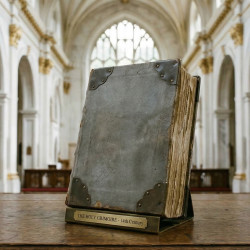
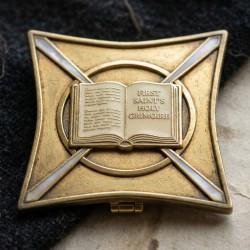
At the center of the deep archive, in a sealed chamber accessible only to the Saint and the most senior archivists, rests the First Saint's Grimoire: the oldest Holy Grimoire in existence, the template against which every Grimoire produced since has been measured. It has not been opened in living memory. It sits in a case of treated glass and reinforced stone, surrounded by wards that prevent ambient mana interference, and it is monitored constantly. The chamber
Connected records