Living folio · Guilds
Ranger Guild
The Rangers Guild is not one of the four seats of the Grand Council. It does not hold civic authority over the city's streets, control the flow of refined stone, monopolise healing magic, or coordinate the commercial networks that keep Versa fed and supplied. In the hierarchy of Versa's great institutions,...
Overview
The Rangers Guild is not one of the four seats of the Grand Council.
It does not hold civic authority over the city's streets, control the flow of refined stone, monopolise healing magic, or coordinate the commercial networks that keep Versa fed and supplied. In the hierarchy of Versa's great institutions, the Rangers Guild occupies a different tier entirely: smaller, more specialised, and built around a single, clearly understood objective.
Put as plainly as the Guild itself would put it: they produce Hunters, and Hunters produce mana stones.
The Rangers Guild is Versa's largest trainer of adventurers by volume. Not because the Hunter class is the most powerful, or the most celebrated, or the most technically demanding. Because it is, by a meaningful margin, the safest reliable path into the Tower. Distance is armour. A Hunter who manages their spacing correctly, reads their terrain intelligently, and keeps their ammunition stocked is operating at a remove from the thing trying to kill them that most other classes never enjoy. That remove translates, over time, into survival rates that other classes do not match, and survival rates translate into a steady, predictable flow of adventurers returning from the Tower with stones to sell.
The Guild understands this calculation precisely. It has built its entire institutional model around it.
More Hunters means more parties descending. More parties descending means more stones coming up. More stones coming up means more Guild tax revenue from every sale at the Guardian Checkpoints, more affiliated adventurers paying their membership contributions, and a larger, more sustainable institution that can train more Hunters. The cycle is not accidental. It is the deliberate product of an organisation that decided, early in its history, that volume and survivability were more valuable than exclusivity and prestige.
The Rangers Guild is not glamorous. It is not selective in the way institutions that pride themselves on selectivity are selective. It is productive, reliably and at scale, and in Versa's Tower economy, productivity is its own form of power.
Origins and Purpose
The Rangers Guild did not begin as a guild in any formal sense.
It began as a tradition.
In Versa's early decades, before the party system had standardised around Anchor capacity and before the Tower's upper floors were anything resembling mapped territory, the people who fought from range were not a class. They were simply archers, throwers, and crossbowmen who had survived enough encounters to understand that staying out of reach was not cowardice. It was method.
These early ranged specialists developed their techniques independently: personal systems of breath control, target reading, spacing, and terrain use that they refined through repetition and near-death experience in equal measure. Some of them taught what they knew to younger adventurers. Some of those younger adventurers survived long enough to teach others. Over time, the accumulated knowledge of what worked and what got people killed in the Tower's specific conditions began to coalesce into something teachable.
The Rangers Guild formalised that accumulated knowledge and then went one step further than most institutions would have. Rather than protecting it, restricting it, and making it exclusive, the Guild made a different decision entirely. It made the knowledge accessible, the training affordable, and the entry requirements achievable for anyone with the physical and mental baseline the class demands.
The result is the largest adventurer-producing institution in Versa. Not the most prestigious. The largest. And in an economy built on consistent stone extraction, largest turns out to matter considerably more than prestigious.
Symbol and Identity
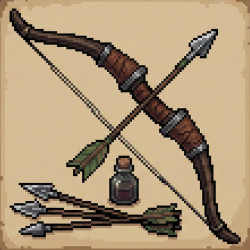
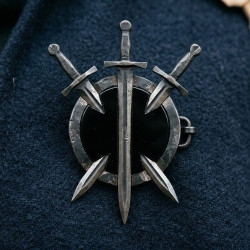
The symbol of the Rangers Guild is a drawn bow with an arrow at full draw, its tip aimed directly toward the viewer.
The image is confrontational in a way that most guild symbols carefully avoid. It does not depict a target struck, a creature defeated, or a trophy claimed. It depicts the moment before. The tension held. The decision not yet made. The arrow pointed outward from the symbol as if the Guild itself is the thing doing the aiming, and whoever looks at the mark is standing in the space the arrow is meant to cross.
The bow is rendered simply, in clean dark lines without decoration. The arrow is straight, the tip sharp and clear. The draw is full, the form correct in ways that experienced archers notice and appreciate and that most civilians simply read as authority. There is no wasted line in the image. No flourish. No background or framing element. Just the weapon, the moment, and the implied distance between them and whatever the arrow is aimed at.
Guild colours run to deep forest green and weathered brown: the colours of terrain, cover, and patience. Not the bright identification colours of an institution that wants to be seen. The colours of something that prefers to see first.
Structure and Leadership
The Rangers Guild is led by a Guildmaster: a single head of institution who holds the position for a term of ten years, after which the senior membership votes on whether to renew the appointment or open the position to new candidates from within the Guild's senior ranks.
This differs meaningfully from the appointment-for-life structures of larger institutions and reflects something important about the Rangers Guild's character. The Guild does not build its identity around any single person. It builds it around the volume and quality of Hunters it produces. A Guildmaster who serves well is renewed. A Guildmaster who does not is replaced without ceremony, because the Guild's value is the instruction it provides, not the individual providing it.
The Guildmaster oversees training operations, manages relationships with other institutions, certifies new Hunters, and represents the Guild in any formal negotiation with the Grand Council guilds. They also oversee the Guild's financial model, which is structured with enough precision that the Guildmaster's office functions as much like a commercial management role as an adventuring leadership one.
Below the Guildmaster, the Guild organises around Range Masters: experienced Hunters who have retired from active Tower descents and taken on instruction as their primary function. Each Range Master is responsible for a specific discipline within Hunter training. Range Masters are not appointed by the Guildmaster. They are recognised by the senior membership when an experienced Hunter demonstrates both the technical depth and the communicative ability to teach what they know reliably under pressure. Many Hunters are technically excellent. Fewer can break down what they do into something a newer practitioner can actually learn from. The ones who can become Range Masters.
Training — What the Guild Actually Builds
Hunter training in the Rangers Guild is not an exclusive programme designed to filter down to a small elite. It is a structured progression designed to take as many people as the class can support and move them through to functional competence as efficiently as possible, without compromising the standard that makes Guild-certified Hunters worth hiring.
Entry and the One-Year Rule
Entry into the Rangers Guild is deliberately accessible. Applicants undergo a baseline assessment covering visual acuity, hand-eye coordination, spatial awareness, and the patient stillness that distinguishes a Hunter's temperament from a fighter's. The bar is real but it is not prohibitive. The Guild is not looking for prodigies. It is looking for people whose instincts are pointed in the right direction and who can be built from there.
Those who pass enter as Trainees and begin their formal instruction period.
The Guild operates on a single defining rule regarding its trainees: if you have not passed your certification assessment within one year of entry, you are removed from the programme.
This rule is not punitive in intent. It is structural. The Guild's model depends on throughput. Trainees who are not developing at the pace the class demands are consuming Range Master time, training range space, and institutional resources that could be supporting someone whose instincts are better aligned with what the class requires. The Guild removes them cleanly, without stigma attached, and in most cases with a direct conversation about which other class their profile might better suit.
The one-year deadline also functions as a motivational structure. Trainees who know the clock is running develop a relationship with their training that more open-ended programmes do not produce. Urgency, applied correctly, accelerates learning. The Rangers Guild has found this to be true consistently enough to build its entire entry model around it.
Foundation Training
The Guild's foundation training covers the mechanics of ranged combat in controlled conditions: stance, grip, draw, release, breathing patterns, sight alignment, and the repetitive drilling of basic form until it is no longer something the trainee thinks about. This phase is unglamorous and deliberately so. Range Masters who rush past fundamentals produce Hunters whose technique collapses under pressure. The Rangers Guild does not rush past fundamentals.
Trainees also begin learning weapon specialisation during this phase. The Guild trains crossbow, longbow, shortbow, and throwing weapon disciplines as distinct tracks, and trainees are assessed early for which primary weapon their physical profile and instincts best support. The choice is guided rather than forced, but the guidance is direct. A trainee who insists on a weapon that does not suit them is a trainee who is going to fail their assessment.
Venom and coating work is introduced during foundation training as a practical field skill rather than a craft discipline. The Guild is explicit about what this is and what it is not. Hunters learn a practical, field-safe subset of coating preparation: the bleed agents, paralytic micro-doses, and irritation toxins that extend their damage output and contribute to fight control. This is tool use. It is not Alchemist-level craft. Trainees who want that depth are redirected toward Alchemist training as a secondary investment, which the Guild actively encourages because a Hunter with genuine coating knowledge is significantly more valuable than one without it.
The Certification Assessment
Full Hunter certification requires passing the Guild Assessment: a two-part test that every trainee must complete within their one-year window.
The first part is a knowledge test. It covers Tower ecology in the upper floors, monster behaviour patterns relevant to ranged engagement, ammunition management principles, party role doctrine, spacing and positioning theory, and the basic protocols of working within a mixed-class party. Trainees who have been paying attention pass this comfortably. Trainees who have been focusing only on their shooting and neglecting the classroom component do not, and the Guild considers that failure informative about how they would perform in an actual Tower situation where information matters as much as technique.
The second part is a practical test: a live assessment on the training range and in a controlled Tower environment, conducted under Range Master observation. Trainees are evaluated on their form, their target selection, their spacing discipline, their ammunition efficiency, and their ability to perform under the specific kind of pressure that comes from knowing you are being watched by someone who knows exactly what good looks like.
Trainees who pass both parts receive full Hunter certification and formal Guild membership. Trainees who fail are given direct feedback and, if their one-year window has not closed, may attempt the assessment again. The Guild does not limit re-attempts within the year. It does enforce the year boundary without exception.
Party Building — The Guild's Structural Contribution
The Rangers Guild produces more certified adventurers than any other training institution in Versa. That volume creates a specific logistical challenge and a specific institutional opportunity simultaneously: newly certified Hunters need parties, and parties need Hunters.
The Guild addresses this directly rather than leaving newly certified members to navigate the party formation process alone.
The Party Matching service is one of the Guild's most actively used functions. Newly certified Hunters register their availability, their weapon specialisation, their preferred floor range, and any relevant experience from their training descents. The Guild's administration then actively facilitates introductions with parties from other institutions, particularly the Guardians Guild's newly certified Vanguards, the Saint Guild's junior Priests, and the Wayfinders Guild's certified Rogues, who are often in the same position of needing to form a first functional party.
The Guild does not form parties by mandate. It does not assign members to teams or dictate composition. What it does is maintain the relationships with other institutions that make introductions possible and create the regular Party Formation gatherings at the Guild's facilities where newly certified adventurers from different classes can meet in a structured context and assess whether they want to work together.
This service is provided at no additional cost to Guild members. The Guild considers it a direct investment in the survival rate of its Hunters. A Hunter who enters the Tower in a well-matched, properly composed party is more likely to come back than one who takes whatever employment is available out of desperation. A Hunter who comes back sells stones. Stones generate tax revenue. The party matching service, in the Guild's internal accounting, essentially pays for itself.
The Rangers Guild also maintains informal relationships with the other class-training institutions that go beyond simple party introductions. Range Masters know the Wayfinders Guild's senior instructors by name. The Guardians Guild's training officers and the Rangers Guild's Range Masters have standing arrangements for joint training exercises that benefit both institutions. These relationships are not formal alliances. They are the practical connections that form between organisations whose members need each other to survive underground, and the Rangers Guild cultivates them with the same pragmatic intentionality it applies to everything else.
The Tax System — How the Guild Sustains Itself
The Rangers Guild does not charge high membership fees. It does not sell information or exclusive access to knowledge archives. It does not hold a monopoly on something the city cannot function without. Its financial model is simpler and more reliable than any of those approaches.
Every Rangers Guild member pays a small percentage tax on every stone and material sale processed through the Guardian Checkpoints.
The mechanism is straightforward. When a Guild Hunter returns from a descent and sells their extracted materials through the Checkpoint's Loot Buyer's office, a defined percentage of the sale value is automatically recorded as a Guild contribution and transferred to the Rangers Guild's accounts through an arrangement with the Guardians Guild that both institutions have maintained for long enough that neither considers the administrative detail worth revisiting.
The percentage is deliberately modest. The Guild's founders understood that a tax set too high discourages honest reporting and creates resentment that corrodes institutional loyalty. A tax set at the right level is simply the cost of membership, low enough that no individual sale feels painful and high enough that the volume of sales across a large membership generates a genuinely substantial institutional income.
The result is a financial model that scales directly with the Guild's primary output. More certified Hunters means more descents. More descents means more stones sold. More stones sold means more tax revenue. The Guild's income grows precisely as its membership grows, which means the institution has a structural incentive to certify as many Hunters as possible, keep them alive long enough to keep selling, and maintain the quality of its training so that its Hunters continue to be the kind of people that parties want to descend with.
Every element of the Guild's model points in the same direction. Volume. Survival. Consistent extraction. Repeat.
What the Guild Does Not Do
The Rangers Guild trains damage dealers. It does not do much else, and it does not pretend otherwise.
It does not gather Tower intelligence. It does not sell maps, route information, floor assessments, or Warden timing data. It does not maintain an archive of tactical observations or offer consultation services on Tower navigation. These functions belong to the Wayfinders Guild, where Rogues are trained and where the information economy of the Tower is managed by people whose entire professional identity is built around knowing things that other people do not.
Rangers Guild Hunters buy from the Wayfinders Guild the same way everyone else does. They pay for maps when they need maps. They purchase route assessments before descents into unfamiliar floors. They use the intelligence that the Wayfinders produce to inform the tactical decisions that their own training has prepared them to make. The two guilds are complementary rather than competitive, and the Rangers Guild's members are among the Wayfinders' most reliable customers precisely because good intelligence and good marksmanship produce better outcomes than either one alone.
The Rangers Guild also does not train combat classes other than Hunter. It does not offer cross-training programmes, does not certify Rogues, Mages, Vanguards, or any other class, and does not attempt to expand its institutional identity beyond the lane it occupies. The Guildmaster's office has received proposals for expansion over the years. They have been declined consistently, on the grounds that the Guild's value comes from doing one thing better than anyone else rather than doing several things adequately.
Membership and Culture
The Rangers Guild's culture is shaped by the volume of its membership and the pragmatism of its financial model in ways that distinguish it clearly from smaller, more exclusive institutions.
It is not an elite club. It does not present itself as one. The Guild's membership includes newly certified Hunters on their first serious contracts alongside veterans with years of Tower experience, and the culture treats both with the same basic professional respect rather than creating a rigid hierarchy of prestige. What matters in the Rangers Guild is whether you come back with stones, whether your party wants to descend with you again, and whether your technique is improving rather than stagnating.
The culture around ammunition discipline and preparation is one of the most distinctive features of Guild life. Hunters who let their supply management slip, who arrive at a descent without appropriate stock, or who make poor tactical choices about committing expensive coated ammunition are corrected directly by fellow members before a Range Master has to do it. The Guild's institutional memory contains too many records of Hunters who ran dry at the wrong moment to treat ammo logistics as anything other than a fundamental professional responsibility. New members learn this quickly. Those who do not learn it quickly tend not to be members for very long.
The Party Formation gatherings held regularly at the Guild's facilities have a social function that extends beyond their official purpose. They are where friendships form, where party relationships develop into lasting professional partnerships, and where the informal community of the Guild's membership maintains itself. The Rangers Guild does not have the tight-knit intensity of a smaller institution, but it has a breadth of community that smaller guilds cannot replicate, and many of its members find genuine belonging in that breadth.
Relationship with Other Guilds
The Rangers Guild's relationships with the major institutions of Versa are almost entirely practical and almost entirely positive, which reflects the fact that the Guild is not competing with anyone for anything they particularly want to protect.
The relationship with the Guardians Guild is the most operationally significant. The tax collection arrangement runs through the Guardians' Checkpoint infrastructure, which means the two institutions have a standing administrative relationship that both find straightforward. The Guardians appreciate the Rangers Guild's contribution to the volume of certified, registered adventurers moving through their Checkpoints. The Rangers Guild appreciates the Guardians' reliable and corruption-resistant processing of its members' sales.
The relationship with the Wayfinders Guild is the most functionally complementary. Hunters need intelligence. Rogues produce it. The two guilds have an informal but genuine mutual appreciation built on the recognition that their members need each other in the Tower in ways that no amount of institutional independence changes. The party matching service the Rangers Guild operates frequently connects its Hunters with Wayfinders Guild Rogues, and both institutions benefit from that connection.
The relationship with the Merchant Guild is commercial and unremarkable. Guild members spend money in Merchant Guild-affiliated establishments. The Merchant Guild sells equipment and supplies that Rangers Guild members need. The relationship functions smoothly because it was never complicated.
Public Perception
The Rangers Guild is viewed by most of Versa's residents with the particular warmth that attaches to something useful and visible without being threatening.
Hunters are everywhere in the city. The Guild's volume means that green and brown guild colours appear in every district, on every market street, and in every tavern where adventurers gather after a descent. Most people in Versa know someone who is a Rangers Guild Hunter, or know someone who knows someone, or at minimum recognise the guild mark on sight and associate it with the category of people who go below and generally come back.
That visibility generates goodwill that more exclusive institutions do not enjoy. The Rangers Guild does not feel distant or powerful or politically complicated to the average Versa resident. It feels like the place young people go when they decide they want to try the Tower and have enough sense to start at a reasonable distance from the thing trying to kill them.
Among the adventuring community specifically, the Guild's reputation is one of reliable competence rather than exceptional prestige. A Rangers Guild Hunter is not assumed to be extraordinary. They are assumed to be trained, functional, and unlikely to do something tactically catastrophic in a corridor. For a party forming up for a standard contract, that assumption is worth a great deal.
The most experienced Tower parties, operating in the deeper floors where the Guild's membership rarely ventures, sometimes speak of Rangers Guild Hunters with a gentle condescension that the Guild itself does not particularly mind. Let them. The Guild's Hunters are alive, selling stones, and paying their tax contributions. The deep-floor veterans can think whatever they like from their considerably more dangerous position.
Quick Descriptive Lines for Prose
- "Most adventurers in Versa wore green and brown. That was simply what the numbers looked like." - "The Rangers Guild didn't promise you would be great. It promised you would come back, and in the Tower that was the more valuable guarantee." - "One year. Pass or go home. The Guild had found that people worked harder when the clock was visible." - "They weren't in the business of secrets. The Wayfinders had secrets. The Rangers Guild had arrows, and arrows were considerably more straightforward." - "The tax was small enough that nobody complained about it more than once. That was how you knew it was set correctly." - "A Hunter who ran dry mid-fight wasn't unlucky. They were underprepared, and in the Guild those were considered very different things." - "Every party needed a Hunter. The Rangers Guild made sure there were enough of them that every party could have one." - "The party matching service had introduced more lasting professional partnerships than any other institution in Versa. The Guild considered this a side effect. Everyone else considered it one of the most valuable things the Guild did." - "Distance is armour. The Rangers Guild had built an entire institution on that single truth." - "They trained more adventurers than anyone else and asked less of them than anyone else. The stones came back anyway. That was the whole point."
Connected records