Living folio · Guilds
Guardians of the Tower Guild
The Guardians Guild is not the most powerful institution in Versa. It is not the wealthiest. It does not hold the monopoly on something the city cannot live without, the way the Saint Guild holds healing and the Mana Guild holds refined stone. It does not move the volume of goods the Merchant Guild...
Overview
The Guardians Guild is not the most powerful institution in Versa.
It is not the wealthiest. It does not hold the monopoly on something the city cannot live without, the way the Saint Guild holds healing and the Mana Guild holds refined stone. It does not move the volume of goods the Merchant Guild coordinates daily. In any direct comparison of resources, influence, or raw commercial output, the Guardians finish last among the four seats of the Grand Council.
And yet nothing in Versa functions without them.
They are the institution that stands between the city and the Tower. Not metaphorically. Physically. Every Checkpoint is a fortress wall between the world people have built and the dungeon that made building it possible in the first place. Every Guardian patrol is a presence that keeps the commerce of a dangerous industry from consuming the city around it. Every adventurer card in the economy was issued from one of their desks. Every mana stone that reached the market passed through one of their warehouses first.
But the Guardians are not simply Tower gatekeepers. They are Versa's law enforcement in its entirety. Their patrols do not stop at the Inner Circle's edge. They extend across every district in the city without exception: the dockside warehouses, the noble quarter walls, the crowded outer residential wards, the market spines of the inner city, the back alleys of the craftsmen's districts, and the long roads that connect the port to the Tower's rim. If something goes wrong on a Versa street, at any hour, in any district, a Guardian patrol is what answers. They investigate crimes, manage public disorder, enforce the city's commercial regulations, settle disputes that spill out of guild halls and taverns into public streets, and serve as the institutional backbone of everything that keeps a city this size from tipping into the particular kind of chaos that only dense, wealthy, and dangerous places can produce.
The Guardians do not sell the stones. They do not refine them. They do not move them in bulk or negotiate the contracts that price them. They simply make sure that everything which crosses the boundary between the Tower and Versa does so in a way that can be tracked, accounted for, and stopped if it needs to be. And they make sure that the city those stones sustain remains a place worth returning to.
That dual function, unglamorous and essential in both its halves, is the entire foundation of what they are.
Origins and Purpose
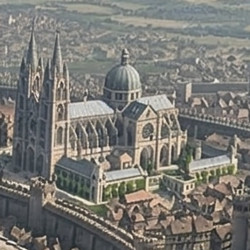
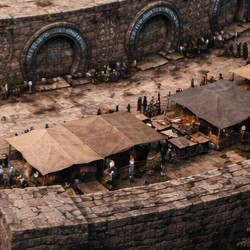
The Guardians Guild is old enough that the original reason for its creation has been absorbed into institutional assumption. Everyone in Versa knows the Guardians manage Tower access. Far fewer people stop to ask why that function required the specific architecture it did, or why the buildings that house it were constructed with the walls, moats, and tower positions of a military fortress rather than a customs house.
The official record states that the Guardians were established to regulate adventurer traffic, prevent uncontrolled extraction, and maintain order in the commercial zone surrounding the Tower's rim. All of this is true. None of it explains the moats.
The Guild's internal documents, which are not public, are somewhat more candid. The Checkpoints were not built to process paperwork. They were built to contain escalation. In the early history of Versa, before extraction was regulated and before the party system standardised around Anchor capacity, incidents occurred at the Tower's edge that required more than administrative response. Things that had been encountered inside sometimes came out in ways that crowds and market stalls were poorly positioned to address. Parties that had been below too long sometimes returned in conditions that required quarantine rather than registration.
The Checkpoints were built with that reality in mind. The processing of adventurer cards and loot purchases is what happens in the Guardians' buildings during normal operations. The architecture reflects what those buildings were also designed to do when operations are not normal.
Over time, as Versa grew from a settlement at the Tower's edge into one of the great cities of the known world, the Guild's mandate expanded alongside it. Guarding the Tower's threshold was one problem. Guarding the city that had grown up around that threshold was another and considerably larger one. The Guardians absorbed both responsibilities without ceremony and without any single founding document marking the expansion. The city needed law enforcement at a scale that no private guild security or noble house guard could provide. The Guardians already had the personnel, the structure, the discipline, and the institutional authority. The transition happened the way most things in the Guardian Guild happen: quietly, practically, and without particular announcement.
The Guardians do not discuss the distinction between what they were and what they became. They do not need to. The institution covers the whole city now. That is simply how things are.
Symbol and Identity
The symbol of the Guardians Guild is three swords driving downward through a black circle: one at the centre, one to each side, all three blades angled to pierce the circle from above and emerge fully from the other side.
The black circle is the Tower. Not a metaphor for it. The Tower itself, its opening, its darkness, the wound in the earth around which Versa was built and upon which the entire city's survival depends. The three swords drive into it from above and pass completely through, their points clearing the far edge without stopping.
The image is not subtle. It is not decorative. It does not aspire to the refined elegance of the Saint Guild's open book or the precise geometry of the Mana Guild's conduit circle. It is a statement of function rendered as plainly as possible: the Guild stands over the Tower, enters it, and comes out the other side. The Tower does not stop the Guardians. The Guardians go through it.
The three swords are rendered in clean, unornamented iron. No gilding. No flourish on the crossguards. No decorative engravings along the blades. The circle beneath them is solid black, absolute and unbroken except where the three blades pierce it, and the points of all three emerge clearly on the far side with enough space visible beneath them to make the passage unmistakable. In some renderings a thin horizontal bar connects the three hilts, suggesting a unified weapon or a wall from which the blades descend. In others the swords stand independently, which gives the symbol a slightly more aggressive and less architectural quality. Both versions are considered legitimate and both appear across Checkpoint signage, uniform insignia, patrol badges, and official documentation depending on regional tradition and the preference of the craftsman producing it. The meaning does not change between them.
The symbol appears on Guardian uniforms, Checkpoint signage, official documentation, and the adventurer cards issued to every registered delver in Versa. It is one of the most frequently seen institutional marks in the city, encountered so often that most residents stop consciously registering it. The card in your pocket has three swords through a black circle. The Checkpoint you pass through has the same mark above its gate. The patrol walking your street wears it on their chest. The symbol is everywhere because the function it represents is everywhere, not just at the Tower's edge but across every street and district in the city.
Guild colours run to iron grey and dark blue: functional, serious, and deliberately free of warmth. The Guardians are not trying to look approachable. They are trying to look reliable, which is a different thing entirely, and the colour choices reflect that distinction at a glance.
The Vanguard Pipeline — The Guild's Most Visible Contribution
Of all the things the Guardians Guild provides to Versa, the one that shapes the city's character most visibly, in both its streets and its dungeons, is this: they train Vanguards.
The Vanguard class does not emerge from independent schools, private academies, or adventurers who taught themselves to hold a line in a dungeon corridor and survived long enough to call it a method. It emerges from the Guardians Guild. Every Vanguard in Versa, whether they eventually descend into the Tower as a professional adventurer or spend their entire career walking a city patrol route, received their foundational instruction inside a Guardian Checkpoint's training barracks. The Guild is the sole institutional source of Vanguard certification, and entry into that instruction requires formal Guild membership.
This is not an accident of history. It is a deliberate arrangement that serves the Guild's dual mandate with unusual efficiency. A city that enforces its own laws and guards its own Tower access needs people who can stand between a threat and the people behind them and hold that position under pressure. The Vanguard is exactly that person, and training them is exactly the kind of long-term institutional investment that suits the Guardian Guild's character.
The pipeline works as follows.
Recruits join the Guardians Guild through the standard intake process: physical assessment, background examination, aptitude review. Those who show the physical and temperamental profile that Vanguard instruction demands are directed into the training track. The qualities the assessors look for are specific and not always the ones recruits expect to be tested on. Raw strength matters but is not the primary measure. What the assessors are looking for is the particular combination of endurance, spatial instinct, aggression management, and capacity to absorb punishment without breaking that distinguishes a functional Vanguard from a person who is simply willing to stand in front of something dangerous.
The training is long, genuinely demanding, and conducted entirely within the Guild's facilities. Recruits learn weapon discipline, guard work, threat reading, forced positioning, the specific endurance conditioning that separates a Vanguard's stamina from a fighter's raw output, and the combat intelligence that makes all of it useful rather than merely brave. They also, during this period, learn the Guardian Guild's institutional culture: the procedures, the authority structures, the values, and the particular discipline of an institution that has been doing a dangerous and necessary job for a very long time without stopping.
At the end of that training, the newly certified Vanguard faces a choice.
They can remain with the Guardians Guild as a city Guardian: patrolling Versa's streets, staffing Checkpoint security, managing public disorder, and serving as the Guild's frontline response to anything that requires a trained body between a problem and the people around it. This path is stable, salaried, professionally respected, and considerably safer than the alternative. Many people make this choice from the beginning and never reconsider it. The city needs them. The Guild values them. The work is real.
Or they can register as an adventurer and take their Vanguard training into the Tower.
Many choose the Tower. The money is better when the contracts are good. The rank progression is faster in environments where genuine threats produce genuine growth. And there is a particular kind of young person, recently certified, newly aware of what they are capable of, for whom the dungeon is simply where they want to be. These adventurer Vanguards move through the party system, take contracts, descend, and build the kind of combat experience that no patrol route can replicate and no training barracks can manufacture.
Many of them come back changed.
The Tower does things to people that are not recorded on an adventurer card. There is damage that accumulates over time in ways that attribute scores cannot capture: the particular exhaustion of repeated lethal encounters, the weight of losing party members to situations that could not be controlled, the specific way the Tower's mana pressure works on a body and a mind that have been inside it too many times and for too long. A significant number of adventurer Vanguards, after some years in the Tower, stop descending. They return to the Guild. They take a city patrol assignment and do not go back below. Sometimes this is a quiet decision made over a period of months. Sometimes it happens after a single run that ends in a way that makes the next one unthinkable.
The Guild accepts them without comment and without ceremony. The transition is common enough that the procedures for it are as routine as any other personnel matter. And the Guild has long since recognised that a Vanguard who has spent three years in the Tower's middle floors brings something to a city patrol that a Vanguard who trained and stayed behind cannot replicate. The Tower experience does not go to waste. It simply gets redirected.
The practical consequence of this pipeline is visible to anyone who pays attention to the composition of adventuring parties in Versa.
Most Vanguards encountered in the Tower are young. Not because the class attracts youth as a matter of personality, but because the experienced ones have largely made their way back to city work. The Vanguard population in active dungeon descent skews strongly toward the recently certified: ambitious, capable, not yet seasoned by the particular education the Tower provides to people who survive it long enough. Veterans exist and are highly sought after precisely because of their rarity, but they are rare because experience teaches most of them, sooner or later, to stop.
This also means there are a great many Vanguards in Versa overall. The training pipeline runs constantly. The Guild certifies new Vanguards on a regular basis because the city needs them in both directions at once, on its streets and in its dungeon, and the demand from adventuring parties for frontline fighters never slackens. The result is a city where the Guardian Guild's symbol is everywhere, its patrol presence is constant, and its most visible product, a young Vanguard in iron grey and dark blue who still has something to prove, is one of the most common sights in both the Inner Circle markets and the streets of the outer wards.
Structure and Leadership
The Guardians Guild is led by a Commander: a single head of institution who holds the position for life and administers the Guild's affairs from the North Checkpoint's command floor, where the view over the Inner Circle and the Tower rim beyond it serves as a permanent reminder of what the job is ultimately about.
The Commander is not elected by public membership vote. They are appointed by a Council of Captains: the senior officers who hold command responsibility over each of the four Checkpoints and the specialist divisions that support them. When a Commander dies or formally steps down, the Council convenes and selects their successor from among the Guild's experienced senior officers. Political manoeuvring occurs during this process. The Guardians do not pretend otherwise. They simply ensure that the manoeuvring happens within the institution rather than involving outside parties, which is considered non-negotiable.
Below the Commander, the Guild divides along two parallel lines.
The Field Command structure runs through the four Checkpoint Captains, each of whom holds complete operational authority over their building, their patrol territories, and the city districts assigned to their zone of responsibility. The city is divided into four patrol sectors corresponding to the four cardinal Checkpoints, each managed by its Captain and staffed by a mix of Vanguard-trained city Guardians and administrative personnel. Beneath the Captains sit ranked officers managing patrol rotations, Checkpoint processing, loot appraisal oversight, criminal investigation, and incident response. The field structure is military in its organisation, direct in its chain of command, and deeply resistant to anything that interferes with clear lines of authority. A Guardian on duty knows exactly who they report to, exactly what they are authorised to do, and exactly what requires escalation. That clarity is considered the foundation of everything the Guild does.
The Administrative structure runs parallel, handling registration records, card production, warehouse management, the postal and orders system, and the legal affairs that inevitably accumulate around an institution that processes this volume of transactions and exercises this breadth of civic authority. Administrative staff are not field Guardians. They are specialists in the bureaucratic infrastructure that makes the operational side function, and they are treated with corresponding respect in the Guild's internal culture, which was not always the case and became so only after several generations of institutional leaders recognised that losing experienced administrators caused operational failures just as serious as losing experienced fighters.
Membership and Culture
Joining the Guardians Guild is not difficult in principle. It is demanding in practice.
Applicants undergo a physical assessment, a background examination conducted through the Guardian's own records systems, and an aptitude review that tests for the particular combination of qualities the Guild has learned to value: steadiness under pressure, reliable judgement about when to act and when to wait, the ability to manage confrontation without escalating it unnecessarily, and the specific kind of patience that comes from understanding that most of what the job involves is not dramatic.
New members enter as junior Guardians and spend their first years rotating through the different functions of Checkpoint operation and city patrol: desk processing, warehouse duty, patrol assignment, and incident support. Those on the Vanguard track move through their training in parallel with this rotation, emerging certified but not yet experienced. That experience comes on the job, either on Versa's streets or in the Tower's corridors, and the Guild considers both equally valid paths toward it.
The culture of the Guild is built around several principles that have been maintained long enough to become genuine rather than performed.
Consistency is the job. The Guardians do not aspire to heroism. They aspire to showing up, performing the function correctly, and being there again tomorrow to do the same. The adventurers who pass through their Checkpoints are often flashier, more individually impressive, and considerably more celebrated by the city at large. The Guardians are not competing with them. They are the infrastructure that makes the adventurers' work possible and profitable, and they know it.
Authority comes from procedure, not personality. A Guardian on duty is not acting on personal power. They are exercising institutional authority within defined limits. This distinction is taught explicitly and reinforced throughout every rank. It prevents corruption in most cases and provides a clear framework for identifying it in the rest.
The line holds. This phrase appears in various forms throughout Guardian institutional culture, in training documents, carved above Checkpoint entrances, repeated in the informal culture of off-duty barracks conversation. It refers to the boundary the Guardians maintain between the Tower and the city. It also refers, more abstractly, to the principle that no external pressure, commercial, political, or personal, justifies compromising the function. The Mana Guild wants a shipment processed faster than regulations permit. The Merchant Guild wants a pass issued without the standard background check. A noble house wants a Checkpoint cleared of witnesses for a private extraction. The line holds. This is what separates the Guardians from a hired security force. They answer to the function, not to whoever is currently paying attention.
There is a fourth principle that is never written down but understood by every Guardian who has served long enough to watch a colleague come back from the Tower and request a city assignment.
The Tower takes, and the Guild receives what comes back. A Vanguard who returns from years of descending is not considered diminished. They are considered experienced in a way that no training exercise can produce and no patrol rotation can replicate. The Guild's culture holds no stigma for the transition from adventurer to city Guardian. It holds considerable quiet respect for people who understood their limits before their limits expressed themselves in the worst possible way.
Relationship with Other Guilds
The Guardians occupy a position in Versa's political structure that is simultaneously central and isolated.
Their seat at the Grand Council gives them formal equality with the Saint Guild, the Mana Guild, and the Merchant Guild. In practice, the dynamics are more complicated. The other three institutions each control something that the economy actively wants. The Guardians control access to something the economy requires but would prefer to take for granted, which is a different kind of leverage and one that is harder to convert into direct political capital.
The relationship with the Mana Guild is the most commercially significant. The Mana Guild's appraisers operate inside Guardian Checkpoints under Guardian license, and the revenue from loot purchasing flows through agreements that are renegotiated on a regular cycle. The arrangement suits both parties and neither is entirely comfortable with how much it suits the other.
The relationship with the Merchant Guild runs on contract and mutual necessity. Merchant Guild pass applications, Inner Circle market access, and material shipment documentation all pass through Guardian hands. The Guardians enforce the rules the Merchant Guild agreed to. The Merchant Guild occasionally tests those rules. The Guardians enforce them anyway.
The relationship with the Saint Guild is the most formally cordial and the least personally warm. The Saint Guild respects the Guardians as a necessary institution. The Guardians respect the Saint Guild as a reliable source of field medical support and a political actor whose interests rarely directly conflict with their own. Neither institution trusts the other more than the working relationship requires, which both consider appropriate.
Among adventuring parties and independent guilds, the Guardians hold a reputation that is almost universally practical. Adventurers do not tend to love the Guardians. They respect the card system, comply with the registration requirements, and appreciate that the Checkpoints exist when they come back up carrying something that needs processing quickly. When a party gets into serious trouble in the city, a Guardian patrol is what they call. The relationship is transactional. The Guardians do not appear to consider this a failure.
Public Perception
Most residents of Versa interact with the Guardians Guild in two ways: at the Checkpoints when their business involves the Tower, and on the street, where the iron grey and dark blue of a Guardian patrol is as routine a sight as the lamp posts and the market stalls.
The general view is one of quiet approval without particular warmth. The Guardians are not beloved the way a priest who closed a grievous wound is beloved, and they are not admired the way a Mage who did something extraordinary is admired. They are trusted in the specific way that a city trusts its infrastructure: without thinking about it much, and with immediate and pointed attention when something fails.
When Guardian processing slows due to staff shortages, the queues become a topic of sharp public comment. When a patrol fails to respond adequately to an incident, the criticism is loud and specific. When a young Vanguard on their first city assignment handles a confrontation badly, the story spreads through the district faster than any official report. When everything works as it should, which is most of the time, the Guardians are effectively invisible. They consider invisibility a measure of success. It is when people are noticing you that something has usually gone wrong.
There is a particular quality to the way Versa's residents relate to Guardian Vanguards that does not apply to the administrative staff or even the senior officers. The young ones, the recently certified, still bearing the clean edges of training and not yet worn down by either the Tower or the street, are viewed with a combination of reassurance and faint concern. They are everywhere. They are capable. And most people in Versa have known at least one person who went into the Tower as a Vanguard and came back to a city patrol route quieter than they left.
Among the city's more politically engaged residents, the Guardians are viewed with a degree of respect that occasionally shades into unease. The institution controls access to the Tower economy at a structural level, enforces the city's laws without external oversight, trains and certifies the largest class of combat-ready personnel in Versa, and maintains records of every registered adventurer, every loot transaction, and every Inner Circle pass issued in the city's recent history. The Checkpoints are fortresses that also happen to process paperwork. The patrols are law enforcement that also happen to be trained for something considerably more serious than street disputes.
Most people in Versa do not think about this distinction very often.
The Guardians are comfortable with that.
Quick Descriptive Lines for Prose
- "They weren't the strongest institution in Versa. They were the one nobody could afford to work around." - "Three swords through the Tower. That was the whole statement. The Guild had never felt the need to elaborate." - "The gate stays open because they hold it. That was the whole job. Nothing more, nothing less." - "She had processed four thousand adventurer cards in eleven years. She knew a lie when she saw one. She also knew which lies were worth pursuing and which ones kept the queue moving." - "The Guardians didn't make you safe in the Tower. They made sure that whatever came out of it didn't get into the city unaccounted for." - "The line holds. It was carved above the door because sometimes you needed to read it before you opened it." - "Other guilds competed for power. The Guardians just kept showing up, and somehow that turned out to be enough." - "The moat had no official explanation. The Guardians had stopped giving one approximately two hundred years ago." - "Most Vanguards in the Tower were young. The experienced ones had learned things down there that made the city streets feel like a reasonable trade." - "You joined the Guild to learn. After that, the choice was yours. Some went down. Some stayed up. Most who went down long enough eventually came back to stay." - "Every street in Versa had a patrol. Every patrol had a Vanguard. Most of them still had something to prove. A few of them had already learned what that cost."
Connected records