Living folio · Guilds
Wayfinders Guild
The Wayfinders Guild is not the largest institution in Versa. It is not the wealthiest, the most militarily capable, or the most publicly visible. Its members do not hold the line at the Tower's edge the way Vanguards do, and they do not flood the city's streets in the numbers that Rangers Guild Hunters do....
Overview
The Wayfinders Guild is not the largest institution in Versa. It is not the wealthiest, the most militarily capable, or the most publicly visible. Its members do not hold the line at the Tower's edge the way Vanguards do, and they do not flood the city's streets in the numbers that Rangers Guild Hunters do. In a crowd of adventurers, a Wayfinder is not always the easiest person to identify.
That is entirely intentional.
The Wayfinders Guild is Versa's primary intelligence institution: the organisation that knows where things are, what is happening inside them, and what that information is worth to the people who need it. They train Rogues. They map the Tower's shifting corridors. They compile, preserve, and sell knowledge about the dungeon, the city, the wider world, and the movements of the powerful within all three. They are the institution that other institutions quietly depend on and rarely acknowledge depending on, because admitting you bought information from the Wayfinders is admitting you did not already have it.
Their product is not weapons or stones or healing or trade routes. Their product is knowing first, and in a city built on the edge of an ever-changing dungeon, knowing first is worth more than almost anything else a guild can offer.
The Rangers Guild produces Hunters in volume. The Guardians Guild holds the city's lines. The Wayfinders Guild produces something harder to count and more difficult to replace: the understanding of what lies ahead, offered to anyone with the coin to pay for it, and withheld from those who cannot or will not.
Origins and Purpose
The Wayfinders Guild did not begin as an intelligence operation.
It began as a mapmaking service.
In Versa's early decades, when the Tower's upper floors were still being explored in earnest and the Topology Shift had not yet been fully understood as a recurring feature of the dungeon's behaviour, the most valuable thing a returning adventurer could bring back was not always a mana stone. Sometimes it was a sketch of a corridor. A note about where a staircase led. A rough marking of where the rest node sat relative to the entrance descent. Maps were worth money, and the people who made them were worth more.
The earliest Wayfinders were not Rogues in any formal sense. They were simply the adventurers who came back with better notes than everyone else, who had developed the habit of observation, the discipline of recording, and the commercial instinct to understand that other parties would pay for what they had written down. Some of them began selling their notes directly. Others began hiring younger adventurers to help them gather information more systematically.
When the Topology Shift was properly understood, the mapmaking service became something considerably more significant. A map that was three weeks old was not a map. It was a liability. The Tower's corridors, connections, and route structures shifted on a reliable cycle, which meant that accurate floor intelligence had a shelf life, and the institution that could consistently refresh that intelligence within each new cycle held a commercial advantage that no amount of physical strength or mana capacity could replicate.
The Wayfinders Guild formalised around that advantage. It built the structures needed to gather information systematically, update it on schedule, and sell it in formats that other adventurers and guilds could actually use. The Rogue class, with its natural orientation toward observation, movement through uncertain terrain, and the extraction of information under pressure, became the Guild's primary training focus not because it was imposed from above but because it was the class that fit the work.
The maps came first. The Guild followed.
What most people in Versa do not fully appreciate is that maps are the Wayfinders Guild's most visible product, not their most valuable one. A floor map expires the moment a new instance generates. Monster behaviour patterns do not. Warden combat tendencies, accumulated across dozens of kill records from multiple instances, do not. The locations and trigger conditions of secret rooms — which reappear in each new instance in different positions but follow consistent internal logic — do not. Survival protocols for specific environmental hazards, knowledge of which consumables counter which Tower conditions, the social intelligence of which parties are reliable and which are not, the gossip that shapes commercial decisions across the Inner Circle — none of it expires with the instance.
The Guild understood this early. Maps are what bring clients through the door. Everything else is what keeps the institution solvent across the three-week cycle regardless of how recently the last instance turned over. A party that buys a map is a client for three weeks. A party that buys a Warden assessment, a monster profile, and a route survival guide is a client indefinitely
Symbol and Identity
The symbol of the Wayfinders Guild is an eye with the silhouette of the Inverted Tower reflected in its pupil.
The eye is rendered in clean, precise lines: a wide iris, a defined pupil, and the suggestion of depth that gives the image the quality of something genuinely watching rather than merely depicted. Within the pupil, rendered small but unmistakable, is the downward-pointing shape of the Tower's opening, reflected as if the eye has looked directly into the abyss and retained what it saw.
The meaning is direct. The Wayfinders see what others do not. They look where others hesitate to look. And what they find in the looking they bring back, organise, and sell.
The symbol appears on Guild documentation, map covers, archive seals, and the subtle insignia worn by Wayfinder members in the field, which are deliberately small and not immediately visible to casual observation. A Wayfinder advertising their Guild affiliation too loudly in the wrong corridor is a Wayfinder who has misunderstood their own institutional culture.
Guild colours run to deep grey and muted gold: the grey of shadow and uncertain spaces, the gold of the lamp that makes those spaces legible. Not the forest colours of the Rangers Guild or the iron and blue of the Guardians. Something quieter and more deliberate, suggesting observation rather than action and precision rather than force.
Structure and Leadership
The Wayfinders Guild is led by a Guildmaster who holds the position for life, appointed by a closed vote of the Guild's senior membership upon the death or formal retirement of the previous holder.
The lifetime tenure is not an accident. The Wayfinders Guild deals in information, and information operations require institutional continuity in ways that other guilds do not. A Guildmaster who serves for ten years and then steps aside takes with them a decade of relationship knowledge, source management, archive context, and operational understanding that cannot be transferred through a briefing document. The Guild has found, over generations of practice, that longer tenure produces better stewardship of its most valuable asset: the trust of the people who sell it information and the people who buy it.
The Guildmaster oversees all Guild operations but is most directly involved in two areas. The first is the senior archive: the collection of information that the Guild considers too sensitive, too valuable, or too operationally significant to be handled through normal distribution channels. The second is the VIP client relationships: the arrangements with noble houses, major guilds, military interests, and other high-value parties who pay for access to information that the Guild does not offer publicly.
Below the Guildmaster, the Guild divides into two parallel structures that reflect its dual nature as both a training institution and an intelligence operation.
The Field Division manages the Rogues who gather information in the Tower and the wider world. It is organised into teams with specific operational areas: floor bands within the Tower, districts within the city, trade routes and foreign contacts beyond Versa's walls. Field Division leadership is made up of senior Rogues who have transitioned from active gathering into coordination and management roles. They assign contracts, review gathered intelligence for accuracy, manage the safety of field operatives, and maintain the operational relationships between Wayfinders working different areas of the same information space.
The Archive Division manages everything that has already been gathered. Archivists, cartographers, scribes, and analysts who process raw field intelligence into the maps, reports, and briefing documents that the Guild sells. The division maintains two distinct catalogues: the instance catalogue, which contains current-cycle floor maps and route assessments that expire with the next instance change, and the persistent archive, which contains monster behaviour profiles, Warden records, secret room logic, environmental hazard guides, survival protocols, and cross-instance pattern analysis that remains valid and commercially relevant indefinitely. The persistent archive is the larger of the two by a considerable margin and represents decades of accumulated institutional knowledge that no single instance change can erase. AAAAAAAAAAAAAAAQMany of these staff are not Rogues at all. They are specialists in their respective crafts, employed by the Guild for their expertise in information handling rather than their fieldwork capability. The Archive Division also manages the Guild's library of publicly available reference material, the tiered client access system, and the production schedule that ensures new intelligence reaches the market within the correct window after each Topology Shift.
The Information Cycle — How the Guild Operates
The foundation of the Wayfinders Guild's commercial operation is the Tower information cycle: a structured, repeating programme of intelligence gathering and distribution built around the Tower's Topology Shift schedule.
Every three weeks, the Tower's internal layout changes. Corridors that connected two points no longer do. Staircases that descended to a given floor now lead somewhere else. Routes that parties had memorised and relied upon become dangerous misinformation. Every map older than the current cycle is, at best, a starting point rather than a guide, and at worst, a document that leads a party confidently into a dead end or an unmapped monster territory.
The Wayfinders Guild built its entire operational model around this fact.
The Gathering Week
In the first week following a Topology Shift, the Guild deploys its field Rogues into the Tower in coordinated teams. These are not adventuring parties in the conventional sense. They are information gathering operations: Rogues whose primary objective is not to fight, not to extract stones, and not to push for depth, but to map, observe, and record as accurately and as quickly as possible.
Standard field teams operate in the Tower's upper floors, up to the twentieth floor. These are the floors that the majority of the Guild's clients operate on, the floors where the commercial adventuring economy concentrates and where accurate maps generate the most immediate revenue. Standard teams are experienced but not exceptional. Their job is coverage and speed: getting through as much of the changed territory as possible within the gathering window and recording what they find with enough precision that the Archive Division can produce usable products from their notes.
Elite Wayfinder teams operate deeper. A small number of the Guild's most experienced and capable Rogues push past the twentieth floor into the territory between the twentieth and thirtieth floors during the gathering week. This work is significantly more dangerous, significantly more expensive to conduct, and produces intelligence that the Guild charges correspondingly more to access. Elite teams are smaller, more autonomous, and operate under looser coordination than the standard floor teams precisely because the territory they work in does not permit the same kind of systematic coverage. What they bring back is partial, imperfect, and enormously valuable.
The Guild does not currently conduct systematic intelligence gathering past the thirtieth floor. The territory beyond that boundary is too dangerous, too unstable, and too resource-intensive for the Guild's standard operational model to cover reliably. What intelligence exists about floors beyond thirty comes from exceptional sources, extraordinary circumstances, and the occasional elite party that descends that deep and survives to report what they found. When this happens, the Guild acquires that intelligence by whatever means are available and treats it as the premium asset it is.
The Processing Week
In the second week of the cycle, the Archive Division works.
Raw field notes, sketches, verbal reports, and recorded observations are processed into usable products: floor maps rendered in the Guild's standard cartographic format, route assessments that identify the fastest paths between known points, hazard reports that flag new monster concentrations or environmental changes, and comparative analyses that note what has changed from the previous cycle and what has remained stable.
This work is skilled and time-consuming. A Rogue's field notes are not a map. They are a record of what one person observed while moving through unfamiliar territory under time pressure and potential threat. Converting those notes into a document that another party can navigate by requires cartographic knowledge, editorial judgement, and a thorough understanding of how the Tower tends to behave when it shifts. Archive Division staff develop that understanding over years of processing cycles, and the most experienced archivists produce maps that experienced adventurers trust with their lives.
Quality control is taken seriously. A map that contains an error does not just fail commercially. It gets people killed, and people who get killed because of a Wayfinders Guild map become a story that spreads through every tavern in the city's adventuring community before the week is out. The Guild's reputation for accuracy is its most commercially valuable asset and the one it defends most aggressively.
The Sales Week
In the third week, finished intelligence reaches the market.
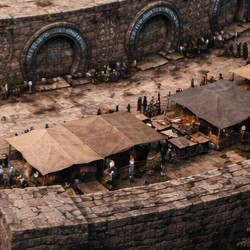
The Guild's public desk operates out of the Wayfinders' Hall, where clients can purchase floor maps, route assessments, and hazard reports for any floor the Guild has covered in the current cycle. Pricing scales with depth. A map of the first five floors costs a modest amount that any newly formed party can afford. A map of the seventeenth floor costs considerably more. A route assessment for the twenty-fifth floor, available only to clients with the appropriate access tier, costs enough that most parties plan around it as a significant expedition expense.
By the time the public desk has been selling for a week, the next instance change is approaching, the next gathering operation is being planned, and the cycle begins again. Floor maps sell hardest in the first days of the sales week and carry a cycle notation showing how many days remain before the next instance renders them obsolete. Persistent intelligence — monster profiles, Warden assessments, survival guides, and the Guild's accumulated reference archive — sells steadily across the entire cycle regardless of timing, because it does not expire with the instance. This persistent catalogue is what the Guild's senior archive staff consider the institution's real product. The maps are the advertisement.
The Tiered Access System — What Money Actually Buys
Not all of the Wayfinders Guild's intelligence is available through the public desk. The Guild operates a tiered access system that determines what each client can purchase, at what price, and under what conditions.
Public Tier
The public desk offers standard floor maps, basic route assessments, and general hazard reports for floors covered by the standard gathering teams. Any adventurer with a registered Guardian card can purchase from the public tier without additional qualification. This is deliberately accessible. The Guild wants as many adventurers as possible using its maps, because adventurers who use the Guild's maps and survive come back and buy the next cycle's maps.
Member Tier
Registered Wayfinders Guild clients, adventuring guilds, and commercial parties who pay a recurring membership contribution gain access to deeper floor intelligence, comparative cycle analyses, and the Guild's historical archive: records from previous cycles that allow experienced parties to identify patterns in how the Tower shifts and predict, imperfectly but usefully, what the current cycle's changes are likely to mean for specific routes.
Member tier clients also receive priority access during the sales week, purchasing new cycle intelligence before it becomes available to the general public. In a competitive commercial environment where multiple parties may be targeting the same floor, being first to the new map is worth the membership cost many times over.
VIP Tier
The VIP tier is not advertised. Its clients do not discover it through the public desk. They are approached by the Guild when the Guild determines that the relationship would be mutually valuable, or they request access through channels that demonstrate they are the kind of client the Guild is willing to work with at this level.
VIP clients receive access to intelligence that the Guild does not offer at any lower tier: deep floor assessments from elite gathering teams, information about specific Warden behaviour patterns, reports on the movements and operations of other major adventuring guilds, city intelligence that has nothing to do with the Tower, and, for the highest-paying clients, bespoke intelligence gathering contracted directly to the Guild's most capable operatives.
VIP relationships are personal in a way that the lower tiers are not. A VIP client does not interact with the public desk or the standard archive. They interact with a specific senior Guild member assigned to manage their account, who knows their operational context, anticipates their intelligence needs, and ensures that what they receive is shaped specifically for what they do rather than formatted for a general audience.
The existence of the VIP tier is not secret. The specific contents of what VIP clients receive are. The Guild maintains this boundary with considerable care.
Rogue Training — What the Guild Actually Teaches
The Wayfinders Guild is the sole institutional trainer of Rogues in Versa. Every certified Rogue in the city passed through the Guild's instruction, and the instruction is shaped entirely by the Guild's operational purpose.
A Wayfinders Guild Rogue is not primarily trained to fight. They are trained to gather information from environments that do not want to give it up, and to survive long enough to bring it back.
Core Instruction
The foundation of Rogue training in the Wayfinders Guild is movement: how to move through uncertain terrain without being detected, without making decisions that trap you, and without losing the situational awareness that keeps you alive when the terrain changes unexpectedly. This is not theatrical stealth. It is disciplined field movement, built on an understanding of how space, sound, and attention work in enclosed and semi-enclosed environments.
Alongside movement, trainees learn observation technique: how to assess a space quickly and accurately, what to record and what to discard, how to remember what you have seen under conditions of stress and time pressure, and how to convert observations into reports that other people can use. This last skill is more difficult than it sounds. Many people can observe. Fewer can communicate what they observed in a form that transfers reliably to someone who was not there.
Navigation is the third core discipline: not just following a route but constructing an understanding of space that persists and updates as the space changes. Wayfinder Rogues develop what experienced members call spatial memory: the ability to hold a mental model of a floor's layout, recognise when it has changed, and update the model correctly rather than continuing to navigate by a version of the space that no longer exists. The Tower's Topology Shift makes this skill essential. Rogues who rely on route memorisation rather than spatial understanding fail after every shift. Rogues who think in models update and adapt.
Field Intelligence Protocols
Beyond the core physical and observational skills, Wayfinder Rogues learn the Guild's field intelligence protocols: the specific methods the Guild uses to ensure that what its operatives gather is accurate, consistent, and usable.
These protocols cover map notation standards, hazard classification, route reliability rating, monster density estimation, and the specific shorthand that Wayfinder field teams use to communicate observations quickly in notes that the Archive Division can process efficiently. A Rogue who completes training and joins a gathering team is not reinventing their recording method. They are applying a system that has been refined over generations of operational cycles and that interfaces directly with the archive processing chain.
The protocols also cover information security: what a field Rogue does and does not discuss outside the Guild, how to handle situations where other parties ask about what has been observed, and how to manage the specific social pressures that arise when a Rogue has information that other adventurers want and is not authorised to share it.
After Certification
A certified Wayfinder Rogue has several paths available to them.
Guild gathering operations are the primary employment track: working as a field operative on the standard or elite gathering teams during the information cycle, contributing to the intelligence that the Guild sells. This is steady, structured work with predictable rhythms and the institutional support of an established organisation.
Independent contracting allows certified Rogues to take private intelligence contracts from clients who need bespoke gathering rather than standard archive products. The Guild facilitates these contracts and takes a percentage of the fee in exchange for providing the client relationship, the legal framework, and the reputational guarantee that comes with Guild certification.
Party adventuring is the path many Rogues choose, at least for a period. A Wayfinder-trained Rogue brings capabilities to an adventuring party that no other class replicates: Tower navigation, hazard detection, information gathering that the party can use directly and sell back to the Guild, and the specific kind of spatial awareness that keeps a group from walking into situations they cannot escape. Many Rogues spend years adventuring before transitioning into Guild operations, and the Tower experience they accumulate during that period makes them significantly more effective as gathering team operatives when they return.
Membership and Culture
The Wayfinders Guild's culture is quieter than most institutions its size and more internally varied than it appears from outside.
Field Rogues and archive staff occupy the same institution but live in very different professional worlds. Field operatives work in danger, uncertainty, and physical demand. Archive staff work in careful, methodical precision in an environment that rewards patience and accuracy over speed and adaptability. The two groups respect each other's competence without always fully understanding each other's experience, and the Guild's culture accommodates both without requiring them to be the same kind of person.
What the culture does require, consistently and across all roles, is discretion. Wayfinders do not discuss what they know with people who have not paid for it. They do not speculate publicly about client relationships. They do not use their access to information for personal advantage in ways that compromise the Guild's commercial integrity. This standard is enforced seriously, not because the Guild is particularly moralistic about information ethics, but because the entire institution's commercial value rests on the reliability of those standards. A Wayfinders Guild that leaks is a Wayfinders Guild that clients stop trusting, and a Wayfinders Guild that clients stop trusting has nothing left to sell.
The culture also rewards accuracy over bravado. A field Rogue who pushes deeper than their mandate and brings back dramatic but unverifiable information is not celebrated. A field Rogue who covers their assigned floors systematically, records accurately, and returns without incident is exactly what the Guild needs and is treated accordingly. The institutional heroes of the Wayfinders Guild are not the operatives who did something impressive. They are the ones who did something reliable for twenty years.
Relationship with Other Guilds
The Wayfinders Guild's relationships with other institutions are shaped by the fact that information is something everyone wants and most institutions are reluctant to admit they need.
The relationship with the Rangers Guild is the most commercially straightforward. Rangers Guild Hunters are among the Wayfinders' most regular customers. They buy maps before descents, route assessments before unfamiliar floors, and hazard reports when they are working territory they have not covered before. The Rangers Guild's party matching service frequently connects Hunters with Wayfinder Rogues, and the professional relationship between the two classes in the Tower is one of genuine mutual utility.
The relationship with the Guardians Guild is more carefully managed. The Guardians control the city and the Checkpoints, which means they have their own institutional interest in knowing what is happening within their jurisdiction. The Wayfinders Guild sells intelligence to the Guardians like any other client, and the Guardians buy it like any other client, but both institutions are aware that the relationship involves a degree of managed tension that the commercial framing does not fully conceal. The Guardians would prefer to know everything the Wayfinders know. The Wayfinders would prefer that the Guardians not know everything they know. The current arrangement represents a negotiated middle ground that neither party is entirely satisfied with.
The relationship with the Merchant Guild is primarily commercial, with the additional dimension that commercial intelligence, information about trade routes, supplier reliability, foreign market conditions, and the movements of competing interests, is one of the Wayfinders Guild's most consistently purchased VIP tier products. Senior Merchant Guild figures are among the Guild's most valuable long-term clients, and the relationship is managed accordingly.
The relationship with the Saint Guild is the most distant of the major institutional relationships. The Saint Guild has little operational need for Tower intelligence and considerable institutional investment in not appearing to traffic in the kind of information the Wayfinders sell. The two institutions interact rarely and professionally when they must.
Public Perception
The Wayfinders Guild is viewed by Versa's general population with a mixture of practical appreciation and vague unease that the Guild has never made any significant effort to resolve.
Adventurers and adventuring guilds view the Wayfinders with straightforward commercial respect. The maps are accurate. The route assessments are reliable. The pricing is what it is, which is to say higher than people would prefer and lower than the alternative of going in blind. The Wayfinders Guild produces something genuinely useful and prices it honestly, which is about as much as most adventurers ask of any institution.
The broader public is less comfortable. The knowledge that an institution exists whose primary function is knowing things and selling that knowledge to whoever pays creates a particular kind of ambient unease in people who are aware that they themselves might be a subject of that knowledge. The Wayfinders Guild does not confirm or deny what it knows about any specific individual or organisation, which does nothing to reduce this unease and probably increases it.
Among the city's politically engaged residents, the Guild is viewed with the specific wariness reserved for institutions whose power is not immediately visible but is understood to be real. A guild that knows where you have been, what routes you took, and what you encountered on the way there is a guild with a particular kind of leverage that does not require any physical force to exercise. Most people prefer not to think about this too directly.
The Guild does not appear to find this troubling. It appears, if anything, to consider it a reasonable reflection of what it actually is.
Quick Descriptive Lines for Prose
- "They didn't fight the Tower. They read it, and reading it turned out to be worth considerably more." - "The eye with the Tower in its pupil. It meant exactly what it looked like: they had seen inside, and they remembered what they saw." - "A map from last cycle was not a map. It was a story about somewhere that no longer existed." - "They sold what they knew to whoever could pay. They knew considerably more than they sold." - "The first week they gathered. The second week they processed. The third week they sold. Then the Tower shifted, and they started again." - "A Wayfinder who talked too freely about a client's business was a Wayfinder who no longer had clients. The culture enforced itself." - "Every party that went below without buying a current map was betting their lives that nothing had changed. Most of the time they were right. The times they were wrong were why the Guild existed." - "The VIP clients didn't come to the public desk. The public desk didn't know their names. That was the arrangement, and it worked because everyone involved understood what it was for." - "Rogues trained there didn't learn to be shadows. They learned to be accurate. In the Tower, accuracy kept you alive longer than invisibility." - "The Guild knew things about the city that the Guardians would have paid considerably to know. The Guardians occasionally did pay. The Guild occasionally told them. The rest stayed in the archive."
Connected records