Living folio · City
Guardians Guild Checkpoints
The Guardian Checkpoints are not offices. They are not customs houses, registration desks, or administrative buildings that happen to have walls around them. They are fortresses : ancient, deliberate, and built with a purpose that the city has never fully agreed on and the Guardians themselves have never...
Overview
The Guardian Checkpoints are not offices.
They are not customs houses, registration desks, or administrative buildings that happen to have walls around them. They are fortresses: ancient, deliberate, and built with a purpose that the city has never fully agreed on and the Guardians themselves have never fully explained.
They are the operational backbone of the Guardians Guild: the institution that controls access to the Tower, registers every adventurer who descends, purchases the materials they bring back up, and maintains the kind of order that keeps Versa's most dangerous industry from consuming the city around it. Every mana stone that enters the economy passes through one of these buildings. Every adventuring party that forms legally does so with a card issued here. Every merchant who wants access to the Inner Circle market applies at one of these desks.
The Checkpoints are, in practical terms, the hinge between the city and the Tower. Nothing moves between those two worlds without passing through them.
And they were built, by everything the architecture suggests, to make sure that whatever came through could be stopped if it needed to be.
How old they are
The Checkpoints are as old as Versa.
Not old in the way that a building becomes old when the city grows up around it. Old in the way that suggests they came first—that the city was built around them rather than they were built to serve the city. The oldest district records in Versa's civic archives reference the Checkpoints as existing structures. There is no foundation document. No original commission. No name attached to the order to build them.
They simply appear in the historical record already standing, already operational, already surrounded by their water barriers, as if they had always been there and someone had simply decided to build a city nearby.
What purpose the original builders had in mind is not recorded anywhere the public can access. The Guardians Guild, when asked, gives the answer it always gives about questions of this kind: the Checkpoints protect the city. That is what they were built for. That is what they continue to do.
The question of what, specifically, they were built to protect the city from is not one the Guild encourages.
Where they sit
There are four Checkpoints, positioned at the cardinal points of the city: North, East, West, and South.
Each one sits at the boundary between Versa's general districts and the Inner Circle: the controlled zone that surrounds the Tower's rim and contains the most direct access routes to the descent points. The Inner Circle is not a residential district. It is a regulated space—the market stalls, appraisal houses, equipment suppliers, and logistical operations that exist specifically to serve the Tower economy. You cannot enter it without passing through a Checkpoint.
The positioning of the four Checkpoints creates a complete ring of control around the Inner Circle. There is no gap. There is no unofficial route. Every person, every cart, every shipment that crosses the boundary between the general city and the Inner Circle does so through one of the four buildings, under the eyes of the Guardians on duty, with documentation that can be checked and recalled.
For adventurers, this means registration, card verification, and daily pass issuance before every descent.
For merchants and civilians, this means a pass application, a stated purpose, and a record of entry and exit.
For materials coming up from the Tower, this means appraisal, purchase, documentation, and transfer to the warehouse system before anything enters the broader city economy.
Nothing bypasses this process. The Guardians have maintained that position for as long as the Checkpoints have existed, and the architecture of the buildings suggests the original builders intended to make it very difficult to argue with.
The water barriers (the fosses)
Before you reach a Checkpoint, you cross water.
Each building is surrounded by a deep water moat: not a decorative channel but a serious defensive feature, wide enough that it cannot be jumped and deep enough that the bottom is not visible from the surface. The water is dark and still, fed by a network of channels that the city's engineers maintain but do not entirely understand, since the original routing of the water predates the civic water infrastructure by a considerable margin.
The moat runs completely around the building on all sides. There are no bridges except two: one facing the general city and one facing the Inner Circle. Both are wide enough to admit a loaded cart and both are controlled by gate mechanisms at the Checkpoint end. When the gates are closed, the building is an island. When they are open, they are the only way in or out.
The moat is not merely defensive in the conventional sense. It also functions as an insulation barrier: a physical separation between whatever is happening inside the Checkpoint and the districts on either side. Old engineering documents that have survived in the civic archive describe the water channels as part of a "containment system," though the context of that phrase has never been satisfactorily explained. Containment of what, flowing in which direction, under what circumstances, is not specified.
The Guardians do not speculate about this in public.
The structure (the cube fortress)
Each Checkpoint follows the same architectural plan without variation. Whether this was a deliberate design decision or simply the result of the same builders working from the same instructions at the same time is not known, but the consistency is absolute. A Guardian who has served at the North Checkpoint and transfers to the South finds the building identical in every meaningful way.
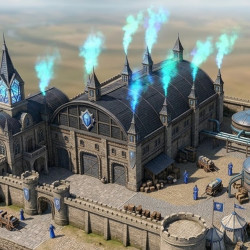
The main structure is a large stone cube: not a tower, not a hall, not a sprawling compound like the Mana Refinery or the Cathedral. A cube. Proportional, symmetrical, and immediately readable as something that was designed to be defensible from every direction equally. The walls are thick dressed stone, the same mana-resistant variety found in the Tower's own construction—a detail that has been noted by every architectural historian who has studied the buildings and explained by none of them.
At each of the four corners of the cube rises a tower: square-based, rising well above the roofline of the main structure, each one fitted with observation positions at the top that provide unobstructed sightlines in all directions. The towers are not ceremonial. They are manned at all hours. The Guardians on tower duty rotate on short shifts because the observation positions are exposed to weather and the Guild has long since learned that cold, uncomfortable guards make worse decisions than rested ones.
The exterior of the cube is plain compared to the Cathedral or even the Mana Refinery's office wing. There is no decorative stonework, no gilding, no banners beyond the functional identification mark of the Guardians Guild above each entrance gate. The building does not attempt to impress. It attempts to endure.
It has succeeded. After however many centuries it has been standing, the stone shows age but not weakness. The corners are sharp. The walls are plumb. Whatever was used to build them was built to last considerably longer than the city around them.
The two entrances
Each Checkpoint has exactly two functional entrances, one on the city-facing side and one on the Inner Circle-facing side, each corresponding to one of the two bridges across the moat.
Both entrances follow the same design: a wide arched gate set into the cube wall, tall enough to admit a loaded cart with room above, flanked by Guardian stations on both sides where the duty personnel check documentation, verify adventurer cards, issue and collect daily passes, and manage the flow of people and material through the building.
The gate mechanisms are heavy iron, operated from inside the building. They can be closed and secured from within without requiring anyone to be outside the walls. This is another feature that reads less like customs administration and more like siege preparation, and it is another feature that the Guardians do not particularly invite questions about.
During normal operating hours both gates stand open and the flow through the building is constant—adventurers heading in, adventurers heading out, merchants with passes, supply carts, material shipments, courier runs. The Checkpoints are busy places during the day and meaningfully staffed at night, because the Tower does not keep business hours and neither do the people who work in it.
Inside the checkpoint
The interior of the cube is divided across multiple floors, each dedicated to a specific function, connected by wide internal staircases built to allow two people to pass each other carrying equipment without difficulty.
The ground floor (the public level)
The ground floor is the busiest part of the building and the only part most visitors ever see.
The central space runs the full width of the cube between the two entrance gates, creating a through-passage that handles the constant traffic of people and materials moving between the city and the Inner Circle. The ceiling here is high—the full height of two normal floors—which prevents the space from feeling cramped despite the volume of people it processes daily.
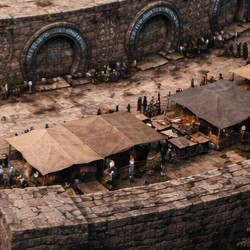
The Loot Buyer's office occupies the right side of the ground floor as you enter from the city. This is where adventurers bring the materials they have extracted from the Tower: rough mana stones, monster parts, relic fragments, alchemical components, salvaged equipment. The office is staffed by Mana Guild-certified appraisers working under Guardian license, seated behind long stone counters with weighing equipment, testing instruments, and the reference documents that allow them to price what they are looking at. The queue for the Loot Buyer's office is rarely short. It moves efficiently because the appraisers are experienced and the process is standardised, but there is always someone waiting.
The Adventurer Registration office occupies the left side of the ground floor. This is where new adventurers register for their cards, where existing adventurers update their documentation, where parties formally register their composition for a descent, and where the daily passes are issued and collected. The paperwork volume here is significant. The Guardians employ dedicated clerks for this function—not field members but administrative personnel who know the registration system completely and process it with the particular efficiency of people who have done the same forms thousands of times.
Between the two offices, the central passage handles moving traffic. Guardians on ground floor duty manage the flow, check passes at the Inner Circle gate, verify cards at the city gate, and maintain the kind of visible, calm authority that keeps a busy crossing point from becoming a crowded one.
The postal and orders office sits adjacent to the Adventurer Registration section, separated by a low partition that makes it technically a distinct space without requiring a separate room. This office handles the logistics of material distribution from the Checkpoint warehouse: receiving orders from guilds and merchants in the city, dispatching shipments, managing the courier contracts that move purchased materials from the Checkpoint to their buyers. It functions like a commercial postal service with the specific focus of Tower economy goods.
The upper floors (Guardian operations)
Above the public ground floor, the upper levels of the cube are Guardian Guild territory. Access from the ground floor requires passing a staffed checkpoint at the base of the internal staircase—a smaller version of the gate process, but no less enforced.
The barracks occupy the second floor. These are functional sleeping quarters for the Guardians currently on rotation at the Checkpoint: rows of beds, storage for personal equipment and duty gear, washroom facilities, and a common room where off-duty personnel eat, rest, and conduct the informal business of people who work together in a confined space for extended periods. The barracks are not comfortable in any luxurious sense. They are adequate, which is the standard the Guardian Guild applies to most things that are not directly operational.
The duty offices and command room sit above the barracks on the third floor. This is where the Checkpoint's senior Guardian manages the rotation schedule, reviews the day's registration records, coordinates with the other three Checkpoints through a messenger system, and handles the administrative function of running a building that processes this volume of people and material daily. The command room has windows facing all four directions—including views over the moat and the approaches on both the city and Inner Circle sides. It is the best-observed room in the building.
The tower positions are accessed from the third floor by internal staircases built into the corner structures. Each tower has observation levels at two heights—a mid-level position sheltered by a partial roof overhang, and a fully exposed top position for maximum sightline. Both are equipped with signal equipment for communicating with the other Checkpoints and with Guardian patrols in the surrounding districts.
The underground (the warehouse level)
Below the ground floor, accessible by a wide goods staircase near the Loot Buyer's office, lies the subterranean warehouse: the Checkpoint's storage and holding level.
The warehouse is large—the full footprint of the cube, minus the structural supports—and built to handle significant material volume. Purchased mana stones and other materials are held here after appraisal, sorted by type and order status, and staged for collection by the guild and merchant buyers who have contracted for them. The shelving systems are stone and metal, permanent fixtures rather than movable racks, organised by a categorisation system that the Guardians have refined over generations of use.
Temperature in the warehouse is stable year-round due to the combination of underground depth, thick stone walls, and a passive mana regulation system built into the floor that no one in the current Guardians Guild fully understands but everyone is careful not to disturb. Materials stored here keep better than they should by normal standards. This is considered a feature and not examined too closely.
Security in the warehouse is the heaviest in the building. Two Guardian personnel are stationed here at all times, in addition to the mechanical lock systems on the access staircase. The value of material passing through the warehouse on any given day is significant enough that the security investment is considered straightforwardly necessary rather than excessive.
The Guardians as city authority
The four Checkpoints together give the Guardians Guild a structural position in Versa that no other institution quite matches.
They are not the city's army. They are not a noble house's private force. They are not a trade organisation or a religious institution. They are the gatekeepers of the Tower economy, and that function makes them, in practical terms, the closest thing Versa has to a standing police force.
Guardian patrols move through both the general city districts and the Inner Circle regularly. They enforce the registration requirements, manage disputes between adventuring parties over contracts and loot claims, respond to disturbances near the Tower access points, and maintain the general order that allows the city's most dangerous industry to function without consuming everything around it.
Their authority is not absolute. The Mana Guild, the Saint Guild, the Merchant Guild, and the noble houses all have their own jurisdictions and their own security arrangements. But in the spaces between those powers—in the streets, at the markets, along the access routes, and at the Tower's edge—the Guardians are the presence that keeps things stable.
The four Checkpoints are the physical expression of that authority: ancient, identical, impossible to bypass, and built in a way that suggests whoever constructed them expected to need them for a very long time.
Quick descriptive lines for prose
- "You didn't enter the Inner Circle. You were admitted to it. The difference mattered to the Guardians, and after the first time you stood in that queue with your card out, it started to matter to you too." - "Four fortresses, four bridges, one function: nothing moves between the city and the Tower without the Guardians knowing about it." - "The moat had no name in any official document. Everyone called it the moat. No one swam in it." - "The building was older than the records that should have explained why it was built that way. The Guardians had stopped finding that unsettling approximately three hundred years ago." - "The Loot Buyer's queue moved fast. The appraisers had seen everything and priced it in seconds. What took time was accepting the number they gave you." - "Every adventurer card in the city had been issued in one of these four rooms. Every stone in the economy had passed through one of these warehouses. The Guardians were not the most powerful guild in Versa. They were the most necessary one." - "The tower positions were cold in winter and exposed in summer. The Guardians staffed them anyway, every hour, without exception. When someone asked why, the senior Guardian at the North Checkpoint gave the same answer she always gave: because something should always be watching."
Connected records