Finding sheet · Mana
Refined Mana Stones
What they are A Refined Mana Stone is not a stone in any natural sense. It does not come from the ground. It is not found in a monster or extracted from a vein in the Tower's walls. It is a manufactured object : a standardised container of processed mana, produced in controlled conditions, shaped to exact...
Overview
What they are
A Refined Mana Stone is not a stone in any natural sense. It does not come from the ground. It is not found in a monster or extracted from a vein in the Tower's walls. It is a manufactured object: a standardised container of processed mana, produced in controlled conditions, shaped to exact tolerances, and charged to a fixed energy output before it ever reaches a customer.
Where a rough mana stone is a natural battery of wildly variable size, purity, and charge—pulled from a monster's core and worth whatever the Mana Guild's appraisers decide it is worth that day—a Refined Stone is something fundamentally different. It is predictable. Every Refined Stone is the same size. Every Refined Stone holds the same charge. Every Refined Stone slots into the same housing, feeds the same device, and lasts exactly as long as the last one did.
That predictability is the entire point.
In a city built around mana-powered infrastructure, unpredictability is the enemy. A heating system that runs on rough stones of variable output is a heating system that is difficult to regulate, expensive to maintain, and prone to failure at inconvenient times. A heating system that runs on Refined Stones is a system that behaves the same way every single day until the stone runs out, at which point you replace it with an identical one and the system continues.
Refined Stones are the industrial backbone of Versa. They are what turns the Tower's chaotic output into a city that functions.
What they look like
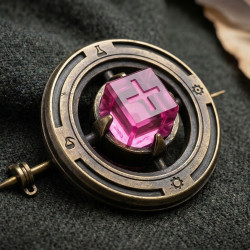
A Refined Mana Stone is a compact crystal cube measuring roughly 4 cm tall, 4 cm wide, and 4 cm deep.
Its shape is clean and geometric, with sharp faces, straight edges, and slightly polished corners that catch the light. It does not look natural or worn down. It looks cut, refined, and deliberate, like a precision-crafted magical crystal rather than something found in the ground. The material is highly polished and translucent, closer to crystal or colored glass than raw stone.
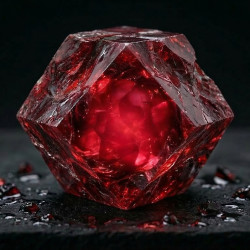
The color is a rich deep pink to crimson, not pale or soft. Light passes through the outer body of the crystal, but the center appears darker and more concentrated, as if dense mana has gathered inside it. The outer edges glow brighter where the light hits, while the core looks turbulent and alive, almost like a suspended flare, ember, or storm of red energy trapped in the middle.
The surface is smooth, glossy, and cold to the touch, with a hard reflective finish. Unlike a rounded gem, this stone has a distinctly cubic silhouette that makes it feel artificial, processed, and valuable. Its clarity is not perfectly uniform: the outer shell is clearer, while the interior is crowded with shifting depth, internal fractures, or dense magical distortion that gives it a vivid, burning heart.
A fully charged Refined Mana Stone feels heavier than its size suggests, with a subtle internal pressure that makes it seem unnaturally dense. Its inner glow is strongest at the core, giving the impression that the mana is compressed into a concentrated central mass. When depleted, that inner radiance fades first, leaving behind only a dull pink crystal shell with little depth and no living light within.
How they are made
The production of Refined Mana Stones takes place in Mana Refineries: large industrial facilities operated under Mana Guild license, found in the industrial wards of Versa close to the Tower's logistics infrastructure. The process is divided into three distinct stages, each conducted in a separate chamber.
Stage One — Extraction (The Crush Chamber)
Rough mana stones of any rank and size are fed into the Crush Chamber: a sealed room built from mana-resistant stone and lined with a mesh of copper-threaded conduit that runs into collection tanks above the ceiling.
Inside the chamber, the rough stones are placed into a mechanical press and crushed under controlled pressure. The crushing is deliberate and graduated—not a single violent impact but a measured compression that fractures the stone progressively. As the stone breaks apart, the mana bound inside it destabilises and begins to release.
This is the dangerous part of the process.
Uncontrolled mana release from a high-rank rough stone can produce heat surges, pressure waves, or mana distortion events in the surrounding area. The Crush Chamber is designed to contain all of it. The conduit mesh lining the walls acts as a collection net, drawing the released mana upward through the copper threads and into the collection tanks before it can dissipate. The tanks are sealed vessels of treated glass and reinforced metal, pre-pressurised to receive the incoming mana without loss.
Workers do not enter the Crush Chamber during operation. The press is operated remotely. After each crush cycle the chamber is vented, checked for residue, and cleared before the next batch is loaded.
The collection tanks, once filled to a measured threshold, are sealed and moved to Stage Two.
Stage Two — Casting (The Mold Floor)
The crushed and fractured stone material left behind in the Crush Chamber after mana extraction is not discarded. It is collected, moved to a furnace room adjacent to the main floor, and melted down in high-temperature kilns until it becomes a uniform molten glass. The natural mineral composition of mana stones, combined with the residual mana saturation left in the material even after extraction, produces a glass with properties that ordinary silicate cannot replicate—the slight density, the pink tint, the frictionless finish.
The molten glass is then poured into standardised molds: metal forms machined to the exact dimensions of the finished Refined Stone. The pour is precise. Too little and the stone is underweight and structurally weak. Too much and it overflows the mold and the stone must be remelted. Experienced casters on the Mold Floor can judge the correct pour volume by eye, but the operation is also governed by measured ladles that remove the judgement from the equation entirely.
The filled molds are set aside in cooling racks and left undisturbed. Forced cooling is not used. The glass must cool at its own rate or internal stresses form in the material that compromise the structural integrity of the finished stone—a stone with internal stress fractures will not hold a charge safely and cannot be sold.
Once cooled, the molds are opened and the raw stones are removed. At this stage they are the correct shape and the correct material, but they are inert. No charge. No luminosity. No internal movement. They are glass ovals that happen to be made from the remains of something that once held power.
They move to Stage Three.
Stage Three — Charging (The Charging Hall)
The Charging Hall is the largest room in the refinery and the most closely regulated.
Along its walls and ceiling runs an extensive network of mana conduits: thick copper-threaded channels that connect directly to the collection tanks from Stage One. The tanks feed into a central charging apparatus—a framework of conduit, valve mechanisms, and glass contact plates arranged in rows above a series of stone cradles.
The raw stones are placed into the cradles one by one, each stone seated into a contact depression that holds it at the exact angle required for even charge distribution. The operator opens the valves controlling the flow from the collection tanks and the mana gathered during the Crush Stage is fed down through the conduit network and into the contact plates.
The plates press against the surface of the raw stone and the mana is driven inward.
The process is slow by design. A stone charged too quickly develops hot spots—areas of concentrated mana pressure that make the charge uneven and reduce the stone's output reliability. The target is a smooth, uniform saturation from the surface to the center, and that requires a controlled feed rate maintained over several hours per batch.
As the charge builds the stones begin to change. The flat dull glass takes on its luminosity. The pink deepens slightly. The internal movement becomes visible. The weight increases in the way that always surprises new workers, that faint sense of the stone becoming more than the sum of its material.
When the charge reaches the target threshold—measured by Guild-certified instruments built into the cradle system—the valves close automatically and the contact plates retract. The stones are removed, inspected individually, and set into the final quality check.
Any stone that shows uneven luminosity, surface stress marks, or an instrument reading outside the accepted tolerance is pulled from the batch and either recharged or remelted depending on the nature of the fault. Stones that pass are stamped with the Mana Guild seal on a small flat point ground into the base during the mold stage specifically for this purpose, then packaged and moved to the distribution warehouse.
What they are used for
Refined Mana Stones are the standard power unit for every mana-fed system in Versa that requires reliable, consistent output.
Domestic and commercial infrastructure - Heating elements in homes, bathhouses, bakeries, and smithies - Mana lamps lining streets, corridors, and public buildings - Lifts, hoisting mechanisms, and automated gate systems in larger structures - Cooking apparatus in inns, guild halls, and institutions
Industrial use - Powering the refineries themselves—the charging apparatus, the kilns, the press mechanisms - Mana conduit maintenance: keeping pressure in building-wide distribution networks stable - Workshop tools with mana-fed components (grinding wheels, precision heating elements, controlled-output welding tools)
Adventuring and Tower use - Standard power source for mana lanterns, portable heating units, and camp equipment - Feeding Anchor runes in Rest Nodes (though deep Anchors may require higher-rank rough stones for activation cost) - Alchemist field equipment that requires a stable mana feed rather than a variable one - Emergency power for enchanted gear when a rough stone runs irregular
What they are not used for - High-output magical work. A Refined Stone delivers consistent low-to-mid output. It cannot replicate the energy density of a high-rank rough stone. A Mage who needs raw power for a demanding cast does not reach for a Refined Stone. Neither does an Anchor drawing from a deep floor. - Personal mana recovery. The charge in a Refined Stone is not compatible with direct biological absorption in the way the Mooring Fee tattoo processes rough stones. They power machines. They do not feed people.
Quick descriptive lines for prose
- "Every stone in the lamp above his head had started life as something that killed a goblin. It was a strange thought the first time. After that it was just infrastructure." - "The pink was always the same. That was the whole point of them." - "Rough stones were wealth. Refined stones were the city running." - "She'd worked the Charging Hall for six years. She still found it strange, watching dead glass wake up." - "Pull the spent stone. Slot the new one. The lamp doesn't care where it came from."
Connected records