Living folio · City
Inversara
Versa is not a city that formed near the Inverted Tower. It exists because of it. It is one of the greatest cities in the known world, vast enough to hold an immense share of the kingdom's people and wealthy enough to stand as its beating heart of trade, power, and survival. Its size should feel overwhelming...
Overview
Versa is not a city that formed near the Inverted Tower. It exists because of it.
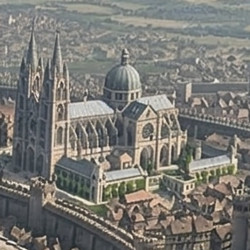
It is one of the greatest cities in the known world, vast enough to hold an immense share of the kingdom's people and wealthy enough to stand as its beating heart of trade, power, and survival. Its size should feel overwhelming even by the standards of great capitals. Versa is not a compact walled settlement clustered around a keep. It is a sprawling coastal metropolis of districts, harbours, temples, noble compounds, crowded wards, and endless rooftops, all gathered around the terrible hollow at its centre. Everything in Versa — its politics, its industry, its social hierarchies, its daily rhythms — bends toward that hollow in one way or another. The city did not choose this relationship. It was born into it, and it has spent every generation since learning how to profit from something that kills people with complete indifference.
The Shape of the City
The city stands beside the sea, and that nearness shapes its character as much as the Tower does. Merchant vessels arrive from distant shores carrying grain, timber, metals, cloth, beasts, oil, rare dyes, spices, and foreign luxuries. In return, Versa sends out worked steel, enchanted tools, refined mana stones, relic fragments, medicines, crafted goods, and wealth drawn from the abyss below. Its docks are never quiet. Its wharves groan under cargo. Its harbours are lined with cranes, warehouses, rope yards, fish markets, and shipwright halls. The sea gives Versa reach. The Tower gives it purpose.
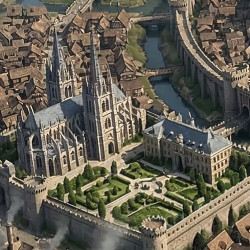
From above, Versa should feel like a city too large to take in at once. Its districts stretch far beyond the central ring of the Inverted Tower, spreading across the land in layers of old stone roads, market avenues, narrow alleys, clustered homes, sprawling inns, guild halls, shrines, counting houses, and smoke-dark workshops. The closer one gets to the inner city, the denser and wealthier it becomes. Houses crowd against one another, taverns wedge themselves between storehouses, and entire streets seem to exist only to feed the constant traffic of labour, trade, and descent. The outer wards are broader, shaped by docks, fisheries, caravans, and incoming trade. The inner wards are older, tighter, and more tightly bound to the Tower's economy.
Noble estates rise behind private walls and iron gates in the districts closest to the inner city, where proximity to the Tower's resources translates directly into political weight. Temple districts ring with bells and the movement of clergy. Market quarters spill over with merchants, animals, shouting porters, and traders selling everything from salted meat and lamp oil to expedition rope, monster bone, and mana stone fragments. Everywhere in the city, life is built on movement. Goods arrive from the sea, are bought and sold in the markets, refined in the workshops, taxed in the halls of power, and sent toward the Tower or drawn back from it.
The Tower at Its Heart
At the centre of everything sits the Inverted Tower: a perfectly circular abyss of impossible depth, its stone rim ancient beyond any record the city holds, its darkness producing a low ambient hum that residents of the inner wards stop noticing within months of arrival and never entirely forget once they leave. Around its rim, the Inner Circle operates as a controlled commercial district — the densest concentration of Tower-adjacent industry in the world. Market stalls, appraisal houses, equipment workshops, information brokers, and taverns built specifically for people about to risk their lives or people who have just survived doing so. All of it enclosed by the outer defensive wall and its four gates, each leading to one of the Guardian Checkpoints that regulate every person and every piece of material that crosses between the Tower and the city.
The Checkpoints are not merely administrative buildings. They are fortresses of dressed stone and deep water moats, ancient enough that the Guardians themselves are uncertain whether they built them or simply inherited them when the institution formed around them. They are the most permanent-looking structures in a city full of old stone, and they communicate something that the rest of Versa's architecture politely avoids stating directly: the boundary between the city and the Tower is managed, not because it is ceremonial, but because something on the other side of it occasionally needs to be stopped.
The Institutions That Run It
Versa is not governed by a king, a council of nobles, or a military authority. It is governed by the Guild Union: a coalition of four institutions whose combined control over healing, mana refinement, law enforcement, and commerce makes them, in practical terms, the only powers capable of administering a city of this size and complexity.
The Saint Guild operates the Cathedral and its network of Chapels, training the Priests who carry Holy Grimoires and providing the only healing magic available in the known world. Their white marble architecture is visible from most of the inner city, and their influence reaches further than their buildings suggest. The Mana Guild runs the Refinery outside the city's formal boundary, refining the rough mana stones that adventurers extract from the Tower into the Refined Mana Stones that power Versa's infrastructure. Their work is why the streets are lit, why the workshops run, and why the city does not simply freeze and go dark when winter arrives. The Guardians Guild holds the Checkpoints, registers every adventurer, enforces the law across every district, and trains the Vanguards that fill both the city's patrol routes and the Tower's more dangerous corridors. The Merchant Guild coordinates the trade that keeps everything moving — the shipping, the supply chains, the contracts, the logistics infrastructure that connects the Tower's output to the people who need it.
These four institutions meet at the Grand Council, a building positioned at the geographic centre of the city with the deliberate symmetry of something designed to remind everyone present that no single power sits at the head of the table. Decisions require three of four votes to pass. The system moves slowly. Most residents of Versa consider this a feature rather than a failure, because the alternative — any single institution gaining enough leverage to govern alone — is the kind of thing that people in Versa discuss in the same tone they use when talking about what happens if the Tower's deeper floors are ever fully breached.
The Mana Revolution and What It Changed
Versa today is not the Versa of two hundred years ago. The Mana Revolution — the Mana Guild's development of industrial refinement processes and the Mana Generator — transformed the city from a wealthy but fundamentally pre-industrial settlement into something that has no precise equivalent elsewhere in the known world.
Before the revolution, mana was a scarce specialist resource. Adventurers extracted rough stones. Wealthy individuals purchased them for personal use. Mages channelled mana directly, Priests worked through their Grimoires, and the rest of the population made do with oil, timber, and manual labour. After the revolution, refined stones became a standardised power unit. Generators became infrastructure. Conduit networks ran through the walls of buildings across every district. Mana lamps replaced oil on the city's streets. Heating elements replaced open fires in workshops and homes. Mechanical lifts appeared in the buildings of anyone who could afford the installation.
The revolution did not distribute its benefits evenly, and Versa's social geography reflects this clearly. The inner wards have reliable mana infrastructure maintained on regular schedules by contracted Guild technicians. The outer wards have infrastructure of varying quality, maintained when it breaks rather than before it does. The dockside districts have coverage that stops and starts depending on which buildings are old enough to have been retrofitted and which were built before the standardisation existed. The quality of the lamps on a street tells you more about which district you are standing in than any sign would.
A City That Knows What It Is
What makes Versa distinct from other great cities is not its size, its wealth, or even the Tower at its centre. It is the particular quality of self-awareness that develops in a population built around an industry that kills people regularly and cannot stop.
Everyone in Versa knows someone who went into the Tower and did not come back. Everyone understands, at some level, that the stones powering the lamp above their head came from a monster that an adventurer killed at personal risk somewhere below the city they are standing in. The economy is visible in a way that most economies are not. The danger is visible. The dependency is visible. And the city has developed, over generations of living with all three simultaneously, a culture that is pragmatic about mortality, commercially sophisticated about risk, and deeply invested in the institutional structures that keep the whole arrangement from collapsing.
It is not a comfortable city in the way that places built around safety and abundance are comfortable. It is a city that works, which is a different thing entirely, and most of its residents would argue it is the more valuable one.
Connected records