Living folio · Lore
Guild Union
The Guild Union is not a single institution. It is not a government in the conventional sense, with a monarch, a council of elected representatives, or a military authority that enforces law through force alone. It is a coalition of powers that have agreed, through centuries of negotiation, compromise, and...
Overview
The Guild Union is not a single institution. It is not a government in the conventional sense, with a monarch, a council of elected representatives, or a military authority that enforces law through force alone.
It is a coalition of powers that have agreed, through centuries of negotiation, compromise, and occasionally violent disagreement, that Versa functions better when the four institutions that actually run it coordinate their actions rather than competing for dominance at the city's expense.
The Union is governed by The Grand Council: a body composed of representatives from the Saint Guild, the Mana Guild, the Guardians Guild, and the Merchant Guild—the four institutions whose combined control over healing, mana refinement, law enforcement, and commerce makes them, in practical terms, the only powers in Versa capable of administering a city of this size and complexity.
The Union does not rule through military might. It does not hold a monopoly on violence. What it holds instead is a monopoly on everything that makes the city function: the only source of healing magic, the only legal refinery for mana stones, the only institution authorized to regulate Tower access, and the largest coordination network for trade and supply chains. A person can live in Versa without the Union's approval. They cannot live well, and they cannot participate in the Tower economy that makes Versa worth living in.
The Guild Union is not beloved. It is not feared in the dramatic way that armies are feared. It is simply unavoidable, in the way that gravity is unavoidable, and the city has long since stopped questioning whether the arrangement is ideal and settled into the more practical question of whether it works.
It does work. Not smoothly. Not without friction. But it works.
The Four Powers (what each guild controls)
The Saint Guild — Healing and Faith
The Saint Guild controls the only healing magic in the world through its monopoly on Holy Grimoire production and Priest training. It operates the Cathedral, maintains the Chapel network across Versa, runs the Healing Halls where the wounded are treated, and administers the faith of the Shepherd of Tides—the god who guides the living back from death's edge.
Their leverage is simple and absolute. If you are dying, they are the only institution that can prevent it. That makes them essential in a way that no amount of wealth or military force can substitute for.
The Saint Guild's position at the Grand Council is built on this foundation: they do not need to threaten anyone. They simply need to be the institution that everyone, eventually, requires.
The Mana Guild — Refinement and Industry
The Mana Guild controls the refinement of rough mana stones into Refined Mana Stones and the production of mana-powered infrastructure that keeps Versa functioning. They operate the Mana Refinery, train Alchemists, develop enchanted items and Mana Generators, and maintain the supply chains that feed mana into every district of the city.
Their leverage is equally absolute. Every lamp on every street runs on stones the Mana Guild processed. Every heating system, lift mechanism, workshop forge, and piece of enchanted gear depends on their output. The Tower produces the raw material. The Mana Guild turns it into civilization.
The Mana Guild's position at the Grand Council is built on industrial necessity: they are the institution that keeps the lights on, literally and without alternative.
The Guardians Guild — Law and Access
The Guardians Guild controls access to the Inverted Tower through the four Checkpoints that ring the Inner Circle, regulates who can descend and under what terms, purchases the materials that adventurers bring back up, and enforces the law across every district of Versa. They train Vanguards, staff the city's patrols, and maintain the physical barriers between the Tower and the world above.
Their leverage is structural. Nothing crosses the boundary between the Tower and the city without passing through a Guardian Checkpoint. No adventurer operates without a Guardian-issued card. No contract is legal without Guardian documentation. The Guardians do not control wealth or healing or mana refinement. They control the gate, and in a city built around extraction, the gate is everything.
The Guardians Guild's position at the Grand Council is built on their role as the city's infrastructure of order: they are the institution that prevents the Tower economy from consuming Versa in the process of sustaining it.
The Merchant Guild — Trade and Supply
The Merchant Guild coordinates the movement of goods into and out of Versa through the Harbour Halls, manages the city's supply chains, operates the affiliation system that most of the city's merchants depend on, and trains the Craftsmen who build and maintain the physical tools and structures that the Tower economy requires.
Their leverage is logistical. The stones may come from the Tower, but the Merchant Guild is what ensures they reach the people who need them. The food that feeds the city arrives on ships the Merchant Guild scheduled. The tools that adventurers carry were made by Craftsmen the Merchant Guild trained. The inns and taverns where the city's social and commercial life happens operate under Merchant Guild standards.
The Merchant Guild's position at the Grand Council is built on the fact that every other institution depends on things moving reliably from one place to another, and no one else in Versa can coordinate that movement at the scale the city requires.
How the Union actually governs
The Grand Council does not govern Versa in the way that a king governs a kingdom or a mayor governs a town.
It governs through negotiated agreements between four institutions that each control a different essential function and that cannot operate without the others' cooperation. No guild has enough power to dominate the other three. No guild is weak enough to be ignored. The result is a system that moves slowly, changes reluctantly, and maintains itself through the accumulated weight of precedent rather than through any single visionary leader's direction.
The voting system
Any significant decision—new city-wide laws, changes to taxation, major infrastructure projects, revisions to the Tower access regulations, diplomatic agreements with foreign powers—requires a vote at the Grand Council table. Each of the four guilds holds one vote. A measure passes if three of the four guilds consent. Two votes is not enough. Unanimous agreement is not required but is occasionally achieved on matters where all four guilds recognize a shared threat or opportunity.
This three-vote threshold was set at the Union's founding and has never been changed, because changing it would itself require three guilds to agree that it should be different, and no coalition of three has ever found that agreement.
The practical result is that the Grand Council moves slowly. Months of negotiation often precede any formal vote. Compromises are layered into every proposal before it reaches the chamber. The guilds spend more energy maintaining existing agreements than creating new ones, because creating new agreements is exhausting and frequently fails.
This is considered, by most of the Council's longer-serving members, to be working as intended. A city that changes too quickly is a city where someone is accumulating too much power. A city that changes slowly is a city where no single institution has managed to dominate the others. The Guild Union was not designed to be efficient. It was designed to be balanced.
What the Council actually decides
The Grand Council does not micromanage the city. Each guild administers its own domain with near-total autonomy. The Saint Guild sets its own donation scales. The Mana Guild determines its own refinery operations. The Guardians manage their own patrol schedules. The Merchant Guild runs its own affiliation system.
What the Council decides are the boundaries between those domains: where one guild's authority ends and another's begins, how disputes between guilds are resolved, and what happens when an action by one guild affects the operations of another in ways that require negotiation.
Examples of issues that reach the Council table: - Checkpoint processing fees affecting Merchant Guild shipping schedules - Mana Guild pricing changes that impact Guardian operations or Saint Guild Grimoire costs - Saint Guild expansion into districts where Merchant Guild-affiliated establishments already operate - Guardian patrol authority in areas where other guilds claim jurisdictional primacy - Infrastructure projects requiring cooperation from multiple guilds (roads, conduit networks, new district development)
The Council also handles external diplomacy on behalf of the city: trade agreements with foreign powers, military alliances, and the formal relationships between Versa and the other great cities of the known world. No single guild speaks for Versa in these matters. The Grand Council does, through representatives who must coordinate positions that all four guilds can support.
The balance of power (and what keeps it stable)
The Guild Union has survived for centuries not because the four guilds like each other, but because none of them can function without the others, and all of them understand this fact clearly enough to prevent any serious attempt at dominance.
Why the Saint Guild cannot dominate:
They control healing, which is essential. But healing requires mana stones, which the Mana Guild refines. It requires patients who can reach the Cathedral, which the Guardians' law enforcement makes possible. It requires food, supplies, and the economic infrastructure that the Merchant Guild coordinates. A Saint Guild that attempted to impose its will on the other three would find its Chapels undersupplied, its Healing Halls understaffed, and its political isolation from the city's commercial life rapidly becoming unsustainable.
Why the Mana Guild cannot dominate:
They control mana refinement, which is the foundation of everything. But refined stones require rough stones, which adventurers extract under Guardian regulation. The infrastructure that distributes those stones is Merchant Guild territory. The workers who keep the refineries running need healing when accidents happen, which the Saint Guild provides. A Mana Guild that attempted to leverage its refinement monopoly into total control would find its supply chain disrupted, its workforce unprotected, and its political position in a city that depends on all four guilds untenable.
Why the Guardians Guild cannot dominate:
They control the Checkpoints and enforce the law, which is genuine power. But Guardian operations require mana for their infrastructure, which the Mana Guild refines. Their Vanguards need healing when Tower runs go badly, which the Saint Guild provides. The food, equipment, and logistical support that keeps the Guardians functional is Merchant Guild territory. A Guardians Guild that attempted military dominance would find itself operating fortresses that cannot be lit, staffed by people who cannot be healed, and isolated from the commercial networks that supply everything the institution needs.
Why the Merchant Guild cannot dominate:
They coordinate trade and supply, which touches everything. But merchants need healing when illness or injury strikes. Their operations depend on mana-powered infrastructure. Guardian law enforcement protects their shipments and their property. A Merchant Guild that attempted commercial dominance would find its warehouses unlit, its members unhealed, and its shipping routes unprotected in a city where lawlessness makes commerce impossible.
The result is a forced interdependence that none of the four guilds can escape and all of them have learned to work within. They negotiate. They compromise. They occasionally threaten each other in ways that never quite cross into action. They remain seated at the same table, year after year, because leaving means losing access to everything the other three control.
The Tavern Guild (the exception)
There is a fifth seat at the Grand Council table, and it is occupied by an institution that is not one of the four founding powers.
The Tavern Guild holds a permanent, non-negotiable seat with full voting rights, despite being formally affiliated with the Merchant Guild rather than independent.
The arrangement is historical. The Tavern Guild was one of the earliest commercial interests to affiliate with the coalition that eventually became the Merchant Guild, and the terms of that original affiliation included a voice in governance that was never revoked when the structure formalized. The Tavern Guild's operations—inns, taverns, restaurants, and the social infrastructure of the city—are large enough, wealthy enough, and integrated enough into Versa's daily life that the Merchant Guild has never seriously attempted to absorb them fully or remove their Council seat.
The other three guilds tolerate the arrangement because the Tavern Guild's vote, in practice, tends to align with pragmatic commercial stability rather than factional interest. The Tavern Guild benefits when the city functions smoothly. They vote accordingly. This makes them a surprisingly reliable coalition partner when deadlock threatens, which has happened often enough over the Union's history that all four major guilds have quietly come to value the Tavern Guild's presence more than they publicly acknowledge.
Public perception
The Guild Union is viewed by Versa's general population with the particular mixture of acceptance and resentment that attaches to any governing body that is both necessary and imperfect.
The pragmatic majority accept the Union as the system that keeps the city running. They may not love it. They may complain about specific policies, fees, regulations, and the occasional decision that makes no sense from street level. But they understand that the alternative—four competing powers with no mechanism for coordination—would be considerably worse.
The resentful minority point to the Union's slow decision-making, its resistance to reform, the institutional self-interest that each guild brings to the table, and the fundamental reality that the four powers are not accountable to the population in any direct way. The Guild Union was not elected by the people of Versa. It was formed by the institutions that already held power, and it has maintained that power through control of essential functions rather than through popular mandate.
The cynical note that the Union's stability depends on mutual dependency rather than mutual trust, and suggest that the moment one guild finds a way to break free of that dependency, the entire structure will collapse. The Guild Union does not publicly respond to this characterization. Privately, its longest-serving administrators consider it an accurate description of the system's weakness and the reason the Union invests so heavily in ensuring that no guild ever finds that breaking point.
The faithful, the merchants, the adventurers, and the laborers do not generally think about the Guild Union as a unified entity. They think about the individual guilds whose services they use. The Saint Guild heals them. The Guardians regulate them. The Mana Guild powers their homes. The Merchant Guild supplies their needs. That these four powers coordinate through a formal structure most Versa residents are dimly aware of but rarely interact with directly.
The Guild Union prefers it that way. Visibility invites scrutiny. The Union governs most effectively when most people are not paying attention to the fact that they are being governed.
Strengths and weaknesses
Strengths:
- No single point of failure. The Union cannot be decapitated. If one guild's leadership collapses, the other three continue operating. - Enforced pragmatism. The three-vote threshold prevents any single guild from imposing purely factional policy. Measures that pass are usually measures that genuinely serve the city rather than one institution's interest. - Deep institutional knowledge. The guilds have been coordinating through this structure for generations. The processes, the precedents, and the informal relationships that make the system work are well-established. - Stability through inertia. The Union resists dramatic change, which prevents the kind of rapid policy swings that destabilize cities and economies.
Weaknesses:
- Glacial decision-making. Urgent problems that require fast action often do not receive it. The Union is built for stability, not speed. - Factional deadlock. When two guilds oppose a measure, it dies regardless of its merit. Good proposals fail as often as bad ones. - No accountability to the public. The guilds answer to each other, not to the population. A policy that all four guilds support but the city hates still passes. - Vulnerability to external disruption. The Union's power depends on the four guilds maintaining their current monopolies. A technological breakthrough, a foreign invasion, or an internal revolution that breaks one guild's control threatens the entire structure.
The Grand Council building (the physical seat)
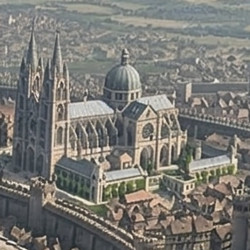
The Grand Council meets in a dedicated building positioned at the geographic center of Versa, deliberately placed at equal distance from each guild's primary headquarters.
The building is large, formal, and neutral in its architecture: dark polished stone, four equal sections on the facade each bearing one guild's symbol, and a round discussion chamber at its heart with no head of table and no elevated position. The design was a compromise between four institutions that could agree on almost nothing except that none of them should appear more important than the others in the space they shared.
The entrance hall is tall and impressive, supported by four rows of columns—one for each guild, each carved from stone that carries that guild's associated color. Deep red carpets run the length of the hall. The walls display the Union's history in carved panels and framed documents, telling the story of every significant decision the Council has made since its founding.
The gaps in that timeline are longer than the entries.
The discussion chamber is a round room with a domed ceiling, plain stone walls interrupted only by four alcoves holding lamps in each guild's color, and a round table at the center large enough to seat all four guilds' representatives with their advisors. The chairs are identical. The floor is inlaid stone in four equal quadrants meeting at the center point beneath the table.
Voting requires three of the four guilds to consent. This threshold has never changed because changing it would require the same three-vote consensus.
The office wings house the Grand Council's administrative staff: personnel seconded from all four guilds in equal numbers, working under Council authority rather than their home institution's direction. Each guild also maintains a dedicated representative suite furnished according to their own preferences—the only part of the building where guild identity is openly expressed.
The underground level, accessible through a side entrance that most visitors do not look at longer than necessary, contains the Union's prison: where those who violate agreements between guilds, break contracts that cross jurisdictional boundaries, or commit offenses that all four powers agree warrant containment are held under joint custody.
How the Union came to be (brief history)
The Guild Union was not founded in a moment of visionary leadership or collaborative goodwill.
It was founded after a jurisdictional war that nearly destroyed the city.
In Versa's early history, before the Union existed, the institutions that would become the four great guilds competed openly for dominance. The Saint Guild controlled healing and used that leverage to extract concessions. The proto-Mana Guild attempted to monopolize all mana stone trade. The Guardians sought to expand their law enforcement into domains other institutions considered their own territory. The Merchant interests fought to maintain independence from all three.
The conflict escalated over years into something that historians describe with remarkable consistency as a disaster that everyone saw coming and no one prevented. Trade disrupted. Healing withheld. Checkpoint access restricted. The city's economy contracted. Violence between guild-affiliated forces became common enough that ordinary commerce in the inner city became dangerous.
The breaking point came when a coordinated shutdown threatened to collapse multiple essential functions simultaneously: the Saint Guild refusing to treat non-paying patients, the Guardians closing Checkpoint access except under emergency authorization, the Merchant coalition halting food shipments into districts controlled by rival powers, and the Mana refiners threatening to cut power to entire wards.
The city was days away from famine, darkness, and the kind of civil collapse that no individual guild could survive.
The four powers convened—not because they wanted to, but because the alternative was mutual destruction—and negotiated the founding agreement of what would become the Guild Union. The agreement established: - Formal recognition of each guild's primary domain - The three-vote decision threshold - The neutral Council building and equal representation structure - The prohibition on any guild using its monopoly to directly threaten another's core function - The dispute resolution mechanisms that channel conflict into negotiation rather than violence
The agreement did not make the guilds friends. It made them bound parties to a contract that all four recognized as preferable to war.
The Guild Union has operated under that contract ever since.
The Union's authority (what it can and cannot do)
What the Union controls:
- City-wide law and policy (when three guilds agree) - Taxation and public works (funded through guild contributions and coordinated projects) - Diplomatic relations (Versa speaks to other cities and kingdoms through Council representatives) - Inter-guild disputes (formal arbitration when guilds cannot resolve conflicts internally) - Emergency coordination (natural disasters, military threats, Tower disruptions affecting the entire city)
What the Union does not control:
- Individual guild internal operations (each guild governs itself) - Private contracts and commerce (the Merchant Guild coordinates but does not dictate) - Religious doctrine (the Saint Guild's relationship with the Shepherd of Tides is theirs alone) - Military command (Versa has no standing army; the Guardians are law enforcement, not soldiers)
The distinction between Union authority and guild autonomy is not always clean, and much of the Grand Council's actual work involves arguing about where that line sits in any given situation.
Relationship with the wider world
To foreign powers, the Guild Union is Versa's government regardless of how the city understands itself internally.
When ambassadors arrive from other kingdoms, they are received at the Grand Council. When trade agreements are negotiated, they are signed by Council representatives. When military alliances are discussed, the Council speaks for the city. The fact that Versa's actual governance is a coalition of four competing monopolies coordinating through forced compromise is an internal complexity that most foreign powers do not care about and the Union does not emphasize.
This creates occasional diplomatic confusion when foreign delegations expect to negotiate with a single authority and instead find themselves navigating a multi-party process where any agreement requires satisfying three of four institutions simultaneously. The Union has learned to manage this by appointing lead negotiators for external matters—usually Merchant Guild representatives for trade discussions and Guardians Guild representatives for security matters—who can present a unified position without requiring the full Council to be present.
The arrangement works adequately. Foreign powers generally conclude that Versa is bureaucratic, slow to commit, and reliable once committed, which is an accurate assessment and one the Union does not consider damaging.
Current tensions (what threatens the balance)
The Guild Union is stable but not static, and several ongoing tensions shape its internal dynamics.
The Mana Guild's growing power. The Mana Revolution has made the Mana Guild wealthier and more commercially significant with each passing decade. The other three guilds are aware that mana dependence is a form of leverage, and the Mana Guild's willingness to use that leverage has increased alongside its confidence. The question of whether the three-vote threshold can contain a Mana Guild that controls something genuinely irreplaceable is one the other guilds think about more than they discuss openly.
The Saint Guild's monopoly on healing. The theological justification for the Saint Guild's exclusive control of holy healing is accepted by the faithful and questioned by everyone else. The other guilds have occasionally explored whether alternative healing methods—advanced alchemy, experimental mana treatments, foreign traditions—could provide a check on the Saint Guild's position. None have succeeded, but the exploration continues.
The Guardians Guild's enforcement scope. The Guardians' authority extends across the entire city, which gives them a presence in every district and every guild's operational territory. The question of where law enforcement ends and overreach begins is a permanent source of friction, particularly with the Merchant Guild, whose members sometimes feel that Guardian regulation is less about safety and more about control.
The Merchant Guild's diffuse structure. The Merchant Guild is the largest of the four powers by membership and the most internally varied. The affiliation system means the Guild speaks for thousands of independent operators who do not always agree with each other or with Guild leadership. Maintaining internal cohesion while representing that diversity at the Council table is an ongoing challenge that occasionally produces faction splits the other guilds attempt to exploit.
The Player phenomenon. In recent years the Guild Union has identified a category of individual that does not fit any existing classification in Versa's institutional framework. These individuals — referred to internally by the Guild Union as Players, a term extracted through interrogation of captured subjects — arrive in the city apparently from nowhere, demonstrate unusual familiarity with the Tower's systems and lore, and consistently produce economic anomalies in the mana stone market. The Mana Guild identified the pattern first: certain adventurers extract stones from the Tower at normal rates but sell measurably fewer than their extraction records suggest, with the discrepancy never appearing in any legitimate secondary market. The stones are not being traded. They are being consumed by something. What that something is, the Guild Union does not fully understand, and that lack of understanding is itself a source of significant institutional anxiety. The formal position, established after considerable internal debate, is that Players are economic criminals operating outside the Tower's sanctioned extraction framework, and that their activities constitute theft from Versa's resource base. A standing bounty has been issued. Active investigation continues. The Guild Union's ability to actually locate and identify Players before they establish themselves in the city remains limited in ways that no institution has publicly acknowledged.
None of these tensions have reached the breaking point. Yet.
Quick descriptive lines for prose
- "Four guilds, one table, centuries of arguing about the same things in slightly different ways. It was called governance." - "The Union didn't rule Versa. It coordinated the institutions that did, which was close enough that most people didn't bother with the distinction." - "Three votes to pass. Two votes to block. One vote to make everyone else miserable. That was the system, and it worked because no one had figured out how to break it." - "Every significant decision the city made required satisfying three institutions whose interests rarely aligned naturally. The result was slow, frustrating, and considerably better than the alternative." - "The Saint Guild controlled life. The Mana Guild controlled light. The Guardians controlled access. The Merchants controlled supply. Separately, each was essential. Together, they were Versa." - "The Grand Council building had no throne because no guild would permit another to sit higher. The round table was not symbolism. It was the compromise." - "Foreign ambassadors arrived expecting a king and found a committee. The committee still took their money." - "The Union's power was not that it could make anyone do anything. It was that no one could do anything significant without it." - "Stability through mutual hostility. The Guild Union had built an entire system of government on the principle that no one trusted anyone and everyone needed everyone else." - "The red carpet in the entrance hall had been replaced six times in the Union's history. The agreements that kept the four guilds seated at the same table had never needed replacing once."
Connected records