Living folio · Class
Ritualist
Ritualist is the Tower's living weapon : the party member who turns their own body into an enchanted instrument through mana circuits drawn directly into their skin . They do not cast spells outward like a Mage. They do not prepare substances like an Alchemist. They become the enchantment —a body running on...
Overview
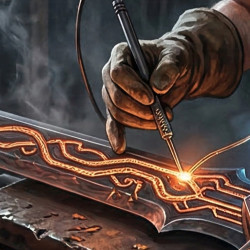
Ritualist is the Tower's living weapon: the party member who turns their own body into an enchanted instrument through mana circuits drawn directly into their skin. They do not cast spells outward like a Mage. They do not prepare substances like an Alchemist. They become the enchantment—a body running on activated mana ink, hitting harder, moving faster, and enduring more than any unenhanced fighter could manage.
Tag fit: Mana / Close Range / Damage.
In a five-person party, the Ritualist's slot is usually: - Primary melee damage (enhanced strikes, reinforced joints, amplified force) - Sustained frontline pressure (body enhancements that outlast a single burst) - Flex threat (mind enhancements for reaction, perception, and threat reading—rarer but devastating) - External enchantment (limited support role; applying ink circuits to allies when needed)
What makes Ritualist different from other classes
- Their power is written on them. Every enhancement they run is a circuit drawn into their skin—permanent knowledge expressed as temporary activation. There is no kit to lose, no bottle to drop, no spell to misfire. The weapon is the person. - They are limited by surface area. The number of circuits a Ritualist can run at once is physically bounded by how much skin they have and how complex the ink patterns they carry. A beginner has simple, isolated marks. A veteran is covered in interlocking geometry that would take hours to fully read. - Body enhancements come first, mind enhancements come later. Reinforcing muscle, bone density, joint articulation, and pain tolerance is complex but achievable. Enhancing perception, reflex speed, threat calculation, and mental clarity is an order of magnitude harder—and far more dangerous if it goes wrong. - They are the hard boundary of living enchantment. Where Alchemists enhance gear and Priests buff companions through holy mana, Ritualists are the only class that enchants the living body directly through mana circuits. That territory belongs entirely to them.
The Ink Circuit System (the heart of the class)
Ritualist power runs entirely through specialized mana ink applied directly to the skin in circuit patterns.
How it works:
- The ink itself is inert until the Ritualist directs mana into the pattern, at which point the circuit activates and produces its effect. - Circuits are temporary activations, not permanent states. The ink stays. The activation costs mana and fades when mana stops flowing or the pattern destabilizes. - The complexity of the pattern determines the power and precision of the effect. A simple line reinforces a single muscle group. An interlocking web of circuits across a full limb can produce something that barely resembles the original body. - More circuits require more mana to sustain simultaneously. A Ritualist running three full-body enhancements at once is burning mana fast. Knowing which circuits to activate, in what order, and for how long is the real skill.
Key rules:
- Skin is the hard limit. A Ritualist can only carry as many circuits as their body surface allows, and circuits must be placed with precision—poorly spaced patterns interfere with each other. - Circuit knowledge grows with experience. Early Ritualists carry a handful of isolated marks. Veterans carry deeply integrated networks where one activated pattern feeds into the next, multiplying efficiency. - Damaged skin disrupts circuits. Scars, burns, and wounds over ink patterns degrade or destroy them. A Ritualist who takes heavy damage to a circuit-covered area loses that enhancement until the ink is reapplied.
What the ink is:
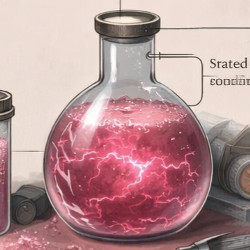
- A suspension of powdered mana stone in a specialized carrier fluid, charged to align particles for precise mana flow. - The ink bonds to the upper layers of skin through mana saturation, sitting close to the surface. - Old ink doesn't stop working—it stops being predictable. Aged or improperly charged ink can misfire, producing unstable effects.
External Enchantment (their support ceiling)
Ritualists can apply their ink circuits to other people, but with significant limitations: - External circuits on another body run at roughly one third the power of the same circuit on the Ritualist themselves. The ink does not have the same resonance with a foreign body. - The process requires physical contact and time—it is not a fast combat buff. It is closer to pre-fight preparation. - The recipient cannot control the circuit themselves. The Ritualist must activate and sustain it, which splits their mana attention and reduces what they can run on their own body simultaneously. - This makes external enchantment a situational tool, not a reliable support identity. A Ritualist who tries to play full support loses most of their own damage output in the process.
Stat tendencies (Adventurer Card attributes)
(Typical leanings, not hard locks.)
Best / most emphasized - MNA (Mana): the more circuits they run, the faster they drain; a low-MNA Ritualist can only sustain enhancements for short bursts. - RSN (Resonance): critical—ink circuits under Tower pressure need a stable mana flow or they distort, producing unpredictable or damaging results. - END (Endurance): a Ritualist needs to sustain both the physical demands of melee and the mana cost of active circuits simultaneously; running dry mid-fight is dangerous.
Usually weaker - INS (Insight): variable; mind enhancement builds invest here heavily, but pure body Ritualists often neglect it. - AGI (Agility): they are faster than unenhanced fighters once circuits activate, but their base agility without ink is often unremarkable. - STR (Strength): same logic as AGI—their effective strength is circuit-amplified, not naturally exceptional.
Where they shine
- Sustained melee damage: enhanced strikes land harder and more consistently than any unenhanced fighter at the same level. - Durability under enhancement: reinforced bone, dampened pain response, stabilized joints—a Ritualist mid-activation can take hits that would drop a normal fighter. - Escalating threat in long fights: the longer the engagement, the more efficiently an experienced Ritualist manages their circuit load, while unenhanced fighters are simply getting tired. - Melee range dominance: they are built for close contact. In the space where most damage classes lose effectiveness, Ritualists are at their peak.
Where they don't shine
- Opening burst without warm-up: activating circuits takes a beat. A Ritualist caught cold in an ambush before their ink is running is just a person in a fight. - Mana drought: when mana runs out, the circuits go dark and they become an unenhanced melee fighter with no fallback tools. - Ranged threats: they have no natural ranged identity. A Hunter or Mage who keeps distance and denies approach is a genuine problem. - Heavy circuit damage: targeted attacks on ink-covered skin can strip enhancements mid-fight. Enemies that know what they are fighting will aim for the marks.
How Ritualist "works" in-world (skill access logic)
Ritualist guild tracks unlock circuit families and integration depth:
Body enhancement families (primary identity) - Structural reinforcement: bone density, joint stability, impact distribution across the frame - Muscle amplification: raw strike force, grip strength, sustained exertion capacity - Pain dampening: not true invulnerability—they still take damage, but the signal is reduced enough to keep fighting through it - Recovery acceleration: faster muscle repair between activations, reduced bruising and micro-tear accumulation
Mind enhancement families (advanced, dangerous) - Reflex sharpening: reaction time compressed; the body moves before the conscious mind catches up - Threat perception: spatial awareness expanded; harder to flank or surprise - Focus locking: resistance to fear responses, Tower-pressure mental fog, and disorientation effects - Mind circuits that go wrong do not produce physical injuries. They produce cognitive distortion—and that is considerably harder to fix.
Circuit integration (the mastery track) - A beginner activates one circuit at a time, in isolation. - An intermediate Ritualist runs two or three in sequence, managing the mana cost rotation. - A veteran runs integrated networks: circuits that feed into each other, share mana pathways, and produce combined effects that no single mark could achieve alone. - True masters carry patterns so interconnected that activating one corner of their body begins a cascade that optimizes itself across the whole frame.
Mana relationship (fits your "Mana" tag)
Ritualists are mana-defined but in a uniquely internal way: - They do not project mana outward like a Mage. - They do not bind it into external substances like an Alchemist. - They run mana through themselves, using the ink as a structured channel to direct it precisely where it needs to go. - High RSN is essential because Tower pressure disrupts mana flow—and disrupted flow in a body circuit does not produce a failed spell. It produces a body that is actively fighting itself.
Social/economic role (fits your Tower economy)
Ritualists occupy an unusual position in Versa: - They are valued but quietly feared. A veteran Ritualist at full activation does not look like a person doing something impressive. They look like something that should not be possible. - The ink trade is a secondary economy. Specialist ink formulators supply Ritualists exclusively, and the quality of the ink directly affects circuit stability and power ceiling. - External enchantment creates political complications. The ability to enhance other people's bodies—even at reduced power—means noble houses and military powers take an interest in Ritualists for reasons that have nothing to do with dungeon work. - They rarely transition out of field work the way Alchemists do. The circuits are on their body. The Tower is where those circuits make sense.
Quick phrasing you can reuse in prose
- "They don't wear their power. They are their power." - "Every scar over an ink mark is a lesson about what not to do in close range." - "A Mage shapes mana into the world. A Ritualist shapes mana into themselves." - "The more skin they show, the more dangerous they usually are." - "Old ink doesn't stop working—it stops being predictable. That's worse."
Connected records