Living folio · Lore
Shepherd of Tides
The Shepherd of Tides is the divine protector of the living, the god who guides souls away from the drowning depths of death and anchors them to life through His grace. He is not a god of resurrection or transcendence. He is a god of preservation —the boundary keeper who stands between the living shore and...
Overview
The Shepherd of Tides is the divine protector of the living, the god who guides souls away from the drowning depths of death and anchors them to life through His grace. He is not a god of resurrection or transcendence. He is a god of preservation—the boundary-keeper who stands between the living shore and the endless dark waters beyond, holding fast against the pull that would drag every wounded, dying person into the Deep.
His blessing does not reverse death. It prevents it. It holds the line. It keeps souls moored to flesh long enough for the body to heal, the mind to recover, and the person to continue living. That is His domain and His limit, and the faith built around Him has always been honest about both.
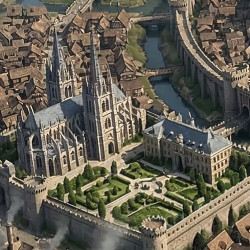
The Shepherd of Tides is worshipped across the known world, but nowhere is His presence felt more strongly than in Versa, where the Cathedral stands as the physical embodiment of His protection and the Saint Guild operates as the institutional keeper of His blessing. In a city built around a dungeon that kills without mercy, where every descent into the Tower is a journey into dark waters that may not give you back, the Shepherd's promise—that the living can be guided home—is not abstract theology. It is survival doctrine.
The Founding Story (What the Faithful Believe)
In the beginning, according to the oldest liturgical texts preserved in the Cathedral's deep archive, there was suffering without answer.
The Tower had opened—or had always been open, depending on which theological school one follows—and people descended into it seeking wealth, materials, and the mana stones that would later reshape civilization. They found all of those things. They also found deaths that no healer of the time could prevent. Wounds that festered despite poultices. Poisons that burned through organs before an antidote could be prepared. Mana corruption that twisted the body and mind in ways no herb or prayer could slow.
The healers of that era used everything they had: plants, pressure, rest, blood-letting, charms, prayers to older gods whose names are now lost. Some of it worked sometimes. Most of it did not work often enough. The Tower consumed people faster than the surface could replace them, and the city that would become Versa was, in those early generations, a place where funerals outnumbered weddings and every family knew the particular grief of losing someone who should have been saveable.
Then the Shepherd of Tides intervened.
Not with fire from the sky. Not with armies of angels or the destruction of the Tower. The Shepherd's intervention was quieter and, in its way, more devastating to the world's understanding of what divine aid looked like.
He appeared to a single person.
The records name them the First Saint, and preserve almost nothing else about their life before that moment. No birthplace. No family. No documented accomplishments or notable history. Just a person who, one night in the early years of Versa's settlement, encountered the god in a form the texts describe as "a figure standing at the shore of still waters, holding a staff and an anchor, with eyes that saw through flesh to the soul beneath."
The Shepherd spoke. The First Saint listened. And in that exchange, the knowledge of holy healing was passed from the divine to the mortal—not as raw power granted directly, but as understanding: the capacity to channel something larger than personal mana through a structured vessel, in patterns that could close wounds, remove poison, cleanse corruption, and keep people alive who should have died.
The First Saint was told, explicitly, that this knowledge came with a boundary.
"Guide the living back from the dark waters. Do not follow the dead into the Deep. That shore is not yours to walk."
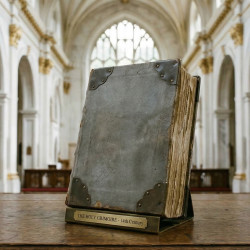
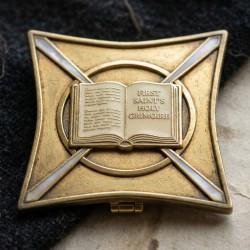
The Shepherd's blessing was given to preserve life, not to reverse death. The First Saint accepted this. They built the first Holy Grimoire—or were taught how to build it, the texts are unclear—and began the work of teaching others. They trained the first Priests, established the binding ceremony, codified the healing verses, and laid the foundations of what would eventually become the Saint Guild.
When the First Saint died—of natural causes, in old age, surrounded by students who had learned to carry the work forward—their body was interred beneath what is now the Cathedral. The Grimoire they carried was sealed and placed in the deep archive, where it remains to this day: the oldest physical object in the Saint Guild's possession and the template against which every Grimoire produced since has been measured.
Theology (What the Shepherd Is and Is Not)
The Shepherd of Tides is not an all-powerful creator deity. He is not the god of the sun, the harvests, the seasons, or the soul's final destination. His domain is specific and His power is limited by choice, and the faith built around Him has always acknowledged that limitation as a feature rather than a flaw.
What the Shepherd governs:
- The boundary between life and death. He stands at the Living Shore—the edge where a person can still be pulled back—and prevents souls from slipping into the Deep. - The guidance of the wounded. His blessing allows Priests to channel holy mana in ways that close wounds, remove corruption, cleanse poisons, and stabilize dying bodies. - The mooring of the living. Through His grace, souls remain anchored to flesh long enough for healing to take root. Without that anchoring, the body drifts and dies regardless of treatment.
What the Shepherd does not govern:
- Death itself. Once a person crosses the threshold—once the soul has left the body entirely—the Shepherd's blessing no longer reaches them. He does not resurrect. He does not retrieve. He does not bargain with whatever lies beyond. - Fate, destiny, or cosmic justice. The Shepherd does not decide who lives or dies. He offers the means to preserve life. The rest is circumstance, skill, and the donation you can afford. - Other divine domains. He is not a harvest god, a war god, a forge god, or a god of knowledge. He does one thing. He does it absolutely. That is enough.
This theological clarity has made the Shepherd of Tides one of the most widely accepted deities in the known world. He does not demand conversion from followers of other gods. He does not claim dominion over their souls. He simply offers a very specific form of protection, and most people, regardless of what else they believe, are willing to accept that protection when they need it.
The result is that worship of the Shepherd exists in two forms simultaneously: 1. Devoted faith, practiced by those who attend Chapel services, recite the liturgies, and structure their lives around His creed. 2. Pragmatic acknowledgment, practiced by those who may not consider themselves devout but will still pay a donation at a Healing Hall and murmur a prayer to the Shepherd when the wound is deep enough to scare them.
The Saint Guild welcomes both. A person does not need to be devout to receive healing. They simply need to be alive and capable of offering a donation.
The Shepherd's Symbol
The holy symbol of the Shepherd of Tides is a shepherd's staff crossed with an anchor, carved or cast in white, gold, or silver depending on the formality of the context.
The staff represents guidance—the Shepherd leading souls away from danger, steering the wounded back toward life, and supporting those too weak to stand on their own.
The anchor represents stability and mooring—the divine force that keeps a soul tethered to the body, preventing it from drifting into death even when the body is failing.
The two are crossed at the center, forming an X-shape that also suggests a crossroads: the moment of crisis where a person can still be saved or lost, and the Shepherd's intervention determines which direction they go.
The symbol appears on every Chapel door, every Healing Hall entrance, every Priest's vestment, and every official Saint Guild document. It is stamped into the wax seals used on contracts, carved into the stone above Cathedral arches, and embroidered onto the curtains that separate treatment alcoves in the Healing Hall.
In Versa, it is one of the few religious symbols that is universally recognized regardless of literacy, social class, or personal faith. If you see the staff and anchor, you know what the place offers: healing, if you can pay for it.
Sacred Terminology (How the Faith Speaks)
The language of Shepherd worship is deliberately nautical, coastal, and immediate. It does not rely on abstract metaphysics or complex allegory. It describes the lived experience of survival and the divine aid that makes it possible.
Core doctrinal phrases:
- "The Shepherd guides the living through the dark waters. Beyond the threshold, His staff does not reach." - "We are His flock, moored to life by His grace." - "The tide turns, but the Shepherd's mooring holds fast." - "He does not resurrect. He prevents. That is enough."
Common phrases in daily use:
- "The Shepherd's blessing" – a general expression of hope for safety, healing, or survival. Used both religiously and secularly. - "Guided back" – to be healed or saved from a near-death state. "The Priest guided her back from the edge." - "Lost to the Deep" – dead, beyond recovery. "He was already lost to the Deep when they found him." - "The Shepherd's Harbor" – any place of safety, healing, or refuge. The Cathedral itself is sometimes called this. - "Moored" – alive, stable, recovering. "The wound was bad, but she's moored now." - "Unmoored" – dying, fading, slipping toward death. "He's unmoored. We need a Priest now."
In formal liturgy:
- "The Living Shore" – the boundary between life and death where the Shepherd's power is active. - "The Deep" – the realm of the dead, beyond the Shepherd's reach. - "The Shepherd's Chart" – another name for the Holy Grimoire, framed as divine navigation instructions. - "Shepherds of flesh" – a poetic term for Priests, emphasizing their role as guides.
The Shepherd's Creed (The Core Vows)
The creed recited in Chapel services and taught to every child raised in a devout household is short, direct, and structurally simple. It has remained unchanged since the First Saint's generation.
*The Shepherd's Creed*
The Shepherd stands at the Living Shore. He guides the wounded back from the dark waters. He anchors the soul to flesh. Beyond the threshold, He does not reach.
Healing is His gift. Preservation is His work. Life is His flock.
We are moored by His grace. We are guided by His hand. We do not follow the dead into the Deep.
The creed is recited at the opening of Chapel services, before major Healing Hall procedures, during Priest ordinations, and at funerals—where it serves as both a prayer for the deceased and a reminder to the living that the Shepherd's protection is for them, not for the person who has already crossed.
The Shepherd in Versa's Culture
In Versa, where the Tower dominates daily life and death is a constant occupational reality, the Shepherd of Tides is not an abstract figure of myth. He is a practical god, worshipped by people who understand exactly what His blessing does and does not offer.
Among adventurers, invoking the Shepherd before a descent is common regardless of personal faith. It is not superstition. It is acknowledgment that if something goes wrong, the Shepherd's Priests are the only people who can fix it, and you would very much like them to succeed when it is your turn.
Among families, prayers to the Shepherd are offered when a loved one is injured, ill, or descending into dangerous work. The prayers are not requests for miracles. They are requests for enough time—time for the Priest to arrive, time for the healing to work, time for the person to stabilize before it is too late.
Among Priests themselves, the relationship with the Shepherd is more complex. They are His instruments. They channel His blessing. They understand, more clearly than anyone, that the blessing has limits and that those limits are not negotiable. A Priest who loses a patient does not blame the Shepherd. They blame circumstance, inadequate donation, insufficient skill, or the simple fact that the person was already too far gone. The Shepherd gave them the tools. The rest is on them.
Among the cynical, the Shepherd is acknowledged but not trusted. They point out that His blessing is controlled by an institution that charges for it, that the donation system creates tiered access to survival, and that the Saint Guild's monopoly on holy healing has made it one of the wealthiest and most politically powerful organizations in the city. The Shepherd may be real. His blessing may work. But the people administering it are still people, and people have always found ways to profit from desperation.
The Saint Guild does not argue with this characterisation publicly. Privately, its administrators consider it an oversimplification that ignores the genuine logistical difficulty of maintaining a global healing infrastructure, but they also understand that the criticism will never fully disappear. The Guild's response is institutional competence: the healing works, the Grimoires are maintained, the Priests are trained, and the system endures. That is the answer.
The Shepherd and the First Saint (Theological Distinction)
One of the most carefully maintained distinctions in Shepherd theology is the separation between the Shepherd of Tides (the god) and the First Saint (the mortal who received His blessing).
The Shepherd is divine. The First Saint was human.
The Shepherd granted the knowledge. The First Saint built the institution that preserved it.
The Shepherd's power is eternal and unchanging. The First Saint lived, taught, aged, and died like anyone else.
This distinction is emphasized deliberately in Saint Guild teaching to prevent two specific theological errors: 1. Deification of the First Saint. The Saint was chosen, blessed, and instrumental, but they were not divine and are not worshipped as a god. Prayers go to the Shepherd, not to the Saint. 2. Confusion of the institution with the divine. The Saint Guild administers the Shepherd's blessing. It does not own it. The blessing belongs to the Shepherd. The Guild is the custodian, not the source.
That said, the First Saint is venerated in ways that come very close to worship without technically crossing the line. Their image dominates the Cathedral. Their name is invoked in liturgies. Their Grimoire is treated as a holy relic. The day of their death is a major feast day in the religious calendar.
The Guild walks this line carefully. The First Saint is honoured as the bridge between the divine and the mortal, the person who made the Shepherd's blessing accessible to the world. But they are not prayed to. They are prayed about—an example, a founder, a guide, but not a god.
Most laypeople do not make this distinction carefully. In practice, a significant portion of the faithful blur the two together in casual speech, referring to "the Saint's blessing" when they mean the Shepherd's, or praying to "the First Saint" when they are technically supposed to be praying to the Shepherd. The Saint Guild tolerates this in public and corrects it gently in formal instruction.
The Shepherd's Limits (The Theological Problem)
The single most difficult aspect of Shepherd theology is the same aspect that makes it so practically useful: the Shepherd does not resurrect the dead.
This is not a flaw in His power. It is a boundary He has chosen not to cross, and the faith frames that choice as correct and necessary. The creed is explicit: "Beyond the threshold, He does not reach."
But that does not make it easy.
A person who arrives at the Healing Hall with a dying loved one and is told, "We can save them if we act now," understands the Shepherd's blessing as mercy and miracle.
A person who arrives five minutes too late and is told, "They were already gone when you brought them in," understands the Shepherd's blessing as cruelly limited.
The Saint Guild has spent centuries refining its pastoral response to this problem, and the core answer has not changed:
The Shepherd's blessing is given to guide the living back from the edge. It is not given to retrieve the dead. That boundary is not cruelty. It is honesty. Death is real. The Shepherd does not lie about that. What He offers is the chance to prevent it, if you act in time.
This framing works for many people. It does not work for everyone.
The families who lose someone they believe could have been saved—if the Priest had arrived sooner, if the donation had been higher, if the Healing Hall had not been full that day—do not always accept that the boundary is divine rather than institutional. Some leave the faith entirely. Some become bitter but pragmatic, continuing to use the Healing Halls while resenting the system that runs them. A very small number become hostile, blaming the Saint Guild for gatekeeping a divine blessing that should be freely given.
The Saint Guild acknowledges all of these reactions as understandable and does not attempt to suppress them. What it does not do is change the boundary. The Shepherd does not resurrect. The Guild cannot change that. The best it can offer is stabilisation for those who can still be saved, and honesty about the ones who cannot.
The Shepherd in Art and Architecture
Depictions of the Shepherd of Tides follow a consistent iconographic tradition across centuries of religious art, established by the First Saint's generation and maintained with only minor stylistic variation since.
The Shepherd is always shown as a tall, robed figure standing at the edge of water, holding a staff in one hand and an anchor in the other. His face is usually obscured or idealized to the point of abstraction—no specific features, just the impression of calm authority. His robes are white or pale blue, sometimes trimmed in gold. The water at His feet is depicted as dark, still, and deep, representing the boundary between life and death.
In more elaborate representations, the Shepherd is shown with a flock of people behind Him—men, women, children, adventurers, merchants, sailors—all standing on the shore rather than in the water, anchored by His presence.
The staff and anchor symbol appears in every representation, either held by the Shepherd or carved into the frame of the image.
In the Cathedral, the largest depiction of the Shepherd is the towering white marble statue behind the altar in the Great Hall—the figure standing with both arms extended, the staff in the left hand pointing downward toward the congregation, the anchor in the right hand held at chest height as if offering it forward. The statue's face is smooth and featureless, a deliberate artistic choice meant to suggest that the Shepherd's identity transcends individual human understanding.
Quick Descriptive Lines for Prose
- "The Shepherd does not bring back the dead. He keeps the living from joining them. In Versa, that was enough." - "She murmured a prayer to the Shepherd as the Priest worked. Not because she was devout. Because the wound was deep enough to scare her." - "The staff guides. The anchor holds. Between them, the living stay moored." - "He was already lost to the Deep when they brought him in. The Priest said it quietly, but the family heard it all the same." - "The Shepherd stands at the shore. The rest of us just hope we reach it in time." - "Every Chapel carried the same symbol above the door. Every family in Versa knew what it meant."
Connected records