Living folio · Guilds
Merchants Guild
The Merchant Guild is not the most dangerous institution in Versa. It does not train the fighters who hold the line between the city and the Tower. It does not control the only healing magic in the world. It does not regulate the flow of every mana stone that passes from dungeon to market. In any direct...
Overview
The Merchant Guild is not the most dangerous institution in Versa.
It does not train the fighters who hold the line between the city and the Tower. It does not control the only healing magic in the world. It does not regulate the flow of every mana stone that passes from dungeon to market. In any direct comparison of raw institutional power, the Merchant Guild occupies a middle position among the four seats of the Grand Council, respected but not feared, necessary but not irreplaceable in the way the Guardians or the Saint Guild are irreplaceable.
And yet, in a very practical sense, the Merchant Guild is the reason Versa functions as a city rather than a frontier camp.
They are the institution that takes the raw outputs of the Tower economy, the stones, the materials, the harvested components, the salvaged relics, and turns them into a supply chain. They coordinate the ships that bring grain and timber from distant shores. They manage the contracts that move refined stone from the Mana Guild's warehouses to the workshops that need it. They negotiate the agreements that determine which goods reach which markets, at what price, on what schedule. Without the Merchant Guild, the Tower would still produce wealth. That wealth simply would not reliably reach the people who need it or create the commercial density that makes Versa worth living in.
They also, in a quieter and more pervasive way, train the people who build, repair, and supply everything that the Tower economy consumes. The Craftsmen who emerge from Merchant Guild instruction are not adventurers. They are the engineers, toolmakers, material specialists, and skilled tradespeople who keep the city's physical infrastructure functional and whose work supports every party that descends into the dungeon. Without them, the Tower runs. Without the things they make and maintain, it runs considerably worse.
The Merchant Guild is not glamorous. It is not heroic. It is the part of the city that most people interact with every single day without ever stopping to think about who organised it.
That invisibility, much like the Guardians', is a form of success.
Origins and Purpose
The Merchant Guild did not begin as a single institution. It began as a loose coalition of trading families, shipping interests, and market operators who recognised, in the early decades of Versa's growth, that the Tower economy was producing more wealth than any individual trader could manage and more chaos than any individual market could absorb.
The problem was coordination. Adventuring parties were bringing materials up from the Tower faster than appraisal and distribution could process them. Ships were arriving with goods that had no organised buyer. Workshops were producing tools that had no reliable supply of raw materials. The prices of basic goods swung wildly from week to week because there was no institution whose job it was to stabilise them.
The early Merchant Guild was the answer to that problem. Its founding families agreed to a set of common standards: shared pricing references, coordinated shipping schedules, a unified pass system for the Inner Circle market, and a collective agreement to enforce basic commercial law among their members. In exchange, member merchants gained access to the coalition's network, its warehouses, its negotiated shipping rates, and the commercial credibility that came from operating under a recognised institutional banner.
Over time, the coalition formalised. The department structure emerged as the coalition grew too large for a single leadership body to manage. Membership expanded from founding families to any trader willing to pay the affiliation fee and operate under the Guild's rules. The Craftsman training programme began as an informal apprenticeship arrangement between established Guild members and promising tradespeople, and gradually became a structured institution in its own right.
The Tavern Guild joined the arrangement later, under circumstances that are still occasionally debated in the back rooms of Versa's more historically minded drinking establishments. What is agreed is that the arrangement proved mutually beneficial enough that an exception to the standard membership structure was created specifically to accommodate it, and that exception has remained in place ever since.
Symbol and Identity
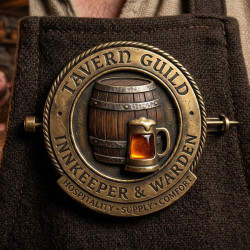
The symbol of the Merchant Guild is a circle set inside a barrel.
The barrel represents trade itself: the vessel that carries goods, the container that preserves them across distances, the fundamental unit of organised commerce that has appeared in every market culture the known world has produced. It is a deliberately humble symbol for an institution of this size, and that humility is intentional. The Merchant Guild does not present itself as a power. It presents itself as a service.
The circle inside the barrel represents the Tower. Not the Tower as a threat or a mystery, but the Tower as a source, the origin point of the wealth that flows through every barrel, crate, and shipment the Guild handles. The goods of the Inverted Tower are managed by them. That is the statement the symbol makes, simply and without aggression. The Tower produces. The Guild moves it.
The combination reads as a claim of stewardship rather than dominance, which suits the Merchant Guild's preferred self-presentation exactly. They do not position themselves as masters of the Tower economy. They position themselves as the people who make sure it works.
Guild colours run to deep brown and brass: the colour of good timber, worn leather, and the fittings of a well-maintained warehouse. Warm without being soft. Functional without being austere. The palette suggests reliability, physical work, and the particular kind of competence that comes from doing commercial logistics seriously for a very long time.
The Department Structure — How the Guild Is Actually Run
The Merchant Guild is not led by a single elected head or a small council of senior members. It is led by the Department Heads: the appointed directors of each of the Guild's major operational divisions, who together form the Trade Table, the governing body that makes every significant institutional decision through majority vote.
This structure is old enough that most Guild members treat it as simply the way things are. Its logic, when examined, is straightforward. The Merchant Guild manages too many distinct areas of commercial life for any single person to understand all of them well enough to govern them effectively. The Department Heads are not politicians who happen to oversee a portfolio. They are operational experts who have spent their careers inside a specific area of the Guild's work, appointed by the person who held the role before them precisely because their expertise was recognised and trusted.
Appointment and Succession
To become a Department Head, a candidate must be appointed by the outgoing Head of that department. There is no public election, no Council vote, no external review process. The outgoing Head names their successor, and that appointment takes effect upon the outgoing Head's retirement, death, or formal resignation from the role.
This system produces leadership that is deeply knowledgeable and institutionally continuous. A Department Head who has spent thirty years in shipping logistics appoints someone who has spent twenty years learning the same work. The expertise compounds across generations. The Guild does not produce visionary reformers at the top of its structure. It produces people who know their area of the trade so thoroughly that they can identify problems before they become crises and solutions before they become obvious.
The weakness of the system is equally apparent. Succession disputes occur when an outgoing Head dies without naming a replacement, or when a named successor is challenged by other senior members of the department. These disputes are resolved internally, through negotiation and occasionally through the Trade Table's intervention, but they can be ugly and protracted. The Guild's history contains several periods where a department ran without effective leadership for months while the succession was contested, and the operational consequences of those periods are well documented in the Guild's internal records.
The Trade Table
The Trade Table convenes when any matter of significant institutional weight requires a decision: new membership policies, changes to the affiliation fee structure, major contracts with external parties, disputes between departments, and any question that affects the Guild's relationship with the Grand Council or the other three major institutions.
Each Department Head holds one vote. Decisions require a simple majority except in defined categories of major institutional change, which require two thirds agreement. The Trade Table does not meet on a fixed schedule. It meets when a Head calls for it, and any Head can call for it. In practice the Table convenes several times a month during busy commercial seasons and less frequently when the Guild's operations are running smoothly.
The Tavern Guild representative holds a permanent seat at the Trade Table as a special exception to the standard department structure. They vote on all matters and their vote carries equal weight to any Department Head. The reasons for this exception are historical, the arrangement predates the current formal structure, and the Merchant Guild has long since stopped treating it as unusual.
The Departments
The departments are not fixed in number and have changed over the Guild's history as new commercial areas emerged and old ones consolidated or became obsolete. The current structure includes the following primary divisions:
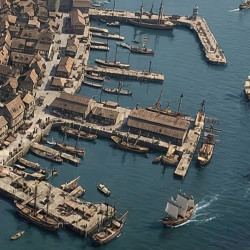
Shipping and Transit manages the movement of goods into and out of Versa by sea and by road. Ship schedules, pier allocation, caravan contracts, road maintenance agreements, and the courier networks that connect Versa to its trading partners are all administered here. This is the largest department by headcount and the one most directly connected to the Harbour Halls' daily operations.
Market and Pricing oversees the Inner Circle market and the Guild's network of affiliated market spaces throughout Versa. Stall allocation, pricing reference standards, market day scheduling, and the enforcement of commercial regulations among affiliated traders are all this department's responsibility. It is also the department that manages the affiliation fee collection and the benefit distribution that makes membership worthwhile.
Materials and Supply coordinates the flow of raw materials, manufactured goods, and Tower-extracted components through the Guild's distribution network. This department works closely with the Mana Guild on refined stone supply chains and with the Guardians on loot transfer documentation. It is the department most directly connected to the Tower economy in a practical sense.
Craft and Production oversees the Merchant Guild's Craftsman training programme and the network of Guild-affiliated workshops, small shops, and production facilities that supply the city and the Tower adventuring economy. This department runs the apprenticeship system, certifies qualified Craftsmen, and manages the commercial relationships between Craftsmen who have opened independent operations and the Guild that trained them.
Contracts and Legal handles the formal commercial agreements that the Guild enters into with external parties, the dispute resolution processes that adjudicate conflicts between member merchants, and the legal representation the Guild provides to affiliated members who require it. This department also maintains the Guild's relationship with Versa's civil legal system and with the Guardians' enforcement arm.
Foreign Trade manages relationships with merchant interests outside Versa: the trading families of other cities, the shipping consortiums that operate the long-distance sea lanes, and the diplomatic commercial relationships that keep Versa's import and export economy functioning. This department is the smallest in headcount but manages some of the highest-value contracts the Guild holds.
The Affiliation System — How the Guild Holds the City's Commerce
The Merchant Guild does not directly operate most of the businesses in Versa. It does not need to. It operates the system that those businesses depend on, and it charges for access to that system.
Any merchant, trader, shopkeeper, craftsperson, or commercial operator in Versa can apply for Guild affiliation. Affiliation is not mandatory. A business can operate in Versa without it. Many small independent operations do, particularly in the outer wards where enforcement is lighter and commercial ambitions are modest. But affiliation provides access to a set of advantages that non-affiliated businesses cannot replicate independently, and for any trader with serious commercial intentions, the calculation tends to resolve in the Guild's favour.
The Affiliation Fee
Affiliated members pay a periodic fee to the Guild, scaled to the size and revenue of their operation. Small shopkeepers pay modest amounts. Large trading houses pay considerably more. The fee structure is set by the Market and Pricing department and reviewed periodically by the Trade Table.
In exchange for the fee, affiliated members receive:
Market access. Only affiliated businesses can hold stalls or premises in the Inner Circle market and the Guild's managed market spaces throughout the city. The Inner Circle is where the Tower economy's commercial traffic concentrates. Non-affiliated traders cannot reach those customers directly.
Legal protection. The Contracts and Legal department provides dispute resolution, contract drafting, and legal representation to affiliated members. A merchant who is owed money by a party member who has gone below and not come back has recourse through the Guild. A non-affiliated merchant does not.
Supply chain access. The Materials and Supply department's distribution network is available to affiliated members at preferential rates. Access to bulk goods, reliable delivery schedules, and priority allocation during shortage periods are all benefits that non-affiliated businesses cannot easily replicate.
Guild certification. The Merchant Guild's mark on a business signals to customers, suppliers, and partners that the operation meets certain commercial standards and is subject to Guild oversight. In a city where trust is a commercial asset, that mark is worth more than it costs in many sectors.
Collective negotiating power. When the Guild negotiates shipping rates, supply contracts, or arrangements with the other major institutions, the benefits of those negotiations flow to affiliated members. A single small merchant cannot negotiate with the Mana Guild. A member of the Merchant Guild can.
Non-Affiliation
Businesses that choose not to affiliate are not prevented from operating. They simply operate without the network. They cannot access the Inner Circle market directly. They cannot use Guild dispute resolution. They pay standard market rates for everything rather than the preferential rates Guild membership provides. In the outer wards, where commercial competition is lower and customer bases are local, this is manageable. In the inner city, where the Tower economy drives traffic and the Guild's infrastructure is everywhere, non-affiliation is a serious commercial handicap that most serious traders eventually decide is not worth maintaining.
The Guild does not threaten non-affiliated businesses. It does not need to. The advantages of membership are sufficiently clear that coercion is unnecessary. The Merchant Guild has found, over generations of managing this system, that the most effective way to maintain the affiliation structure is simply to make the Guild's services genuinely valuable.
The Tavern Guild — A Special Seat
The Tavern Guild is not a department of the Merchant Guild. It is not a subsidiary, a division, or an affiliated branch. It is a distinct institution with its own internal organisation, its own leadership, and its own commercial identity.
It also has a permanent, non-negotiable seat at the Merchant Guild's Trade Table, with full voting rights on all matters.
The arrangement is historical. The Tavern Guild was one of the earliest large-scale commercial interests to affiliate with the Merchant Guild's predecessor coalition, and the terms of that original affiliation included a permanent voice in the coalition's governance in recognition of the Tavern Guild's commercial scale and the volume of its affiliation fee contribution. When the coalition formalised into the current Merchant Guild structure, the Tavern Guild's seat was retained as a defined exception rather than absorbed into the department system.
The Tavern Guild's interests overlap with the Merchant Guild's in obvious ways. Taverns are among the largest buyers of food, drink, fuel, and basic supplies that the Merchant Guild's distribution network moves. They are also, in a less obvious but equally important way, the primary informal commercial spaces of Versa: the places where merchants negotiate, where adventurers spend their stone earnings, where information about Tower routes and contract opportunities circulates, and where the city's commercial culture lives in its most human form.
The Merchant Guild understands that the health of the Tavern Guild is directly connected to the health of Versa's commercial environment. The Tavern Guild understands that its access to the Merchant Guild's supply chains and legal infrastructure is essential to its members' operations. The arrangement has persisted because both parties benefit from it more than they would benefit from ending it.
The Tavern Guild representative at the Trade Table is not always the most powerful voice in the room. But they are consistently one of the most listened to, because their members' establishments are where the rest of the economy talks about itself, and what gets said in those rooms eventually matters to everyone sitting at the table.
The Craftsman Programme — The Guild's Other Trade
The Merchant Guild trains Craftsmen.
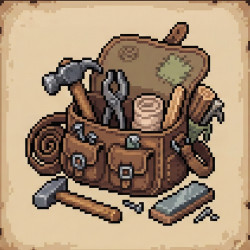
This is less well understood outside the Guild than the affiliation system or the Trade Table structure, but it is in many ways the institution's most significant long-term contribution to Versa's commercial life. The Craftsmen who emerge from Guild training are not merchants in the conventional sense. They are the engineers, toolmakers, material specialists, structural technicians, and skilled tradespeople whose work underlies everything the Tower economy produces and consumes.
What a Guild Craftsman Is
The Craftsman class, within the Merchant Guild's framework, covers a deliberately wide range of specialisations. The common thread is practical expertise in making, repairing, or working with physical materials and systems. A Craftsman who specialises in structural engineering and a Craftsman who specialises in monster-material toolmaking are both Guild Craftsmen, both trained through the same institutional framework, and both subject to the same certification standards. Their day-to-day work may look entirely different.
Guild Craftsmen are the people who build and maintain the physical infrastructure that the Tower economy depends on: the reinforced storage facilities that hold mana stones safely, the specialised tools that adventuring parties carry into the dungeon, the workshop equipment that processes Tower-extracted materials into commercially useful products, and the structural systems that keep the Harbour Halls and Checkpoints functioning under the load they carry daily.
They are also, in significant numbers, the people who turn raw Tower materials into new products. Monster components, harvested alchemical ingredients, structural materials extracted from the dungeon's walls, and the occasional relic fragment that does not qualify as a straight mana stone transaction all pass through Craftsman workshops at some point on their way from Tower extraction to commercial use. The Craftsmen who work in this area are part material scientist, part manufacturer, and part commercial operator, understanding both what a Tower material is and what the market will pay for what can be made from it.
The Tower Immersion Period
Most Craftsmen begin their Guild training with a period of formal instruction in workshop skills, material science, and the specific technical disciplines of their chosen specialisation. This instruction happens in Guild-affiliated workshops and training facilities and takes several years to complete at the foundational level.
What distinguishes Merchant Guild Craftsman training from purely theoretical instruction is the Tower immersion period: a defined phase of the programme during which trainees descend into the Inverted Tower, not to fight, not to extract mana stones, but to observe.
The purpose is direct. A Craftsman who has never seen a Tower monster does not fully understand what its components are, how they behave under different conditions, what the practical challenges of extracting and preserving them are, or what their material properties actually mean at a working level rather than a textbook level. A Craftsman who has spent time below, even in the upper floors, watching how materials behave in the Tower's mana environment and handling them before they are processed and changed by the journey to the surface, is a fundamentally different kind of specialist.
Most Craftsmen descend only in the Tower's upper floors and for limited periods. They are not combat trained in the way adventurers are, and the Guild does not send them below without appropriate party support. What they bring back from those descents is not loot. It is knowledge, the specific, irreplaceable understanding of material reality that can only come from direct encounter. That knowledge then shapes their entire working career.
Many of the Guild's most respected Craftsmen completed their Tower immersion decades ago and have not descended since. They do not need to. One thorough period of direct observation, processed through years of subsequent workshop experience, produces expertise that no amount of additional descents would significantly improve. The Tower teaches them what they need to know. The workshop is where they spend the rest of their lives applying it.
After Training — What Craftsmen Do
Qualified Guild Craftsmen have several paths available to them, and the Guild supports all of them through different channels.
Guild workshop employment is the most common outcome. The Merchant Guild operates and affiliates with a substantial network of workshops throughout Versa, and qualified Craftsmen who join these operations receive stable employment, access to the Guild's material supply chains, and the institutional support of an established organisation. Most Craftsmen begin here and many remain for their entire careers.
Independent shop operation is available to any qualified Craftsman who wishes to operate their own business. Guild certification as a Craftsman provides automatic affiliation benefits for any commercial operation the Craftsman opens, on terms that are more favourable than standard merchant affiliation. The Guild considers supporting its trained Craftsmen's independent ambitions to be a direct investment in the quality and reputation of Guild-trained work across the city.
Specialised contracting suits Craftsmen whose skills are too specific or too high-value for standard workshop employment. Structural engineers who consult on major construction projects, material specialists who work exclusively with elite adventuring guilds on custom equipment, and technical experts who advise on Tower-adjacent infrastructure problems all operate in this mode, often maintaining a loose Guild affiliation that gives them commercial credibility and legal support without the obligations of full institutional employment.
The Guild tracks its Craftsmen's output with genuine interest. The reputation of Guild-trained Craftsmen is a commercial asset for the institution, and the Craft and Production department invests in maintaining the quality of that reputation through certification standards that it enforces with more consistency than most external observers expect.
Relationship with Other Guilds
The Merchant Guild's relationships with the other three major institutions are defined by a single consistent dynamic: the Merchant Guild needs things that the other guilds control, and the other guilds need things that the Merchant Guild controls, and the resulting arrangements are simultaneously essential and contentious.
The relationship with the Mana Guild is the most commercially intensive. Refined mana stones move through Merchant Guild distribution networks in enormous volume. The pricing, scheduling, and priority allocation of that supply is negotiated between the two institutions on a regular cycle, and the negotiations are rarely simple. Both guilds understand that neither can function without the arrangement. Neither is comfortable with how much leverage that gives the other.
The relationship with the Guardians Guild runs on compliance and mutual recognition. The Guardians enforce the commercial regulations that the Merchant Guild's market operations depend on. The Merchant Guild's Inner Circle pass system and the Guardians' access control at the Checkpoints are operationally intertwined in ways that require constant coordination. The relationship is professional and functions well precisely because both institutions understand exactly what each one needs from the other.
The relationship with the Saint Guild is the most distant of the three. The Merchant Guild has no direct operational dependency on the Saint Guild's healing services, though its members use them like any other Versa resident. The primary intersection is political, at the Grand Council table, where the two institutions occasionally find common cause and more often find politely managed disagreement about the pricing of things that both consider essential services.
Public Perception
The Merchant Guild is perceived by most Versa residents the way most people perceive a functioning economy: as a background condition rather than an active institution.
The Guild's mark is on the stalls in the Inner Circle market. Its certification appears on the workshops that supply adventuring parties. Its Craftsmen built and maintain the physical structures that the city depends on. Its distribution network is the reason that grain arrives reliably and lamp oil is available in the outer wards as well as the inner city. Most people experience all of this without knowing who organised it or caring particularly.
Merchants who operate within the affiliation system tend to view the Guild with pragmatic appreciation. The fees are real. The benefits are also real. The calculation is made once and then not revisited very often, because the alternative is less attractive than the complaints about the fee structure would suggest.
Merchants who operate outside the affiliation system tend to view the Guild with varying degrees of resentment and respect. The resentment is straightforward: the Guild controls access to infrastructure they cannot reach. The respect is equally straightforward: the infrastructure works, and they know it.
The Craftsmen who trained through the Guild tend to view the institution with the particular loyalty of people who owe their professional identity to an organisation without being entirely comfortable admitting how much they owe it.
The adventurers who buy their equipment from Guild-affiliated workshops, store their earnings in Guild-certified facilities, and spend their off-duty hours in Tavern Guild establishments tend not to think about the Merchant Guild at all. Which is, from the Guild's perspective, the ideal outcome.
Quick Descriptive Lines for Prose
- "They didn't own the Tower. They owned everything that happened to the Tower's output afterwards, which turned out to be more valuable." - "The barrel and the circle. Simple enough that a dockworker could read it. Accurate enough that a trading house would put it on a contract." - "You didn't need to join. You just needed to accept what not joining meant." - "The Tavern Guild had a seat at the table. Nobody fully remembered why anymore. Nobody was willing to be the one to remove it." - "A Guild Craftsman who had been below once and worked with their hands for thirty years knew more about Tower materials than most adventurers who descended weekly. The adventurers found this irritating. The Craftsmen found it accurate." - "The Trade Table didn't vote on who was right. It voted on what worked. The difference mattered." - "Every tool in that party's kit came from a Guild workshop. Every meal they ate before descending came from a Guild-supplied tavern. They thought of themselves as independent operators. The Merchant Guild thought of them as customers." - "Department Heads didn't campaign. They were chosen by the person who understood the job best: the one leaving it." - "The fees paid for the network. The network paid for the city. The city paid for the Tower runs. The Tower runs paid the fees. The Merchant Guild had understood this cycle before most of Versa had finished being built." - "Most Craftsmen went below exactly once, came back with knowledge they spent the rest of their lives using, and considered that a fair trade."
Connected records