Living folio · City
Arcanum
The Arcanum is not trying to impress you. That is the first thing most visitors notice, and the thing they find most disorienting about it. Versa is a city that understands the value of institutional presentation. The Cathedral announces the Saint Guild's power through white marble and gold. The Guardian...
Overview
The Arcanum is not trying to impress you.
That is the first thing most visitors notice, and the thing they find most disorienting about it. Versa is a city that understands the value of institutional presentation. The Cathedral announces the Saint Guild's power through white marble and gold. The Guardian Checkpoints announce their function through fortified stone and water barriers. The Harbour Halls announce the Merchant Guild's commercial scale through sheer physical volume. Every major institution in Versa has learned, over generations of civic life, that buildings communicate before people do.
The Arcanum communicates differently.
It is not small. It is not modest. It does not hide itself or shrink from the city around it. But it does not perform either, and in a city where institutional architecture tends toward deliberate grandeur, the absence of performance is its own kind of statement. The Arcanum looks like a place where serious people do serious work and have never particularly cared whether anyone watching found that work visually impressive. The building is confident in the specific way that things which do not need to prove anything tend to be confident: completely, and without apparent effort.
It is the operational headquarters of the Mages Guild: the single building in Versa where the city's rarest and most valuable class is trained, certified, assessed, and housed during the years of instruction that turn a person with natural attunement into something that changes what a party can do. Every certified Mage in Versa passed through this building. Every Guild policy that governs how Mages operate in the city was written somewhere inside it. Every relationship between the Mages Guild and the other great institutions of Versa is managed from offices within its walls.
The Arcanum is not the Tower. It is not a dungeon or a fortress or a commercial hub. It is a place of instruction, and it has been built, furnished, and maintained with that singular purpose in mind throughout its entire existence.
Where It Sits
The Arcanum occupies a dedicated plot in Versa's inner city, close enough to the Tower's rim to make the ambient mana that the Guild's training depends on consistently available, and far enough from the Inner Circle's commercial traffic to maintain the particular quality of quiet that serious mana work requires.
The location was not chosen casually. The Mages Guild spent considerable time and political capital securing a site with the specific mana profile that the Arcanum's training functions demand. Ambient mana density varies across Versa in ways that most residents never notice but that practitioners who work with mana daily feel immediately. The Arcanum sits at a point where the Tower's mana field reaches the surface in a sustained, relatively stable current, providing a natural training environment that the Guild's controlled chambers can supplement but not fully replicate from scratch.
The streets around the Arcanum are quieter than the surrounding inner city districts. This is partly a function of the Guild's institutional weight, which has discouraged the noisier commercial enterprises from establishing themselves in close proximity, and partly a function of the building itself. There is something about the Arcanum's presence that makes the immediate area feel slightly more serious than the rest of the city. People who live near it tend to walk a little more quietly outside it without being able to explain exactly why.
The approach from the main inner city road brings the building into view gradually rather than suddenly, which is a consequence of the garden that surrounds the outer wall rather than any deliberate architectural choice. The garden is old, dense, and maintained with the same precision that the Guild applies to everything else. It does not look decorative. It looks considered.
The Exterior
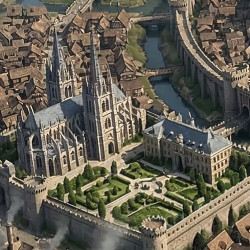
The Arcanum is a single large building of dark stone rising to six floors above street level, with a tower structure at its northern end that adds three additional floors and provides the elevated observation chamber that the Guild uses for open-air mana work when weather and Tower conditions permit.
The stone is a deep charcoal grey quarried from deposits outside the city, chosen not for aesthetic reasons but for its mana-resistant properties: it does not absorb ambient mana, does not develop reactive properties under sustained exposure to shaped mana output, and does not accumulate the particular kind of structural stress that lesser stone develops over decades of hosting the kind of work the Arcanum's training chambers see daily. The surface has been dressed smooth on the primary facades and left slightly more textured on the secondary walls, giving the building a visual hierarchy that is functional rather than decorative.
The windows are the Arcanum's most immediately striking exterior feature, and they are striking for reasons that most visitors take a moment to identify. They are larger than they should be for a building of this apparent purpose, tall and wide, filled with glass of a quality that is noticeably clearer than the standard glazing used in the surrounding inner city architecture. The reason is practical: mana work produces light, and the Guild's training chambers generate more of it than conventional windows are designed to handle. The large, high-quality windows distribute that light effectively and prevent the building from looking, from the outside, as though something alarming is happening inside it on a regular basis. A small, dark-windowed building with light leaking around the frames would communicate exactly the wrong thing about what the Guild considers controlled and professional mana practice to look like.
At night, the effect of those windows is considerable. The Arcanum is one of the most visible buildings in Versa after dark, not because it is illuminated from outside but because the mana lamps within its training chambers and common areas produce a quality of light that reads differently from conventional lamp glow. It is steadier, slightly cooler in tone, and visible from a greater distance than the warm amber of standard mana lamps. People who have lived in the inner city long enough to know the Arcanum by sight can tell at a glance, from blocks away, whether the upper training floors are in active session or at rest.
The main entrance is set into the ground floor of the building's south face, approached across a wide stone forecourt that provides enough open space in front of the door for the small queues that form on assessment days when applicants arrive for their Mana Weaver testing. The entrance itself is not grand. The door is heavy, dark timber reinforced with iron fittings, marked with the Guild's symbol at eye level. The lintel above it carries a carved inscription in the old scholarly script that the Guild uses for formal documentation, which translates approximately as: What you carry determines whether you enter. What you build determines whether you matter. The Guild considers this an accurate description of its admissions philosophy and has never seen a reason to replace it with something more welcoming.
The tower structure at the northern end rises visibly above the main building's roofline and is capped with an open observation platform ringed by a stone balustrade. From street level the platform is not always visible depending on the angle of approach, but from the surrounding inner city it is a recognisable part of the Arcanum's silhouette. On days when the platform is in use, which is most fair-weather days during active training periods, the faint visual disturbance of shaped mana being released into open air is occasionally visible from the streets below, appearing as a shimmer or a brief luminous quality in the air above the balustrade that dissipates within seconds. Most inner city residents have learned to identify this as the Arcanum's training being in session and treat it as unremarkable. Visitors from other districts find it considerably more interesting.
The Ground Floor — Public and Administrative Spaces
The ground floor of the Arcanum is the only level that operates without access restriction, and even here the space communicates the Guild's character clearly.
The entrance hall is wide and simply furnished: stone floors covered by a single long runner of deep purple carpet, mana lamps in wall housings that provide consistent, even light without shadows, and benches along both walls for those who are waiting. The walls carry no decorative artwork. They carry documentation: framed records of significant Guild achievements, floor plans of the building posted at regular intervals for the benefit of visitors unfamiliar with the layout, and a continuously updated board near the entrance that lists the names of Guild members currently certified and active, updated whenever a new certification is completed or a membership lapses. The board is longer than most visitors expect.
The assessment office sits immediately to the right of the entrance hall: a suite of three rooms where all initial applicant contact happens. The reception room is where applicants register for Mana Weaver testing. The two inner rooms are where the testing itself takes place, conducted by Guild assessors in conditions that are kept consistent across every assessment to ensure that the results are comparable. The assessment rooms are the most carefully controlled spaces on the ground floor. Their mana environment is stabilised by conduit fixtures built into the walls, producing a baseline mana field that is identical regardless of what the ambient Tower pressure is doing on any given day. An assessment result that varies because the ambient conditions were different on a Tuesday than a Thursday is not a useful result, and the Guild has invested considerably in ensuring it does not have those.
The administrative offices occupy the ground floor's western section: the rooms where the Practitioner Registry operates, where membership documentation is processed, where the formal correspondence that connects the Arcanum to other institutions is managed, and where the financial administration of the Guild's training programme and scholarship fund is conducted. These are working offices rather than reception spaces and are not generally accessible to visiting clients or applicants. The staff who work in them are administrative professionals rather than practitioners, organised and efficient in the specific way of people who manage large volumes of important paperwork without the ability to use mana to simplify any of it.
The public consultation room is a single space at the far end of the ground floor where parties and institutions seeking to hire Guild-certified Mages can meet with Registry staff to discuss available practitioners, rates, and the Guild's standard contract terms. The room is furnished better than the rest of the ground floor, with comfortable chairs, a proper meeting table, and a mana lamp arrangement that produces the kind of warm, even light that makes commercial conversations feel less transactional than they are. The Guild is aware that the people who use this room are spending significant money and treating them accordingly costs very little and produces measurably better outcomes.
The Upper Floors — Training and Instruction
The floors above the ground level are where the Arcanum becomes what it actually is.
Access to the upper floors requires either full Guild membership, active trainee status, or an escort by a certified Guild member. The access restriction is not primarily about secrecy, though the Guild is not careless about who observes its training methods. It is about environment. The upper floors of the Arcanum are maintained at mana conditions that differ from the ground floor and from the city outside in ways that affect anyone who enters them. A civilian who wanders into an active training chamber during a practical session is not in physical danger in most circumstances, but they are in an environment their body was not prepared for, and the disruption their presence causes to the mana conditions in the room is not trivial.
The Instruction Floors — Second and Third
The second and third floors house the theoretical instruction spaces: the lecture halls, seminar rooms, and individual study chambers where the academic component of Mage training takes place.
The lecture halls are larger than the building's exterior suggests possible, an effect produced by the minimal internal partitioning on these floors and the high ceilings that allow two floors of standard height to be consolidated into one tall space where the acoustics support clear instruction delivery across a large room. The seating is tiered, facing a demonstration area at the front where instructors can perform controlled mana work at a scale that every student in the room can observe clearly. The mana conditions in the lecture halls are actively managed: a stable, slightly elevated ambient field that makes small-scale demonstration work easier and that trainees begin to learn to navigate as a matter of course, since the Tower's own ambient field is considerably less stable and the transition from controlled to uncontrolled mana environments is a lesson that starts before trainees are consciously aware of receiving it.
The seminar rooms are smaller, designed for the closer instruction that discipline discovery requires. These are the rooms where a trainee sits across a table from an experienced practitioner and works through the early stages of identifying what their attunement is actually oriented toward. The furniture in these rooms shows more wear than anything else in the Arcanum because the discipline discovery process is long, often frustrating, and occasionally produces mana outputs that leave marks on surfaces that were not positioned to receive them. The Guild replaces damaged furniture without comment. It considers the marks a form of institutional record.
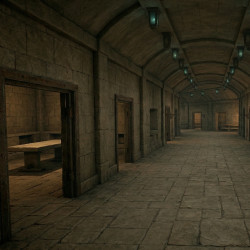
The individual study chambers line the corridors of the third floor in a long row: small private rooms, each fitted with a desk, adequate lighting, a sealed mana conduit port that trainees can connect personal equipment to, and walls that are mana-dampened to prevent a given chamber's occupant from affecting the work of the person in the next room. These rooms are where trainees spend a significant proportion of their non-session time: studying circuit theory, reviewing mana threading exercises, practising the early stages of pattern holding in conditions controlled enough to allow genuine concentration. The doors have no locks. The Guild's position is that a trainee who cannot be trusted to use a study chamber honestly is a trainee who has not understood what the institution is for.
The Practical Training Floors — Fourth and Fifth
The fourth and fifth floors are the Arcanum's functional heart and the spaces that most clearly distinguish it from any other building in Versa.
The practical training chambers are large, high-ceilinged rooms with floors of mana-resistant stone, walls lined with the same dampening material used in the study chambers but at a significantly higher specification, and ceiling fixtures that can actively stabilise or deliberately destabilise the mana conditions within the room depending on what the session requires. Trainees spend most of their active instruction hours in these chambers, and the rooms are in continuous use during training periods, running from early morning through to late evening in rotating session blocks.
The chambers do not look dramatic from the doorway. They look like large empty rooms with careful floors and attentive ceiling fixtures. It is only when a session is running that the space reveals itself: the air in an active practical chamber has a quality that is immediately perceptible to anyone with meaningful mana sensitivity, a density and a directional character that changes as the work within it develops. Instructors managing advanced sessions describe the chamber environment during peak output as similar to standing at the edge of a weather system that has not yet decided what it intends to do. The comparison is considered accurate by most of the Guild's senior practitioners.
The observation corridor runs along the outer wall of the fourth floor, separated from the practical chambers by glass panels thick enough to contain most mana spillover while allowing full visual observation of the sessions within. Senior instructors and certification panel members use this corridor to observe trainee performance without affecting the chamber conditions. Trainees who are aware they are being observed from the corridor and those who are not perform differently enough that the Guild treats observation as a deliberate training variable: sometimes announced, sometimes not, because the Tower does not announce when it is watching.
The fifth floor houses the advanced discipline chambers: smaller, more heavily shielded rooms where senior trainees and certified practitioners work on the more demanding aspects of their discipline development. The shielding on these chambers is the most intensive in the building, built into every surface including the floor and ceiling, and the mana conditions within can be adjusted to replicate specific Tower floor environments with enough accuracy to make advanced training meaningfully relevant to actual descent conditions. The Guild considers these chambers its most significant physical asset and maintains them accordingly.
The Residential Floor — Sixth
The sixth floor of the Arcanum's main structure houses the residential quarters for trainees who do not maintain independent accommodation in the city.
Not all trainees live in the building. Many, particularly those from wealthier families who arrived in Versa with established city connections, maintain private residences or rented rooms elsewhere. But the Guild offers residential places to trainees who require them, and takes up most of those places with scholarship recipients for whom the alternative to Guild accommodation would be a level of financial pressure that the institution considers incompatible with genuine focus on the training.
The quarters are simple and functional. Individual rooms of adequate size, shared bathing facilities at each end of the corridor, a communal study space and a small dining area where basic meals are available at hours calibrated to training schedules rather than conventional social timing. The rooms are quiet in the way that rooms in a building maintained for serious work tend to be quiet: not enforced silence, but an ambient seriousness that most residents find easier to live with than to resist.
The sixth floor also houses the Instruction Council's offices: the working rooms of the senior instructors who design and oversee the training programme. These are small, occupied offices rather than formal reception spaces, filled with the accumulated documentation of people who have been teaching the same complex subject for many years and have developed strong opinions about how it should be done. The Instruction Council meets in a shared room at the end of the corridor that is large enough for the council's full membership and furnished with the particular sparse functionality of a room where decisions are made rather than impressions created.
The Tower Structure — The Observation Chamber
The three additional floors of the Arcanum's northern tower are accessed by a separate internal staircase that branches from the main building at the fifth floor level.
The lower two floors of the tower structure house specialist equipment rooms: storage for the more sensitive and expensive tools that the Guild's training programme uses, maintenance workshops where mana-fed instruments are serviced and calibrated, and the secure archive where the Guild's most significant institutional records are kept. The archive is the only space in the Arcanum with a locked door, and the lock is not a standard mechanism. The Guild considers its institutional records sufficiently significant to warrant a security investment that goes beyond what a key can provide.
The top floor of the tower opens onto the observation platform: a wide stone terrace ringed by a carved balustrade, exposed to the open sky, with an unobstructed view across the inner city rooftops toward the Tower's rim visible in the distance. The platform is used for open-air mana work: exercises where the containment of the indoor chambers is deliberately removed and trainees must work in conditions closer to actual Tower descent, where the ambient mana field is variable, where weather is a factor, and where the absence of walls means that an unstable output does not damage anything except the trainee's assessment score.
The view from the observation platform is one of the finest available from any building in Versa's inner city. The Guild does not advertise this. The platform is not a social space and is not made available for purposes other than training. But practitioners who have spent time on it during evening sessions, when the light is falling across the city and the Tower's rim is visible on the horizon carrying its own faint luminosity, tend to describe the experience with a specificity that suggests it left an impression beyond the technical content of the session.
What It Feels Like to Be Inside
The ground floor feels like the administrative offices of an institution that is serious about what it does and has no particular interest in making that seriousness comfortable for people who are not part of it. The assessment rooms feel like a held breath. The consultation room feels like a very expensive negotiation conducted with unusual courtesy.
The instruction floors feel like a place where things are being built carefully. The seminar rooms carry the particular atmosphere of conversations that matter and know it. The lecture halls, when full and in session, have an energy that is not excitement exactly but something close to it: the specific alertness of people engaged with something genuinely difficult that they genuinely want to understand.
The practical chambers feel like nothing else in Versa. The mana conditions alone distinguish them from every other indoor space in the city, and the work that takes place within them during active sessions produces an atmospheric quality that experienced practitioners recognise immediately and that newer trainees learn to read as a measure of how much is happening in the room. A chamber in full advanced session feels like standing in a room where the air has become interested in what you are doing. It is not a comfortable feeling. The Guild considers that appropriate.
The residential floor feels like the home of people who are too tired to be interesting in the evenings and too focused to care. The observation platform feels like the edge of something.
Quick Descriptive Lines for Prose
- "The Arcanum didn't announce itself. It simply stood there and let the building make the point that the Guild had never needed to make loudly." - "She had passed the assessment in that room. She had never been able to decide whether the room had felt significant at the time or whether she had applied that quality to it afterwards." - "The inscription above the door was in the old script. He couldn't read it. He asked someone who could. He spent the next week thinking about the answer." - "The practical chamber during a full session felt like the air had developed opinions. None of them were comfortable. All of them were useful." - "At night the upper floors were visible from three districts away. The light was different from lamp glow. Everyone in the inner city knew what it meant. New arrivals to Versa noticed it on their first night and asked what was on fire." - "The sixth floor was quiet because the people who lived there were too focused to make noise. That was not a rule. It was simply what happened when you put exhausted people who cared deeply about the same difficult thing in the same building." - "The observation platform had the best view in the inner city. The Guild used it for training in adverse conditions and had never once offered it for any other purpose. Several people had asked. None of them had asked twice." - "The assessment rooms were identical to each other and different from everything else in the building. Whatever they did to the air in there, it made the air honest." - "Entering the Arcanum as an applicant and entering it as a certified member felt like entering different buildings. The walls were the same. Everything else had changed." - "The Guild's certification board was updated the same day every new practitioner passed. The day it stopped being updated for a name already on it was the day the Guild sent a letter to whoever needed to receive one."
Connected records