Finding sheet · Mana
Mana Infrastructure Items
Mana Infrastructure Items are the visible end of a system that is otherwise entirely hidden. Everything upstream of them — the Generator humming in the basement, the conduit network running silently through the walls — exists for one purpose: to deliver usable mana energy to these objects at the moment they...
Overview
Mana Infrastructure Items are the visible end of a system that is otherwise entirely hidden. Everything upstream of them — the Generator humming in the basement, the conduit network running silently through the walls — exists for one purpose: to deliver usable mana energy to these objects at the moment they need it. They are the point where the infrastructure becomes real to the people living and working inside a building. Most residents of Versa interact with several of them every single day without giving any thought to what makes them work or what it would mean if they stopped.
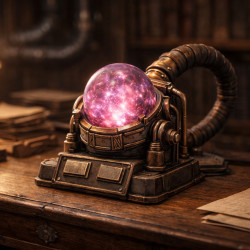
The category is broad by design. A Mana Infrastructure Item is any device built to draw from a conduit network and convert that energy into a useful output. The lamp mounted in the wall bracket is one. So is the heating element set into the floor of a bathhouse, the mechanical lift platform in a guild hall, the forge blower in a smith's workshop, the cooling unit in a wealthy merchant's food storage room, and the signal lamp on the roof of a Guardian tower that pulses in a code the patrol below can read from three streets away. They share a common connection standard and a common power source. Everything else about them varies as widely as the needs they serve.
How They Work
Every Infrastructure Item is built around a mana circuit embedded into its structure during manufacture: a precisely etched pathway of conductive material, usually copper alloy thread or treated glass filament depending on the application, that takes the incoming mana from the conduit connection and routes it through the device in the specific pattern required to produce the intended effect. A lamp circuit routes mana through a filament arrangement that produces light and heat in the right proportion. A heating element routes it through a broader, denser pattern designed to distribute warmth evenly across a surface. A mechanical lift routes it through a circuit that converts mana flow into directed physical force through mechanisms that Mana Guild engineers spent decades refining before they produced results reliable enough to install in buildings people actually used.
The connection point where an Infrastructure Item meets the conduit network is standardised across every Guild-certified product in Versa. This small detail is one of the Mana Guild's most consequential achievements. A lamp housing manufactured in a workshop on the east side of the city fits the conduit socket in a building on the west side without modification, measurement, or custom fitting. When a lamp burns out or a heating element fails, a replacement can be sourced from any Guild-affiliated supplier and installed without specialised knowledge. The standardisation is what makes mana infrastructure practical at the scale of an entire city rather than an expensive luxury requiring constant expert attention.
Each item also incorporates a control interface of some kind, ranging from the extremely simple to the moderately complex. The simplest is a single rune contact on the item's surface: press it and mana flows, press it again and the flow stops. A lamp works this way. So does a basic heating element. More sophisticated items have tiered controls — a forge blower with adjustable output levels, a cooling unit with a regulating mechanism that maintains a target temperature rather than simply running at full power until someone turns it off. The most complex Infrastructure Items, the mechanical lifts and the large-scale ventilation systems found in the Mana Refinery and the deeper sections of the Guardian Checkpoints, have control panels with multiple rune contacts managing different aspects of the device's operation, and require a degree of familiarity to operate correctly. These are not difficult to learn, but they reward the people who have used them long enough to understand their particular behaviours.
Common Types
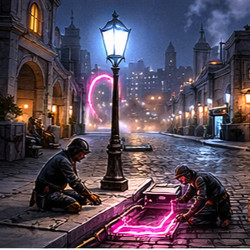
Mana Lamps are the most numerous Infrastructure Item in Versa by a considerable margin and the one most immediately associated with the Mana Revolution in the public imagination. Before the revolution, streets were lit by oil lamps that required regular refilling, produced inconsistent light, and presented a constant fire risk in the dense timber construction of the city's older wards. Mana lamps produce a cleaner, steadier light, require no fuel beyond the conduit connection they draw from, and do not carry the same fire risk. The light quality varies by manufacturer and circuit design — some produce a warm amber tone, others a cooler and more clinical white — but the functional difference from oil is significant enough that districts with mana lamp coverage consider the older alternative genuinely inferior rather than merely old-fashioned.
Heating Elements form the second most common category and the one with the widest variation in design. A domestic heating element is a flat panel set into a floor or wall, drawing from the building's conduit network and radiating warmth into the room at a rate controlled by the interface rune on its face. A bathhouse heating element is a much larger and more robust device, designed to maintain water temperature across a substantial volume rather than simply warming an air space. Industrial heating elements in smithies and alchemical workshops are purpose-built for their specific applications and are not interchangeable with domestic versions despite sharing the same connection standard — the circuit design, the output rating, and the materials used in construction are all different enough that substituting one for the other produces results ranging from inadequate to dangerous.
Mechanical Lifts are the Infrastructure Item that most visibly demonstrates what the Mana Revolution actually changed about urban life. Before reliable lift mechanisms existed, the upper floors of any building were less desirable than the lower ones — more stairs, more effort, less practical for heavy goods movement. After the revolution, the calculation inverted in wealthier districts. Upper floors with lift access became premium spaces precisely because the mana infrastructure made the height irrelevant. The Harbour Halls use large cargo lifts to move goods between the warehouse floor and the subterranean storage level below. The Mana Refinery uses them throughout the production process. In the inner city's more prosperous guild halls and merchant residences, smaller passenger lifts have become a standard feature that their owners consider essential and their visitors often find briefly remarkable before taking them for granted.
Signal and Communication Devices represent a smaller but commercially significant category. The roof-mounted signal lamps used by Guardian patrols are the most visible, but the category also includes the smaller indicator lights used in the Harbour Halls' logistics operations to show which loading bays are active and which cargo stages are complete, the alarm contacts set into the floors of the Mana Refinery's more sensitive production areas, and the simple presence indicators that wealthy households use to signal between rooms without requiring a servant to walk the corridor. None of these devices communicate in the way a Communication Mana Stone does — they carry no voice, no message, only a visual signal whose meaning depends entirely on the agreed convention of the people using it — but they are faster than a runner and cheaper than a CNM installation, which makes them useful for the specific purpose of telling someone something simple across a short distance immediately.
Workshop and Industrial Equipment rounds out the category with the widest range of individual designs and the least standardisation beyond the connection interface itself. A Mana Guild-certified forge blower works on the same conduit connection as a residential lamp, but the device itself, its circuit, its output, and its control interface are all specific to the task of forcing controlled airflow through a forge fire. The same is true of grinding wheels, precision heating tools, pressurised cutting equipment, and the various specialist devices that the Refinery's production process depends on. This segment of the Infrastructure Item market is where most of the Mana Guild's ongoing development work concentrates, because industrial applications are where the performance difference between adequate and excellent translates most directly into commercial output.
Quality, Maintenance, and Failure
Not all Infrastructure Items are equal, and the market reflects that clearly. Guild-certified products carry the Mana Guild's mark pressed into their housing during manufacture, which guarantees they meet the minimum circuit quality, connection tolerance, and output rating standards the Guild has set. Uncertified products exist and are cheaper. They also fail more often, fail less predictably, and when they fail badly they tend to do so in ways that damage the conduit connection point and occasionally the surrounding section of network rather than simply stopping. The repair cost for a failed uncertified item is usually enough to have purchased a certified one with money remaining, a calculation that experienced building managers have made and that inexperienced ones make once.
Maintenance requirements vary by item type and usage intensity. A residential lamp running at normal levels requires almost no attention beyond the occasional cleaning of its housing and the rare replacement of the circuit filament when it finally burns through after years of use. A forge blower running at industrial intensity in a busy smithy needs regular inspection, circuit cleaning, and periodic filament replacement on a schedule that the Guild's maintenance documentation specifies with some precision. Ignoring that schedule does not immediately produce failure — it produces gradual degradation, reduced output, increased stone consumption at the Generator, and eventually a failure that happens at the worst possible time rather than a convenient one. This pattern is well documented and widely ignored, which provides steady work for the Mana Guild's maintenance technicians.
When an Infrastructure Item fails, the failure is usually local. The conduit network's Junction Housings are designed to isolate surges and prevent a single device failure from cascading through the building's network. A lamp that burns out takes itself offline. A heating element that fails does the same. The exceptions are items whose failure mode involves drawing more energy than they should rather than simply stopping — a circuit that shorts rather than breaks can pull a surge through the conduit connection before the Junction Housing responds, and that surge can affect other items drawing from the same branch. This is rare with properly certified equipment and considerably less rare with everything else, which is another entry in the long ledger of reasons the Mana Guild's certification standards exist.
What They Mean for the City
The full significance of Mana Infrastructure Items is not technical. It is social. A district with reliable mana lamp coverage is safer at night than one without it — not dramatically, not absolutely, but measurably. A workshop with proper mana-fed equipment produces more consistent work than one relying on manual alternatives. A building with functioning heating elements is warmer in winter and its occupants are healthier as a result. These are not revolutionary effects taken individually. Accumulated across an entire city over the decades since the Mana Revolution, they amount to a transformation in how urban life feels and what it makes possible.
The people who benefit most from reliable Infrastructure Items are not the wealthy, who had access to personal mana alternatives before the revolution and adapted the new systems into lives that were already comfortable. They are the craftspeople, the labourers, the guild hall workers, and the outer ward residents for whom consistent lamp coverage and affordable heating changed the practical reality of daily life in ways that are difficult to quantify and impossible to miss. The Mana Guild understands this. It is one of the reasons the Guild's public reputation is as strong as it is despite the justified suspicion that attaches to any institution with a monopoly on something essential. The lamps work. The heating works. The lifts work. For most people in Versa, that is sufficient.
Connected records