Living folio · Guilds
Ember Guild
The Ember Guild is not the largest training institution in Versa, nor the most selective, nor the most commercially dominant. It occupies a position in the city's adventuring ecosystem that is harder to define than the Rangers Guild's volume or the Mages Guild's exclusivity, because what it produces sits at...
Overview
The Ember Guild is not the largest training institution in Versa, nor the most selective, nor the most commercially dominant. It occupies a position in the city's adventuring ecosystem that is harder to define than the Rangers Guild's volume or the Mages Guild's exclusivity, because what it produces sits at an unusual intersection that most people do not immediately understand.
A Ritualist is not a Mage. They do not shape mana outward into the world. A Ritualist is not a Vanguard. They do not simply absorb punishment and hold a line. A Ritualist is something that requires both the physical endurance of a frontline fighter and the precise intellectual discipline of a scholar, and the combination of those two demands is exactly what makes the class difficult to fill and the Guild difficult to enter.
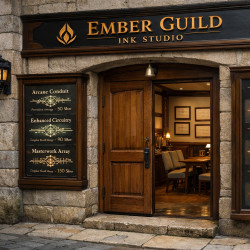
The Ember Guild trains Ritualists. It also, through its network of affiliated ink studios, provides circuit inscription services to the broader population of Versa: adventurers, merchants, guardsmen, and wealthy civilians who want the benefits of mana ink circuits applied to their bodies without undertaking the years of training that the Ritualist class demands. This secondary function is not an afterthought. It is, in many seasons, the primary source of the Guild's commercial revenue, and it shapes the institution's character in ways that distinguish it from every other class-training organisation in the city.
The Ember Guild exists at the intersection of military discipline, scholarly precision, and a craft trade that serves clients who will never themselves become what the Guild's core members are. That is an unusual position to occupy. The Guild has occupied it long enough to be comfortable there.
Origins and Purpose
The Ember Guild emerged from a recognition that the Ritualist class had a problem that talent alone could not solve.
Ritualists had always existed in Versa. The principles of mana ink circuit inscription are not a recent discovery. People with the right combination of physical capability and intellectual discipline had been applying circuits to their own skin and descending into the Tower for as long as anyone could usefully remember. Some of them were extraordinary. Most of them were inconsistent, because the knowledge they operated from was fragmented, personally developed, and died with them or passed to a single apprentice through informal transmission that lost something at every transfer.
The circuits themselves were the problem. A mana ink circuit is not a simple thing. It is a precise geometric pattern drawn in a medium that interacts with living mana at the cellular level, and the difference between a circuit that enhances a muscle group and a circuit that creates a feedback loop in the same tissue is, in some cases, a line of incorrect width at a single point in the pattern. People who developed their circuit knowledge alone, without institutional framework or peer review, made errors. Some of those errors were merely ineffective. Others were the kind that ended careers in specific and unpleasant ways.
The Ember Guild formalised the knowledge. It built the framework that allowed circuit understanding to be transmitted reliably, tested rigorously, and developed collectively rather than reinvented by each practitioner in isolation. It established the training standards that produced Ritualists who understood not just how to apply circuits but why each element of each pattern produced the effect it did, so that when something went wrong, as it inevitably does in the Tower, the Ritualist could diagnose the problem rather than simply suffering the consequences.
The ink studio network came later, as a commercial extension of the Guild's core expertise. If the Guild's members understood circuits well enough to apply them to themselves under Tower conditions, they understood them well enough to apply simpler versions to paying clients who wanted the benefits without the commitment. The studios were controversial when the first ones opened. They are now considered one of the more reliable sources of pre-descent preparation available in Versa, and the controversy has faded in the way that most controversies fade when the thing being debated turns out to work.
Symbol and Identity
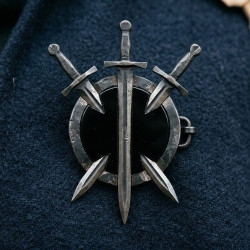
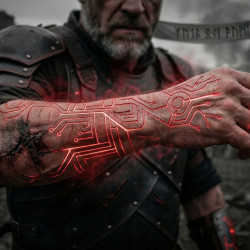
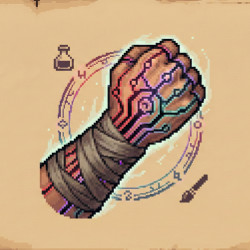
The symbol of the Ember Guild is a forearm seen from the outside, its skin covered in a single visible circuit line that runs from the wrist toward the elbow, glowing with a faint internal light at the point where the mana is actively flowing through it.
The image is deliberately specific. It does not depict a weapon, a creature, a building, or an abstraction. It depicts the work itself: the moment of activation, the circuit alive under the skin, the mana moving through the pattern in the direction it was drawn to move. It is the most literal symbol of any guild in Versa, and that literalism is intentional.
The Ember Guild does not deal in metaphor. It deals in lines drawn correctly and charged precisely and trusted with the physical integrity of the person wearing them. The symbol says exactly what the institution is. There is nothing behind it that the image does not show.
The circuit line on the forearm is rendered in the Guild's primary colour: a deep amber-orange that suggests heat and controlled energy rather than the cold precision of the Mages Guild's purple or the functional grey of the Guardians. Around the forearm, framing it, a simple dark circle closes the image into a seal. Inside the circle, the arm. Inside the arm, the circuit. Inside the circuit, everything the Guild knows.
Guild colours run to amber, burnt orange, and deep charcoal: the colours of embers, which give heat without flame, which sustain without consuming, which require attention and management to remain useful rather than simply burning out. The name of the Guild is not accidental, and the colour choices are not decorative.
Structure and Leadership
The Ember Guild is led by a Head Scribe: a title that reflects the Guild's dual identity as both a martial training institution and a scholarly craft organisation. The Head Scribe holds the position for life, appointed by a council of the Guild's senior certified Ritualists and master ink practitioners when the position becomes vacant.
The title matters. In most adventuring guilds, leadership titles reflect combat seniority or administrative authority. In the Ember Guild, the highest title belongs to the person who knows the circuits best, who understands the theory most completely, and who can transmit that understanding to others with the reliability that the Guild's reputation depends on. A Head Scribe who cannot teach is a Head Scribe who has misunderstood the role.
Below the Head Scribe, the Guild divides into two parallel structures that reflect its two distinct functions.
The Training Division manages the instruction of Ritualist candidates: the curriculum design, the assessment panels, the Tower descent programmes, and the ongoing mentorship relationships that experienced Ritualists maintain with newer members. The Training Division is led by Senior Ritualists, experienced practitioners who have transitioned from active Tower work into instruction. They are the equivalent of the Rangers Guild's Range Masters, though the knowledge they transmit is considerably more complex and the training they oversee is considerably longer.
The Studio Division manages the Guild's network of affiliated ink studios: the commercial establishments where circuit inscription services are provided to the general public. Studio Division leadership is made up of Master Inscribers, practitioners whose expertise lies in the application of circuits to clients rather than the development of their own combat capability. Many Master Inscribers are former active Ritualists who found their skills better suited to the studio environment than the Tower. Others are Guild members who never pursued the full Ritualist track but developed inscription expertise as their primary professional identity. Both are considered full and valued members of the Guild.
District organisation mirrors the Merchant Guild's approach: a Studio Warden is assigned to each district of Versa where affiliated studios operate, responsible for quality standards, client complaint resolution, and the enforcement of the Guild's inscription protocols across all affiliated establishments in their territory.
Training — What Makes It Difficult
Ritualist training in the Ember Guild is long, demanding, and genuinely difficult to complete, not because the Guild makes it artificially hard but because the class itself imposes requirements that a significant proportion of applicants cannot meet regardless of how much they want to.
The failure rate in Ember Guild training is higher than in any other class-training institution in Versa except the Mages Guild. This is not a source of pride for the institution. It is a source of ongoing frustration, because every candidate who washes out represents a real person who wanted something the Guild could not give them, and the Guild is aware of that cost.
Why People Fail
The Ritualist class demands two things simultaneously that most people can provide separately but struggle to provide together.
The first is physical capability: the endurance, pain tolerance, and close-range combat instinct that frontline fighting demands. A Ritualist in the Tower is not a scholar standing at a safe distance. They are in the fight, taking hits, sustaining circuits under physical stress, and performing at close range in conditions that would challenge a dedicated frontline fighter even without the additional cognitive demand of managing active ink patterns.
The second is intellectual precision: the ability to understand, memorise, and apply circuit theory at a level of complexity that most people find genuinely difficult. Circuit patterns are not simple. They are geometric systems with internal logic that must be understood rather than merely memorised, because a practitioner who only memorises patterns cannot diagnose errors, cannot adapt under Tower conditions, and cannot develop new circuits as their experience grows. The Guild's curriculum includes theoretical instruction that would not be out of place in a scholarly institution, and the candidates who struggle with it struggle genuinely.
Most people who apply to the Ember Guild can meet one of these requirements adequately. The combat applicants arrive with the physical profile but find the theoretical instruction overwhelming. The scholarly applicants arrive with the intellectual capacity but find the physical demands of the training barracks beyond what they expected or could sustain. The candidates who make it through are the ones who can hold both requirements at once, and they are not common.
There is a third category of failure that the Guild finds the most frustrating: candidates who have both the physical and intellectual capability but cannot manage the mana interface. Ritualist circuits require the practitioner to direct their own mana through ink patterns in their skin with precision and control. This is not the external mana shaping that Mages perform, but it is mana work, and people with very low mana capacity or very poor Resonance find that their circuits either fail to activate reliably or produce results too unstable to be useful in combat. These candidates are often excellent in every other respect, and the Guild has no solution for them beyond redirecting them toward the studio side of the operation, where inscription skill rather than circuit activation is the primary requirement.
The Training Programme
Successful candidates enter the Guild's training programme and spend their first period in the Foundation Track: a combined curriculum of physical conditioning, circuit theory, and basic mana management that runs simultaneously and is deliberately designed to stress all three at once. The Foundation Track is where most failures occur, because it is where the gap between what a candidate thinks they are capable of and what the class actually demands becomes undeniable.
Candidates who complete the Foundation Track move into Specialist Development: the phase where their primary circuit families are identified and deepened. Like Mage discipline discovery, this phase involves identifying which types of circuits a given practitioner develops most naturally, whether their aptitude runs toward structural reinforcement, muscle amplification, pain management, or the more advanced mind enhancement circuits that the Guild teaches only to candidates who have demonstrated exceptional stability in the foundational work.
The final phase before certification is the Tower Integration Programme: a structured series of Tower descents, conducted in the upper floors under experienced Ritualist supervision, where candidates apply their circuits under genuine combat conditions. The Tower integration is not primarily about combat training. It is about learning what the Tower's ambient mana pressure does to active circuits, which is often different from what controlled training conditions suggest, and developing the management instincts that keep circuits stable when the environment is working against them.
Certification requires demonstrating reliable circuit activation and management under Tower conditions, assessed by a panel of Senior Ritualists who are looking for the same quality that the Mages Guild looks for in its own certification: not impressive performance in ideal conditions, but adequate performance in difficult ones.
The Ink Studios — The Guild's Commercial Heart
The Ember Guild's affiliated ink studios are among the most visited specialist establishments in Versa, and they serve a clientele that extends far beyond the adventuring community.
What the Studios Offer
The studios provide circuit inscription services: the professional application of mana ink circuits to a client's skin by a trained Guild practitioner, calibrated for the client's specific needs, budget, and intended use.
The circuits available through the studios are not the same as the circuits a trained Ritualist applies to themselves. They are simpler, more standardised, and designed to be applied by one person to another rather than self-inscribed. They are also designed to function without the client needing to actively manage the mana flow, which requires a different circuit architecture than the self-directed patterns that Ritualists use. The Guild's Master Inscribers have developed a library of these passive client circuits over generations of studio operation, and the library is one of the most carefully protected pieces of intellectual property the Guild holds.
Common studio circuits include: - Endurance weaves: patterns applied across the legs and lower torso that reduce fatigue accumulation during sustained physical activity. Enormously popular among adventurers preparing for extended Tower descents and among labourers in physically demanding trades. - Impact distribution patterns: circuits across the shoulders and upper back that spread the force of blows across a wider area of the body rather than concentrating it at the point of contact. Not as effective as proper armour, but compatible with it and valued by people who cannot afford high-quality protective equipment. - Thermal regulation circuits: patterns that help the body manage temperature extremes, popular among adventurers heading into floors with significant environmental hazards and among people who work near furnaces or in cold storage. - Focus circuits: simple patterns that reduce the cognitive disruption caused by the Tower's ambient mana pressure, making it easier to maintain concentration in high-mana environments. These are among the most expensive studio offerings because the application requires considerable precision, but they are valued enough by Mages, Alchemists, and other mana-sensitive professionals that the price is regularly paid.
Who Uses the Studios
The studio clientele is more varied than most people outside the Guild expect.
Adventurers are the most numerous customers. A party preparing for a significant Tower contract will often visit a studio before descent, adding endurance weaves and impact distribution patterns to complement their equipment loadout. The cost is significant but the investment calculus is straightforward: a circuit that keeps a party member functional for an additional two hours in a difficult floor pays for itself many times over if it contributes to a successful extraction.
City Guardians, particularly the younger Vanguards who have not yet developed the combat endurance that experience builds, use the studios regularly. The Guardians Guild has an informal arrangement with the Ember Guild that provides affiliated Guardians with preferential studio rates, which the Ember Guild considers worthwhile for the commercial volume it generates and the goodwill it produces with an institution whose cooperation matters.
Wealthy civilians represent a smaller but commercially significant portion of the studio clientele. Merchants who travel dangerous roads, nobles who want physical enhancements without the commitment of adventuring, and anyone with enough coin and enough reason to want their body to perform better than it naturally does will, if they know the studios exist and can afford the rates, eventually find their way through the door.
Mana-sensitive professionals including Alchemists and lower-tier Mages use the focus circuits as a professional investment. The Mages Guild has no formal opinion on its members' use of the studios and most of its members have visited at least once.
Pricing and Expectations
The studios are not cheap. The Guild does not apologise for this.
Circuit inscription requires a trained practitioner, premium mana ink, significant time, and the accumulated expertise of an institution that has been developing and refining its client circuit library for generations. The cost reflects all of these inputs honestly, and the Guild's pricing transparency standards, enforced by the Studio Wardens, ensure that clients know exactly what they are paying for before any ink touches their skin.
The Guild also enforces strict aftercare and maintenance standards. Client circuits are not permanent in the way a Ritualist's self-inscribed patterns are. They fade over time as the mana in the ink depletes and the alignment drifts. Clients who want to maintain their circuits require regular studio visits for refreshing and recalibration. This is explained clearly before inscription and is not considered a hidden cost by the Guild, though some clients discover it with more surprise than the initial consultation warranted.
The Tower and the Craft
Ritualists, like Mages and Alchemists, go into the Tower to learn.
This is less obvious than it sounds, because the Ritualist's primary tool is their own body, and the body's interaction with Tower conditions is the thing that cannot be fully understood anywhere else. Ambient mana pressure affects active circuits in ways that controlled training environments cannot fully replicate. The specific monster physiology of Tower creatures produces combat situations that develop circuit management instincts that sparring partners simply cannot reproduce. The environmental hazards of deeper floors stress the practitioner's mana reserves and Resonance in ways that accelerate the development of stability under pressure more efficiently than any amount of surface training.
The Ember Guild's Tower Integration Programme reflects this understanding, but it is only the beginning. Certified Ritualists who commit to serious Tower careers develop circuit repertoires and management sophistication that practitioners who descend infrequently simply cannot match. The Guild actively encourages its members to maintain regular Tower schedules not as an economic imperative but as a professional development one.
Senior Ritualists who have spent years in the Tower bring that experience back to the training programme and the studio work alike. The circuit library that the studios draw from is not static. It is updated regularly as practitioners return from Tower descents with new understanding of how patterns perform under genuine pressure, and the refinements that result from that experience make their way into both the training curriculum and the client circuit catalogue.
This creates a productive cycle that the Guild considers one of its most important institutional features: the Tower teaches the Ritualists, the Ritualists update the knowledge base, the knowledge base improves the training and the studio work, and the revenue from the studio work funds the Tower operations that generate the next round of learning.
Membership and Culture
The Ember Guild's culture is shaped by the unusual combination of identities that the institution holds simultaneously: it is a martial training organisation, a scholarly institution, and a commercial craft guild, and the people who belong to it reflect all three.
Active Ritualists tend toward a particular kind of quiet intensity. They are people who have survived a genuinely difficult training programme, who understand their own physical and intellectual capabilities with unusual precision because the training demanded that precision, and who operate in the Tower with a self-sufficiency that comes from being, in a very literal sense, their own weapon. They are not generally loud about their capabilities. They do not need to be. The circuits speak clearly enough.
Master Inscribers carry a different professional identity, more craft-focused and client-oriented, with the specific interpersonal skills that studio work requires. They are the face of the Guild for most of Versa's population, and the culture they carry in the studios is warmer and more accessible than the culture of the training barracks. The Guild considers this appropriate. Different functions require different presentation, and the institution is large enough to contain both.
What the culture shares across both identities is a deep investment in precision. A circuit applied incorrectly is not just ineffective. It can be actively harmful. That reality is present in everything the Guild does, from the training programme's insistence on theoretical understanding rather than mere memorisation to the studio's quality standards and aftercare protocols. The Guild does not do things approximately. It does them correctly or it does not do them.
Relationship with Other Guilds
The Ember Guild's relationships with other institutions are defined by the particular commercial position it occupies: producing something that adventurers want before they descend and providing services that the broader city population values regardless of Tower involvement.
The relationship with the Guardians Guild is the most practically significant. The preferential studio rate arrangement generates regular traffic and genuine goodwill. The Guardians appreciate having access to professional circuit work for their Vanguard members. The Ember Guild appreciates the reliable commercial relationship and the implicit endorsement that comes from the city's law enforcement using their services.
The relationship with the Rangers Guild is commercially straightforward. Hunters are among the most regular studio clients, and the party formation process that the Rangers Guild facilitates frequently results in party members visiting Ember Guild studios together before their first serious descent. The two guilds have no formal arrangement but interact constantly at the member level.
The relationship with the Mana Guild mirrors the Mages Guild's arrangement in some respects. The Ember Guild purchases its mana ink through Mana Guild-affiliated suppliers and maintains a commercial relationship built on the Guild's consistent demand for quality ink and the Mana Guild's interest in maintaining that demand. The ink quality that the Mana Guild's suppliers provide is meaningfully better than what the open market offers, and the Ember Guild's studio standards depend on that quality in ways that make the relationship genuinely important to maintain.
The relationship with the Mages Guild is one of mutual professional respect with an undercurrent of philosophical distinction. Mages shape mana outward. Ritualists shape mana inward. The two approaches are complementary in a party context and entirely different in their practice, and the two institutions understand each other's work well enough to appreciate the difference without turning it into competition.
Public Perception
The Ember Guild is viewed by Versa's general population with a combination of respect and mild unease that the Guild has come to accept as the natural consequence of what it does.
The studios are well regarded and widely used. Most Versa residents who have any significant physical demand on their bodies, whether from adventuring, physical labour, or travel, have either visited an Ember Guild studio or know someone who has. The results are visible and the reputation for quality is well earned. The studios generate the kind of steady, positive word-of-mouth that no advertising could replicate.
The Ritualists themselves generate a slightly different reaction. There is something about a person covered in mana ink circuits that most people find simultaneously impressive and slightly unsettling, particularly when the circuits are active. The visible glow of channelled mana under the skin is not a threatening sight in any objective sense. It is simply a reminder that the person in front of you has done something to their body that most people would not and cannot do, and that reminder produces a response that the Guild's members have long since learned to read as a form of respect expressed through discomfort.
Among the adventuring community, Ritualists are valued as frontline combatants in a way that acknowledges both their power and their relative scarcity. They are not as common as Vanguards and not as rare as Mages. They are the frontline fighter that a party is genuinely glad to have, whose capabilities are clearly superior to an unenhanced melee fighter of comparable rank, and whose presence changes the party's combat options in specific and meaningful ways.
Quick Descriptive Lines for Prose
- "The circuit on the forearm, glowing amber at the point of activation. That was the Guild's entire argument, made visible." - "Most people who applied could fight or could study. The ones who could do both at the same time were the ones the Guild was looking for." - "The studios were not cheap. The Guild had found, over many years, that clients who understood why tended not to complain about it." - "A Ritualist didn't carry their power. They were their power. The distinction mattered more the deeper you went." - "The training broke more people than the Tower did. The Guild considered this a feature of the programme rather than a failure of it." - "She had applied the same endurance weave to three hundred clients. Each one was different. She treated each one accordingly." - "The circuit library was the most valuable thing the Guild owned. It was also the thing the Guild was most careful never to write down completely in any single place." - "They weren't as rare as Mages and weren't as common as Hunters. They were exactly as numerous as the training programme could produce without compromising what the class actually required." - "A party with a Ritualist on the frontline fought differently. A party with a veteran Ritualist fought differently again. The Tower had a way of teaching the difference between the two." - "The ink doesn't lie. Either the circuit is drawn correctly or it isn't. The Guild built its entire culture around that single fact."
Connected records