Living folio · City
Harbour Gate Office
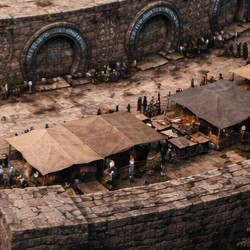
The most immediately visible expression of the Registry is not inside a Checkpoint at all. It is at the Harbour Gate Office : a fortified administrative building sitting at the entrance to Versa's port district, positioned where the docking roads meet the city's main supply routes. Every ship that arrives in...
Overview
The most immediately visible expression of the Registry is not inside a Checkpoint at all. It is at the Harbour Gate Office: a fortified administrative building sitting at the entrance to Versa's port district, positioned where the docking roads meet the city's main supply routes. Every ship that arrives in Versa's harbour must pass through it before its crew, passengers, or cargo can enter the city proper. Every vessel departing must clear it on the way out.
The building is smaller than a Checkpoint but built from the same mana-resistant stone and shares the same institutional character: functional, serious, and not designed to make the process feel welcoming. A wide counter runs the length of the main hall, staffed by Guardian clerks who work in rotating shifts because the harbour does not keep convenient hours. Ships arrive at dawn, at midnight, in poor weather and good, and the Harbour Gate Office is open for all of them.
Entry to Versa: What Is and Is Not Required
Versa does not require documentation to enter.
This surprises many people who have heard of the city's institutional complexity before arriving, and it surprises almost no one who understands how the Guild Union actually thinks about resources and priorities. Versa is the only city of meaningful size on the island of Cantor. The interior of the island is a patchwork of fishing villages, farming settlements, and small communities that have never been subject to centralised documentation requirements because the Guild Union has never found it worth the cost to impose them. There are no civil registries in the villages of Cantor's interior. There are no identification papers issued by the island's rural communities. There is no system that Versa could verify against even if it wanted to.
What the Harbour Gate Office does instead is considerably simpler and considerably more practical.
When a vessel docks, its captain presents a cargo manifest listing declared goods. The goods are checked, spot-inspected, and logged. Undeclared cargo is confiscated. Falsified manifests result in the vessel being held until the matter is resolved. On this point the Guardians are thorough, because commercial fraud at the port has direct economic consequences for the Guild Union institutions that depend on honest trade flows.
People are a different matter.
Passengers and crew pass through the Office individually. A Guardian clerk asks three questions: where they have come from, how long they intend to stay, and what brings them to Versa. The name they give is checked against the active search list — the Registry's record of wanted individuals, persons of interest, and those flagged by previous incidents. If the name does not appear on that list, and if the answers to the three questions are coherent and do not raise immediate suspicion, the person is waved through.
No papers are required. No documentation of origin is demanded. No verification of identity beyond the name given is performed as a matter of course.
The rationale is straightforward. Most people arriving in Versa from Cantor's interior are exactly what they say they are: people from small communities with no formal documentation who have come to the city looking for work, opportunity, or a chance at the Tower economy. Requiring papers they cannot possess would simply mean turning away the labour pool that keeps the lower tiers of Versa's workforce functional. The Guild Union decided, long ago, that this was not a trade worth making. The Tower filters people more efficiently than any gate system could, and the ones who survive become useful. The ones who do not at least tried.
For arrivals from foreign ports — sailors, merchants, travellers from outside Cantor — the process is slightly more formal. Foreign documentation is recorded rather than verified, since the Guardians have no reliable means of checking the civil records of distant cities. A foreign merchant who declares their origin and purpose is logged. If they later appear on a search list or cause a problem, there is a record. If they do not, the log entry ages quietly in the archive and is consulted by no one.
The active search list is the only hard barrier at the Harbour Gate Office. It is updated through the Communication Mana Stone network as new warrants are issued, and the clerks check it against every name given without exception. A person whose name appears on that list is detained immediately and held for Guardian investigation. Everyone else passes.
The Informal Transport Network
Cantor's interior has no organised passenger shipping. What it has is a dense network of small fishing vessels, coastal traders, and opportunistic boat owners who run informal routes between the island's minor ports and Versa's harbour. These boats carry fish, local goods, and anyone willing to pay the passage fee — which is negotiated directly with the boat's owner and recorded nowhere.
A person from a small village in Cantor's interior who wants to reach Versa takes whatever boat is heading that way. The boat may stop at two or three other small ports before reaching the city. No manifest covers the passengers. No record logs their departure. When they arrive at the Harbour Gate Office, they are simply another arrival from the island's interior, indistinguishable from the dozens of others who arrive the same way every week.
The Guardians are aware of this informal network. They have never moved to formalise or regulate it, because doing so would require maintaining a presence at every minor port on the island's coastline, and the Guild Union has consistently determined that the cost of that infrastructure exceeds any benefit it would provide. Cantor's interior regulates itself. People come to Versa when they want to come. The Tower handles the rest.
After Entry: The Versa Identification Card
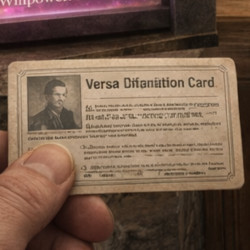
Entering Versa requires nothing. Living and working in Versa formally requires a Versa Identification Card.
The card is not an entry document. It is a residency document — issued by the Guardians to people who have decided to establish themselves in the city rather than passing through. It contains a name, a registration number, and whatever details the applicant provides about their origin and circumstances. It is press-printed on treated paper with a Guardian stamp and logged in the Registry.
The process for obtaining one is simple. An applicant goes to any Checkpoint or to the Harbour Gate Office, provides their name and declared origin, states that they are establishing residence in Versa, and the card is issued. No documentation of origin is required, because for most applicants from Cantor's interior, no such documentation exists. The Guardians record what is declared. If the declaration is false, that is the applicant's legal risk, not a reason to deny the card to everyone who cannot prove where they came from.
The Versa Identification Card is required for: - Applying for an Adventurer Card - Opening a formal commercial account with Guild-affiliated institutions - Entering into certain categories of contract under Guild law - Renting permanent accommodation through licensed landlords
It is not required for: - Living in the city informally - Working in the city's unregulated labour markets - Visiting taverns, markets, or public spaces - Entering the Inner Circle with a day pass obtained at a Checkpoint
For many people who arrive in Versa from the island's interior, the Versa Identification Card comes weeks or months after their arrival, when they have settled enough to know they are staying. In the meantime, they exist in the city the way thousands of others do: present, functional, and not yet formally recorded.
Connected records