Living folio · Lore
Arriving in Versa (Player Reference)
This entry describes the practical experience of arriving in Versa for the first time, with specific attention to the systems, questions, and obstacles that a new arrival — with no prior documentation, no contacts in the city, and limited knowledge of its institutions — will encounter in their first days....
Overview
This entry describes the practical experience of arriving in Versa for the first time, with specific attention to the systems, questions, and obstacles that a new arrival — with no prior documentation, no contacts in the city, and limited knowledge of its institutions — will encounter in their first days.
The Harbour Gate Office: What Actually Happens
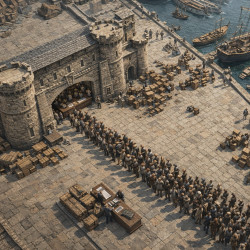
The Harbour Gate Office is the first formal contact most people have with Versa's institutional infrastructure, and it is considerably less intimidating in practice than its stone-and-iron construction suggests it should be.
The building processes a continuous flow of arrivals from Cantor's coastline and from international shipping. The clerks behind the wide counter are experienced, efficient, and largely uninterested in individual arrivals beyond the minimum required to perform their function. They are not investigators. They are not trained to detect deception in any sophisticated sense. They are administrators with a queue behind them and a shift that ends at a fixed time.
The process for a new arrival from Cantor's interior is as follows.
The arrival approaches the counter when their turn comes. The clerk looks up. The clerk asks three questions, usually in the same order every time:
Where do you come from?
Any coherent answer referring to Cantor's interior is sufficient. A village name, a region description, a vague reference to the coast or the highlands — all of these work. The clerk does not know the name of every settlement on the island and does not pretend to. If the name sounds plausible for Cantor's interior, it is accepted. If the arrival seems uncertain or gives contradictory information, the clerk may press briefly, but this is rare for arrivals who answer simply and without excessive detail.
How long do you intend to stay?
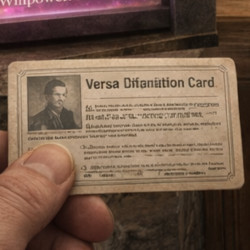
The expected answer is some version of indefinitely, permanently, or until I find what I'm looking for. Arrivals who say they are passing through are processed differently — noted as transient visitors and waved through faster. Arrivals who indicate they intend to settle are reminded that a Versa Identification Card is available at any Checkpoint and recommended for anyone planning to work in the city's formal economy.
What brings you to Versa?
The most common answers, given so frequently that the clerks could recite them in their sleep: work, the Tower, a relative already in the city, opportunity in general. Any of these answers is accepted without follow-up unless something about the arrival's manner or the internal consistency of their answers raises a flag.
After the three questions, the clerk checks the name given against the active search list. This check takes approximately ten seconds using a reference document updated each morning from the Communication Mana Stone network. If the name does not appear, the arrival is waved through. If it does, they are detained.
That is the entire process. No papers are requested. No documentation of origin is examined. No verification of any kind is performed beyond the search list check.
The total time from approaching the counter to being waved through is, for a typical uncomplicated arrival, between two and four minutes.
Common Points of Failure
The Harbour Gate Office process fails new arrivals in two ways.
The first is the search list. If a name given at the counter matches an entry on the active search list, the person is immediately detained. The search list is specific — it contains names, and sometimes physical descriptions, of individuals the Guardians have active reason to look for. A person whose name does not appear on the list passes regardless of what they are. A person whose name does appear is detained regardless of whether they are actually the person the Guardians are looking for, and sorting out cases of coincidental name matches is a process that takes time and is not pleasant for the person involved.
The second is behavioural inconsistency. The clerks are not sophisticated investigators, but they have processed thousands of arrivals and they notice when something is wrong in a general sense. An arrival who cannot answer simple questions coherently, who changes their story mid-conversation, who reacts with obvious confusion to routine information, or who demonstrates unfamiliarity with things that any Cantor islander would know as a matter of course may prompt a clerk to flag them for a secondary conversation with a Guardian on duty. This secondary conversation is more thorough. It is also much less common than paranoid first-time arrivals tend to assume — clerks flag people when something is genuinely wrong, not as a general practice.
The most reliable way to pass the Harbour Gate Office without difficulty is to answer the three questions simply, consistently, and without elaboration. A short answer that makes sense is better than a long answer that might contradict itself. A person who does not know much about Cantor's interior should claim to come from somewhere rural and small, where nothing of note ever happened, because rural and small is precisely the kind of origin that produces people who know little about the wider world and raises no flags.
The First Days: Before Any Documentation
A new arrival in Versa who has passed the Harbour Gate Office is in the city. They are not in the Registry. They are not formally documented. They are simply a person in a large city, which is a condition shared by a significant portion of Versa's working population at any given moment.
The city does not require documentation for most daily functions. Taverns serve anyone with coin. Markets sell to anyone with coin. Informal labour — dock work, hauling, cleaning, kitchen work in the city's numerous eating establishments — is available to anyone who presents themselves and can perform the task. The Guild Union's formal economy requires documentation. The informal economy beneath it does not.
A new arrival with no contacts, no documentation, and no established income can survive in Versa by working the informal labour market while establishing themselves. This takes time. It takes the specific patience of someone who knows they are in a temporary condition and can see a way out of it. But it is possible, and it is the path that a significant number of Versa's current residents have taken.
The Versa Identification Card becomes relevant when a new arrival is ready to enter the formal economy. The process for obtaining one is simple: go to any Checkpoint or the Harbour Gate Office, provide a name and declared origin, state the intention to establish residency, and the card is issued. Since most arrivals from Cantor's interior have no documentation to provide, none is required. The card records what is declared. It is the arrival's legal risk if what is declared is false, but the Guardians do not cross-examine declarations for basic residency cards from people who are not on any search list.
With a Versa Identification Card, the path to an Adventurer Card is open. With an Adventurer Card, the Tower is open. And the Tower, for those who survive it, is what Versa is actually for.
Quick Reference: The Sequence
For a new arrival with no prior documentation or contacts, the practical sequence is: 1. Arrive at the Harbour Gate Office. Answer three questions. Give a simple, consistent origin from Cantor's interior. Pass. 2. Survive the first days informally. Informal labour, careful spending, learning the city's layout and institutions. 3. Obtain a Versa Identification Card at any Checkpoint when ready to formalise. No documentation required. Name and declared origin sufficient. 4. Obtain an Adventurer Card at a Checkpoint using the Versa ID. Standard registration process applies: interview, class assessment, card production, blood binding. 5. Enter the Tower. Everything before this point was preparation. This is what the system was built for.
Connected records