Threat dossier · Tower Entities
Shelf Crawler
Floor Range: 001–004 highest density on Floors 003 and 004, correlated with room heavy architecture and storage infrastructure Physical Description The Shelf Crawler is not a fixed shape. What adventurers identify as a Shelf Crawler is, in most encounters, not the creature itself but the structure it has...
Overview
Floor Range: 001–004 (highest density on Floors 003 and 004, correlated with room-heavy architecture and storage infrastructure)
Physical Description
The Shelf Crawler is not a fixed shape.
What adventurers identify as a Shelf Crawler is, in most encounters, not the creature itself but the structure it has assimilated.
At rest, it presents as a piece of storage furniture: a stone shelf, a wooden rack, a storage frame, a stacked archive unit, or a low-tiered supply structure built into the walls of a room. The mimicry is not superficial. The materials appear correct — grain, weight, texture, age — because they are correct. The structure is real. The Shelf Crawler has consumed, hollowed, and replaced it from within.
Edges are often slightly wrong on close inspection. Lines are too soft where they should be sharp, or too continuous where wear should have broken them. Objects resting on the surface may sit at an angle too perfect to be natural, or sink imperceptibly into the material beneath them.
The body of the creature exists inside and throughout the structure.
It is a dense, cohesive mass that has spread through the interior volume of the storage unit, anchoring itself along surfaces and reinforcing the outer shell. Internally, it retains a semi-fluid consistency, able to shift mass from one section of the structure to another. This allows limited reconfiguration: shelves can thicken, edges can bulge, gaps can open where no gap previously existed.
The offensive anatomy is normally hidden.
When activated, portions of the structure deform. Sections of shelf collapse inward and then reopen as a mouth-like cavity lined with dense, blunt teeth formed from compacted internal mass. These teeth are not clean cutting implements. They are crushing surfaces — irregular, heavy, and capable of gripping and tearing through pressure rather than sharpness.
These structures retract when not in use, returning the outer surface to its inert appearance.
The creature produces very little sound while inactive. When active, the sound is wrong for the materials it imitates — wood that flexes without splintering, stone that shifts without fracturing, internal movement dampened but present, like weight sliding inside something that should be solid.
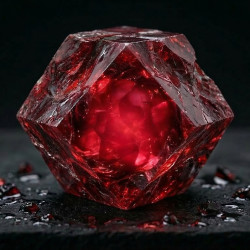
The mana stone is located at the core of the organism, embedded within the densest part of the internal mass. Its position shifts slightly as the creature redistributes itself but remains centrally protected within the assimilated structure.
What It Is
The Shelf Crawler is a single organism with two distinct states.
In its unassimilated state, it is a low-density, semi-cohesive mass — functionally similar to a slow-moving slime. In this form, it lacks the structural integrity required to exert force. It cannot meaningfully harm a human. It cannot crush, strike, or resist damage effectively.
In this state, the mana stone is exposed within the mass and can be extracted with minimal effort.
This state is rarely encountered in active floor sections.
The creature’s primary survival mechanism is assimilation.
When it encounters a suitable structure — typically storage units, shelving, racks, or built-in furniture — it begins a gradual integration process. The original structure is consumed internally while the external form is preserved. Over time, the Shelf Crawler replaces the interior completely, reinforcing the outer shell with its own mass.
Once assimilation is complete, the creature gains the ability to exert force through that structure.
This is the state in which it becomes dangerous.
The variation between individual Shelf Crawlers is determined almost entirely by the structure they inhabit. A narrow wall shelf produces a different threat profile than a multi-tier storage rack or a heavy stone supply unit.
There is only one organism per structure.
What appears to be a multi-part entity is a single continuous body distributed through the assimilated form.
Behaviour
Shelf Crawlers anchor themselves within rooms and remain inactive for extended periods.
The waiting phase can last through multiple party passes. The creature does not respond to distant movement. Its detection is based on proximity and contact — pressure, vibration through surfaces, and mana disturbance within immediate range.
A party that avoids interacting with room structures will often pass without triggering it.
Activation occurs when something enters the creature’s immediate working range.
This typically includes:
Direct contact with the structure Weight applied to its surface Close inspection within arm’s reach Interaction with objects resting on or within it
The activation is subtle at first.
A slight deformation. A shift in weight distribution. A surface that gives when it should not.
This is followed by rapid structural change.
Sections of the shelf open into grasping cavities. The creature extends internal mass outward, forming temporary limbs or jaws. The attack is close-range and force-driven: pulling, crushing, and pinning rather than striking.
The creature does not pursue beyond the limits of its structure.
It is anchored. Its effective range is defined by how far it can extend mass from the assimilated unit. Larger structures provide greater reach and more attack angles. Smaller structures are more limited but often harder to identify before activation.
Movement between positions is possible but slow.
If a Shelf Crawler abandons a structure, it must revert to its unassimilated state. In this form, it moves with low cohesion and limited speed, making relocation a vulnerable process. As a result, most individuals remain fixed in a chosen structure for extended durations.
Threat Assessment
Assimilated state (undetected): Low direct threat, high ambush potential. The danger lies in misidentification. A party that treats the structure as inert may trigger the creature at close range with no preparation time.
Assimilated state (detected/engaged): Moderate. The creature lacks mobility but compensates with immediate proximity force. It is most dangerous in confined spaces where targets cannot easily disengage from its reach.
Unassimilated state: Negligible. The organism cannot exert meaningful force. It can be safely destroyed or harvested with minimal risk.
Large structure assimilation: Moderate to High depending on scale. Larger storage units allow for multiple attack points, extended reach, and greater internal mass distribution, increasing durability and engagement complexity.
Notes on Architecture
Shelf Crawlers are most common in rooms designed for storage, habitation, or supply.
Floors 003 and 004 provide ideal conditions due to the prevalence of:
Wall-mounted shelves Storage racks Barracks-style furnishing Archive rooms Supply chambers Recessed storage structures
In corridor-dominant floors, suitable structures are less common and Shelf Crawlers appear less frequently.
Any room containing multiple storage fixtures should be treated as a potential multi-instance environment, though each structure will contain only one organism.
Economic Notes
The mana stone yield is consistent with mid-range first-band creatures when the Shelf Crawler is in its assimilated state.
Extraction is more labor-intensive due to the need to break through the reinforced structure and internal mass.
In unassimilated state, the mana stone is easily accessible and can be removed with minimal effort, making such encounters highly efficient for resource collection.
The assimilated structure itself has no commercial value.
Once the organism is destroyed, the remaining material rapidly degrades, losing both structural integrity and resemblance to the original object.
No secondary components are considered reliably extractable.
Connected records